
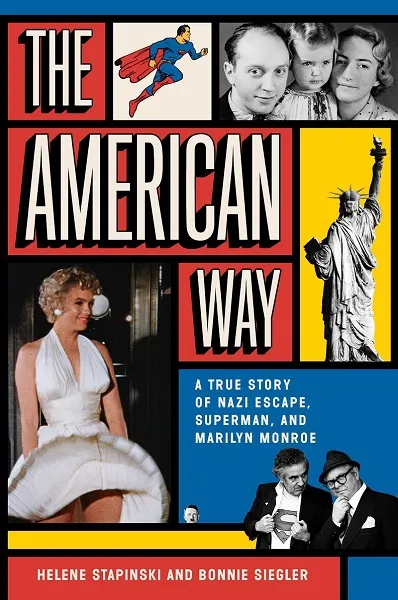
Book Review – ‘The American Way: A True Story of Nazi Escape, Superman, And Marilyn Monroe’
by Rachel Bellwoar
Summary
People always say “real life is stranger than fiction,” but never has a book proven that phrase more than Helene Stapinski and Bonnie Siegler’s, The American Way: A True Story of Nazi Escape, Superman, and Marilyn Monroe.
Overall
8.5/10There are certain stars (and images) that transcend the movies they’re in. James Dean in his red, Rebel Without a Cause jacket. Audrey Hepburn in her Breakfast at Tiffany’s pearls. Even with those two examples, though, they’re still fairly closely identified with the movies they’re from.

This is arguably less the case with the famous shot of Marilyn Monroe standing over a subway grate, holding down her white dress as the wind from the subway tries to blow it over her head. Whether the average person will realize this image comes from Billy Wilder’s The Seven Year Itch, most will have encountered it at some point, or seen it referenced elsewhere in pop culture. It’s iconic yet, until Helene Stapinski and Bonnie Siegler’s book, The American Way: A True Story of Nazi Escape, Superman, and Marilyn Monroe, I never gave it much consideration.
Turns out there’s a lot more to story. For one thing, while the footage used in the movie was filmed on a soundstage, that wasn’t the first time Wilder attempted to film the scene. It was also filmed on the streets of New York late one night in 1954 as a PR stunt that ultimately made the footage unusable (too much noise, plus less control over how high the skirt should appropriately go for a Hollywood movie).
But that’s not all! Of course, the scene was reshot for The Seven Year Itch and tons of photos were taken during the PR stunt, but film footage from that stunt? That was thought to no longer exist, until Siegler discovered otherwise.
Wilder may have destroyed the original footage, but he wasn’t the only one with a movie camera on the street that night. Siegler’s grandfather, Jules, was also there, and while he had always claimed to have captured that infamous moment, it wasn’t until after his death that Siegler found the (color!) reels.
It’s Jules’ life, though, that is The American Way’s primary focus, as the book almost takes on the form of a game of “Seven Degrees of Kevin Bacon” (except with Jules at its center, instead of Bacon). Jules may have never met Clark Gable, Billy Wilder, or Superman creators, Jerry Seigel and Joe Schuster, yet Stapinski and Siegler manage to connect the dots and show the uncanny ways in which their lives crossed paths. For instance, if it weren’t for Clark Gable, Siegler and his family may have never been escaped Nazi Germany in time. Like Wilder, they were Berliners, and the same guy who sponsored their trip to America? He played a major role in Seigel and Schuster signing away their rights to Superman.
With each chapter focusing on a different person, Seigel and Schuster make it easier to understand that all of these events are happening at the same time (especially important given the book has one foot in Europe and one in America).
There’s a reason The American Way opens with a cast of characters, too. Rather than try to streamline Jules’ extended family and not cover everyone, Seigel and Schuster count on readers to keep up. If the writing weren’t this good, it wouldn’t work, and there are a lot of names regardless, yet Seigel and Schuster make those names people, so they’re easier to remember and it never feels like a chore.
While film buffs are definitely one audience for this book (along with DC fans looking for a crash course in comics history), readers should be prepared going in that this book deals heavily with the Holocaust and the horrors that were perpetrated are described in great detail. Getting to know Jules and his wife, Edith’s family, means feeling their losses deeply. If Seigel and Schuster are unsparing, that’s because the truth can only be harrowing.
Split into Act 1 and Act 2, Act 2 (by nature of taking place after WWII) gets to be more Hollywood heavy, while setting the stage for Jules being at the right place, right time to film Marilyn, but it’s never a good idea to read this book before bedtime. It can be very unnerving.
I don’t want to give the wrong impression that The American Way is all sadness because it’s not. Jules and Edith were survivors and amazing people who made a huge difference in their community and shared an amazing love story. If Seigler and Stapinski have chosen to use movie terms to tell their story, it’s because their story is the stuff of movies. From acts of bravery to coincidences that would raise eyebrows if they happened in a film (but are 100% true!), people always say “real life is stranger than fiction,” but never has a book proven that phrase more.
The American Way: A True Story of Nazi Escape, Superman, and Marilyn Monroe is on sale now from Simon & Schuster.

