
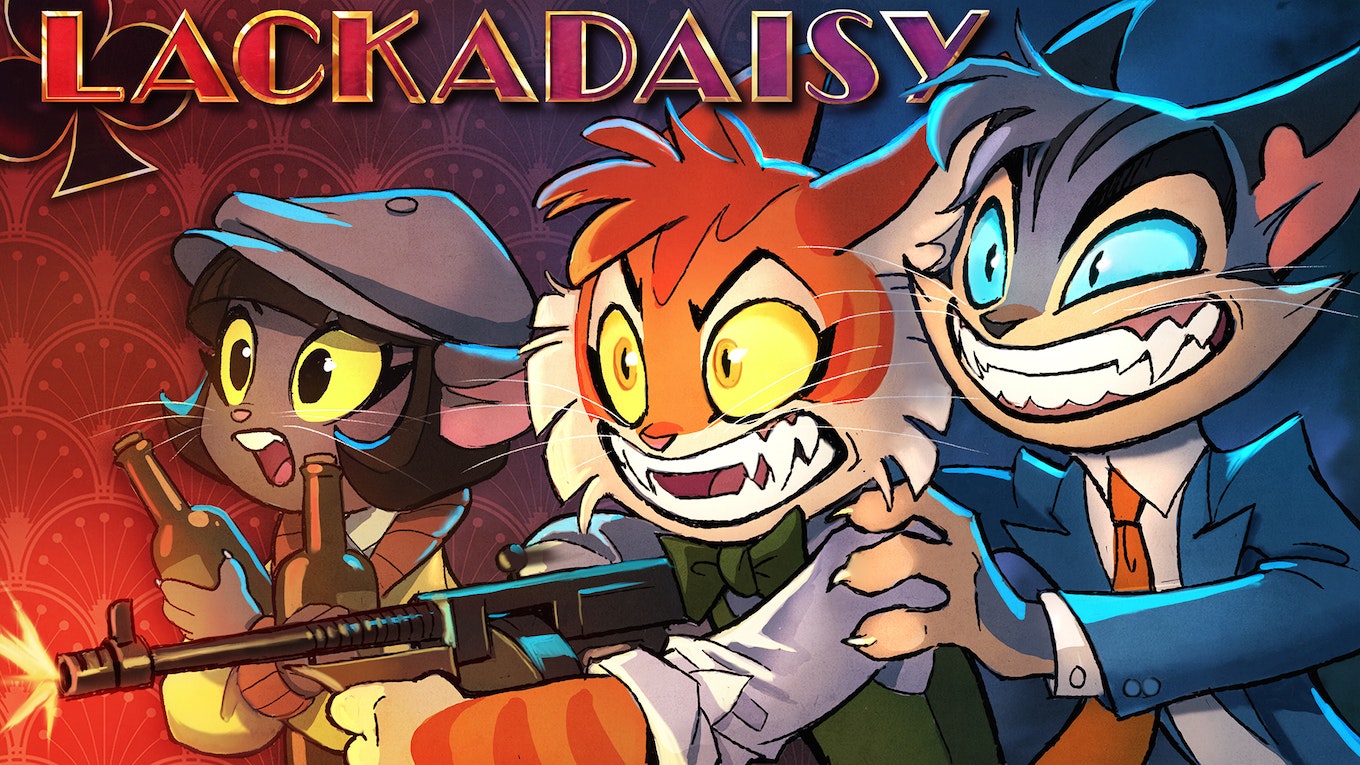
Talking ‘Lackadaisy’, Animation, And Crowfunding With Tracy J Butler And Fable Siegel
by Olly MacNamee
With indie webcomic-turned-animation pilot, Lackadaisy, from animator and creator Tracy J. Butler and director Fable Siegel racking up 10 million views so far on YouTube, and the current crowdfunder for a full first season doing gangbusters too, I thought it was as good a time as ever to catch up with the two to ask them all about the project and the crowdfunder. And, with my very own daughter, Niamh MacNamee, about to embark on an animation degree at university this Autumn, I thought I’d get her involved in fielding a few questions too. Here’s how we both got on:

Olly MacNamee: First off, congratulations on the success of your current Backerkit campaign hitting a million dollars! You must be ecstatic?
Fable Siegel: There are emotions. Many of them. There’s no succinct vocabulary for most. Unless I take up German.
Tracy J. Butler: Thank you! We are a lot of things right now. Ecstatic is one of them. Tired too! Launching the campaign took a lot of prep work, and the week of the launch has been pretty intense. Now that we know we’ll be tackling a whole season, we’re making our plans for how to hit the ground running once the funds reach us. So I guess ‘eager to make more cartoons’ fits in there somewhere too.

Olly MacNamee: Speaking of this campaign, and to summarise it for any newcomers, the goal is to expand on your highly success pilot for Lackadaisy (with nearly 10 million views) into an animated series. With this goal very close to realisation, what next in the production process for this five-episode series?
Siegel: Pre-production, pre-production, pre-production. A lot of crew training, server constructing, staff hiring, render testing, model building, character updating, and other aspects of herding animated cats. All while scrutinizing the season’s outline and scaling it according to our Backerkit’s final number. I want a solid foundation, or at least to improve on past success and make a more sustainable, long term production.
Butler: Fable pretty much covered it here. In order for production to kick off efficiently and effectively, we’ve got to set the stage first. Fortunately, we learned a lot during the production of the animated pilot, and so we’re putting all of that knowledge and experience to use to improve the pipeline.

Niamh MacNamee: What was your own interest in the Prohibition Era as the setting for your saga?
Butler: It’s just a fascinating bit of history. As a period of great cultural shift, artistic and musical movements, zany politics, massive wealth disparity, financial grifts, and corporate malfeasance, it’s perhaps pretty relatable to anyone living in the 2020s too. The way Prohibition is deeply interwoven with the history of my adoptive home of St. Louis – a brewing town and a major commercial hub for the country at that point in time – makes it feel a little personal as well, I suppose.
Niamh MacNamee: What research did you undertake? Any particular source materials?
Butler: I frontloaded the research as much as I could before I embarked on writing the comic. As a result, I’ve amassed a small library of books, both modern and contemporary to the Jazz Age, about the Jazz Age. That’s broad scope stuff, though. While doing the actual writing, things I need to do research for crop up continually – mundane things you wouldn’t even think to look up before you attempt to detail it in a script and realize you don’t know those details. How was a long distance phone call made in 1927? Exactly what medicines were available? What did embalming equipment look like then? What would you see lining the shelves at a general store? How would one operate the windshield wipers on Model T? Research is ongoing, always, and the resources are far too many and too scattered to list. There’s no one fount of information that covers all of it, but I have come to enjoy the detective footwork.

Niamh MacNamee: What was the inspiration behind your character designs? Any particular animation/artistic influences at work in the initial designs?
Butler: Hehe, well, it’s fair to say that cats influenced a lot of the character designs. Real cats I grew up with were the basis for several of the main cast, like Rocky, Mitzi, and Freckle. There are a few historical figures who factored into character design choices as well – for instance, Ivy sporting an iconic Louise Brooks haircut, and Serafine wearing some Josephine Baker-inspired spit curls. Overall, my drawing style was pretty heavily influenced by the types of animation I grew up on, coming from Don Bluth, Warner Bros. shorts, and Disney. I was also of that generation of artists who discovered Bill Watterson’s Calvin and Hobbes at a very impressionable age.
Niamh MacNamee: Why is it so important to keep Lackadaisy an independently sourced property?
Siegel: You really only have to look at the latest round of ongoing Hollywood business disasters to be suspicious. But this summer’s purge victims are only the latest in a long string of tragedies that have befallen animation. It seems our medium is constantly in flux as one of Hollywood’s favorite breadwinners, yet loathed for that same success. We felt like rather than abdicating control to a business system divorced from the production process, it would be less risky to just go it alone. If the public is willing to give us money directly, then we’ll keep providing stories we’re just as invested in.
Butler: After the release of the pilot, we took a good hard look at the terrain of animation production in the mainstream network and studio system. Honestly, and sadly, it appears to be pretty hostile territory for animation at present. Not just for animation, but for writers, artists, and actors too. Ultimately, we felt the way to assure that Lackadaisy continues to exist without becoming a tax write-off, or falling casualty to a merger, and the way to ensure that the cast and crew are treated right, is to try to do this ourselves.

Niamh MacNamee: When did you first harbour the idea of turning your webcomic into an animated pilot and now a series?
Butler: Lackadaisy has always – in my head – looked like animation. That’s what I see when I close my eyes and think about it. I actually started developing Lackadaisy as a comic because I couldn’t figure out how to make it manifest in animated form. I didn’t have the necessary software, the available team of artists to work with, or the funds to cover production costs. I could have done very short animations by myself, but that wouldn’t have allowed me to do the longform storytelling I really wanted to do. So, I endeavored to make a comic – something I could do as a solo artist while keeping it all very visual. I could draw what was in my head as comic panels instead of animation frames. Subsequently, I really fell in love with comics as an art form, but that didn’t negate that initial desire to animate it. So now I figure, why not both?
Niamh MacNamee: How did you go about finding your collaborators?
Siegel: Tracy found me. I found Spike. And I found old crewmates and long-time favorite artists and musical geniuses and fast friends and more and more. The more we kept reaching out to find people capable of filling in the gaps in our knowledge, the more people reached back and wanted to join in. Maybe it was out of boredom or frustration or just the implacable need to create? But I think everyone involved had a spark inspiring them to join this crazy train and used whatever that energy was to make a bunch of cartoon cats wiggle around.

Olly MacNamee: One last one from me, if that’s okay? It looks like you’ve included a tight budget. How may additional funds raised from this campaign come in useful for the future development of Lackadaisy?
Siegel: Thank you for noticing its tightness! What might look like an ungodly amount of money for a cartoon to an outsider’s perspective makes for a slim wallet compared to mainstream studio budgets. In that world, a single episode can cost a million dollars easily. For us, any amount of additional funding creates more wiggle room in the budget for task delegation amongst crew. And that means less energy spent sorting files or fixing computers. Which means more energy focused on lighting Rocky on fire.
Olly MacNamee: Thank you both for your time, and thanks for the additional questions, Niamh.
You can back the campaign for Lackadaisy here now and watch the pilot below:
