
On Oni Press’ ‘Lights’: An Interview With Creator Brenna Thummler
by Rachel Bellwoar
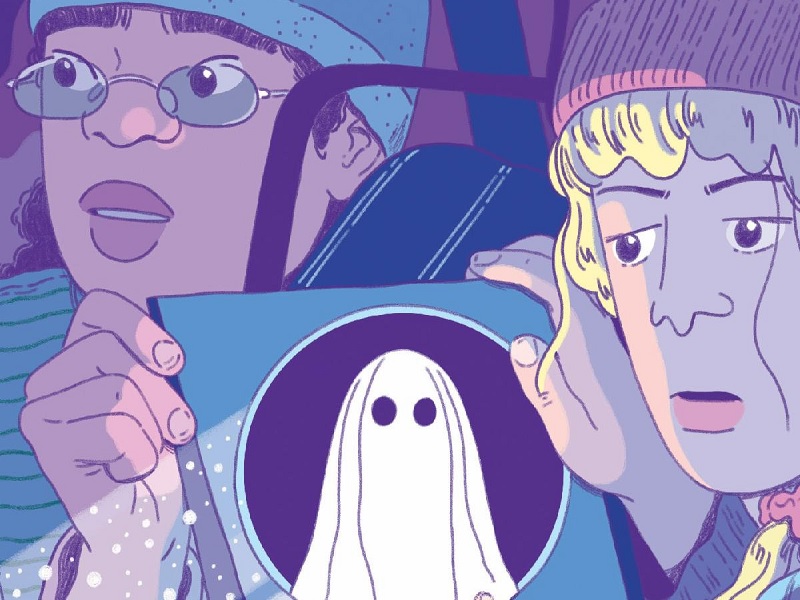
From helping her run the laundromat in the wake of her mother’s death, to making her realize one good friend is worth a thousand bullies, Wendell has always been there for Marjorie. Now in Lights — the final book in Brenna Thummler‘s Sheets trilogy, about a teenage girl who befriends a ghost — it’s Wendell who needs Marjorie’s help piecing the together the events that led to his passing. For more on what it was like working on this series (and coming up with the titles for each book), check out this interview with Thummler below:

Rachel Bellwoar: Was Sheets always planned as a trilogy or did Sheets‘ success make that possible?
Brenna Thummler: Sheets was never meant to be a trilogy. But when the book was finished, I realized that our protagonist, Marjorie, was not sufficiently healed. Her friendship with Wendell the ghost had only just begun, and she still had a lot to learn from it. Above all, I was having too much fun in this world—I wasn’t ready to leave.
Bellwoar: What’s the secret to coming up with a title that both references laundry but also has other associations?
Thummler: For Sheets, it was simple. The story is about sheet ghosts — the truest combination of ghosts and laundry. Delicates went through a few different titles and none of them felt right until I found a single word that related to both laundry and fragility. The title Lights came before book three’s plot development, purely because I saw it as a “light at the end of the tunnel” sort of book. The title ended up shaping many of the storylines.

Bellwoar: Lights picks up where Delicates left off, with Marjorie and Eliza developing the photos from Marjorie’s mom’s camera. Was there a lot of pressure to figure out which moments to capture in Marjorie’s mom’s last roll of film?
Thummler: Honestly, no! Because of a line in Delicates, I knew their family had been on a picnic the morning Marjorie’s mom died, and I had always envisioned this by the water. The photos were going to mean the world to Marjorie no matter the content, so I didn’t force anything. The only necessity was capturing a moment in time.

Bellwoar: Because it picks up then, Lights also takes place in the winter. How did that change of season affect the story, and was Wendell always going to go outside more in the daytime or did that change come about because the snow could act as camouflage?
Thummler: When I decided that Lights would focus on Wendell discovering his past with the help of his non-nocturnal friends, I realized, logistically, he would have to leave the house during the day. And when you unintentionally end up in a trilogy situation, you realize that earlier storylines are no longer working for you. There was no reason to keep him asleep in daylight, though—he’s no vampire. And the snowy camouflage was just a happy coincidence! As was the winter time frame, which added to the story’s overall melancholy.

Bellwoar: In the past, whenever Wendell’s memory has failed him, he’s invented stories to fill in the blanks, but Lights sees Wendell more determined than ever to find out the truth about how he became a ghost. How did you approach depicting Wendell’s memories and transitioning back and forth between the past and present?
Thummler: This was one of my biggest challenges! I was not depicting flashbacks, but rather memories. And Wendell’s memories are foggy. Because of this, you never see his parents’ faces. The color palette is more limited. His perspective gets distorted, and the panels themselves are slanted and wonky, as if to suggest the scenes are only adjacent to reality. It was fun to play with the idea of a forgotten past!

Bellwoar: What has it been like getting to show how much Marjorie’s relationship with her father has evolved since Sheets?
Thummler: With each subsequent book, I’ve asked myself: “How can I take their relationship one small step closer to healing without healing them completely?” The trilogy allowed for a slower, more realistic progression, and it was beautiful to watch both characters realize they still have a lot of work to do. Fifty percent of getting better is simply knowing that you have to.

Bellwoar: Tierney is a new character readers get to meet in Lights. Did you always want to hold off on introducing her until now and what’s been your favorite part about writing or drawing for her?
Thummler: Yes! The development of Tierney’s story, and Lights in general, happened after I had finished Delicates. (I wanted to treat each book as its own.) I love working with the concept of a misunderstood villain, especially one who is so brazen and unabashedly herself. Without giving anything away, I’ll confidently say—though people may disagree —that for the role she played, she was the best one for the job.

Bellwoar: Ultimately, did Lights end the way you expected or were there some developments you didn’t see coming when you first envisioned the series?
Thummler: I had no idea how I was going to end the trilogy until halfway through writing Lights. All I knew was I wanted an “imperfect ending.” Happily-ever-afters are great and all, but they also drive me nuts. More often than not, life doesn’t work out the way you had hoped. Readers, and especially young readers, need to know that happiness is still possible when expectations are not met. Above all, that’s what I hope they get from this final story.
Bellwoar: While Marjorie, Wendell, and Eliza’s story has come to a close, would you ever consider returning to Ghost World and setting another graphic novel there?
Bellwoar: Thanks for agreeing to this interview, Brenna!
Lights is available now from Oni Press.
