
What Was Lost, Now Found: Reviewing ‘Teenage Mutant Ninja Turtles’ #144
by Scott Redmond
Overview
Nightmarish encounters help put a lot of things in perspective as the Splinter Clan and allies look to the future in the emotionally charged Teenage Mutant Ninja Turtles #144. All roads lead to the upcoming big 150 issue, as the powerful series continues to do all the things that have made it one of the best comic books being published for years.
Overall
9/10Since the moment it began, Teenage Mutant Ninja Turtles has been a franchise built around the varied concept of family. Whether it’s blood or found, so many stories took this theme to heart and went various ways within that space.

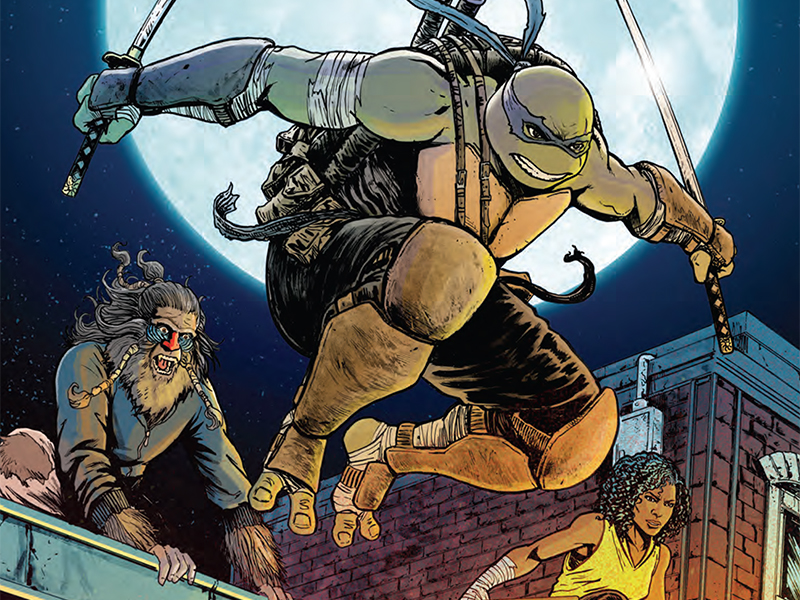
Teenage Mutant Ninja Turtles #144 adds to the tapestry, bringing the Splinter Clan family to a new space — one where they realize they can remain family even if their paths diverge. It’s another character-rich, engaging issue from Sophie Campbell, Gavin Smith, Ronda Pattison, and Shawn Lee.
Recently, it was announced that the current run of this series is concluding with issue #150. What that means for this long-running title, whether it’ll maintain numbering or relaunch, and who will guide it creatively, isn’t clear right now. That’s not important at this moment, though. What is important: just how much the run has accomplished in the few years since this creative team took the reins.
Those of us who have read the entirety up to this point will have an easier time seeing all the threads that led here. Emotional beats, little revelations, namedrops, natural additions, and the like. It all built toward this moment, and where the series is going in the final handful of issues this team has together.

A major part of the arc, so far, is the conclusion of the Doctor Jasper Barlow plot begun so many issues ago. As wonderful and firm as that was, I’m setting that aside here. Before you gasp or scratch your head, there is a good reason.
Paramount to this arc has been the idea that the family has changed and accomplished so much in recent years. Fractures that were left unattended widened things, and too many firmly held to a past that could not be returned to. It’s hard for families or any set of relationships to adjust to great change, especially ones so steeped in emotion. Before all is said and done in this issue, Campbell pulls off big-time character growth and change; the likes of which are only possible following months-to-years of seeding, tending, and cultivating.
Characters built over the past 12 years in this series (39 years in total as a franchise) feel both familiar and different at the same time. Because of how they have been guided in that time, each subsequent story and moment builds onto the next. Yes, that seems unnecessary to say as that’s just good storytelling with such a long format. Yet, it’s not always the case for things, especially in the day and age where resets to the old status quo are commonplace.

Nightmares have plagued the characters since they went after Barlow, thanks to his dragon-scaled experiments. It casts a tough — or rough — feeling onto everything as the characters also battle their own issues. Smith was a perfect artist to capture that feeling and bring it to visual life. I love how there is that deeper, real, and grounded aspect to portions of his artwork. Chiefly the settings, like the sewer spaces and such, but also within the proportions of the various characters.
At the same time, there is a sharpness, helping with that rough tone, that plays through the space. Emotions feel so real and resonate as we witness these characters going through events. Each of the action beats we see are fluid, as is each piece of movement. Framing choices help make this even smoother, allowing the characters to be the center of the focus as they move around. Creating a true sense of motion as well as an actually deep world that feels quite tangible.

Artists have cycled through this run, bringing a variety of styles and sensibilities to the pages. Each of the arcs has been crafted for their differing styles and what genre would benefit from said style. All along, though, it has fallen to one colorist to make sure that each of those styles feels unique color-wise while maintaining its own stylistic touches. Pattison has been that colorist, and she knocks it out of the park month after month, issue after issue.
With this arc, the colors are heavier, more of toned-down or washed-out feeling. It allows those deep spaces/settings I mentioned above to breathe and feel even more real to our senses. Bathing the aspects that mirror our own world in a color scheme that feels natural helps bring us even more into the story. This allows for the less familiar aspects to be the pops of color, from the magical, the horror, or the more superhero-esque bits.
I’ll never stop marveling at how easy Pattison makes it look to keep matching the cycle of artists beat-for-beat. Even as the color shifts through the various arcs, it’s still carrying telltale signs that allow one to know it’s her work if you’ve been reading longterm. Having this tether allowed the series to keep some visual continuity even as it changed.

I’ve said it before and I’ll keep on saying it, the way that letterers often get overlooked by the populace at large and even the industry is a crime. Too many seem to assume it’s just placing the words from the script onto the page, but there is so much more that goes into it. When the letterer is putting their all into it, there is a very distinct feeling that one gets from the different types of lettering on the page. It exudes personality, emotional energy, and just a special spark.
Lee has been here bringing this spark to the series since the start, being one of the go-to creatives touching various portions of the TMNT universe of books. There is a natural flow and feeling to the words on the page. Moving through the panels in a way that naturally guides the eye without taking away from anything else, just adds to the experience. Changes that range from minor to major allow the words to showcase volume or tone, as well as the variety of emotional energies the characters are brimming with.
Little bits of color, bubble changes, shifts in shapes, and other choices really bring a new dimension to words. Would they have the same overall effect to just be the standard type of font and bubble? Sure, in the sense of allowing us to read the words and know what the characters are saying or thinking. But so much would be lost in the moment if the little flairs were not dropped in to take it all to a whole other level.
Teenage Mutant Ninja Turtles #144 is now available from IDW Publishing.


