
Talking 2000 AD’s ‘DeMarco, P.I.’ With Laura Bailey And Rob Richardson
by Rachel Bellwoar
Some scars heal with time. Galen DeMarco still has scars from her case in “An Eye,” which saw the private investigator make some hasty decisions. Her new strip, “A Picture Paints,” debuts in Judge Dredd Megazine #462 and I got to ask writer, Laura Bailey, and artist, Rob Richardson, some questions about it:

Bellwoar: For Laura – what made you want to return to DeMarco, P.I. after four years, and for Rob – how has drawing Galen DeMarco been different from drawing Devlin Waugh (in this year’s “Karma Police”)?
Bailey: Galen is a character that stayed with me over the years. I’d often mull over continuing her story, but the pandemic had other plans for me. Writing a new story for her took a little longer than I anticipated but I’m so glad to be back!
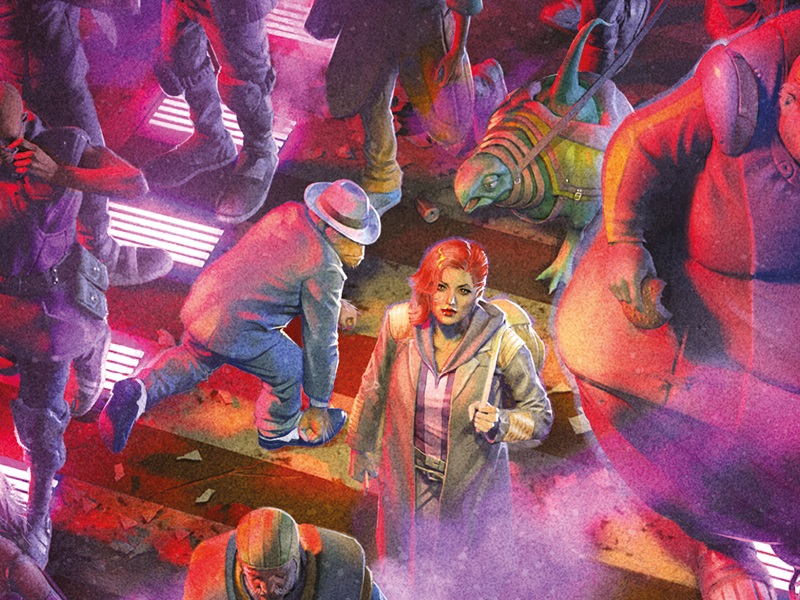
Richardson: Superficially there’s more ducting, tech and architecture! The biggest difference has been creating the right atmosphere. For Devlin Waugh there was a forbidding undercurrent right from the start.
By contrast, DeMarco is still dealing with crime and the underworld, but there’s also a quirkiness and inelegance to her that’s lends itself to bright colours in contrast to the shadows.
Rachel Bellwoar: PI stories aren’t always prone to looking back (when one case ends another begins). What made you decide to have DeMarco still have her scar from ‘An Eye’ (Meg #410-412), as a reminder of that case, instead of letting it heal?
Laura Bailey: Pure stubbornness from my part! When I wrote ‘An Eye’ I always intended for Galen to keep the scar. Now I’ve written ‘A Picture Paints’ I gave myself no option but to include it. Galen’s life is the thread which connects each case and although each job has a conclusion, they should always impact her in some way. Sometime that’s a mental effect, in this instant it’s a bad ass scar on her cheek.
Rob Richardson: Scars, of course, also look cool and have an inherent story to tell. That Galen “wears” her scar like warpaint tacitly says something about her character. It’s also nice to have a little shorthand detail to identify her, similar to Devlin Waugh’s moustache – you immediately know who’s who.
Bellwoar: Where did the idea for DeMarco’s latest investigation come from?
Bailey: Part of the story’s inspiration came from learning about surveillance systems used on Amazon Warehouse employees. Everything you do in there is scrutinized digitally, even down to how long or often you take bathroom breaks. The effect of it is burnout, as staff work themselves into the ground to try and keep up with arbitrary targets. That was something I wanted to explore here.

Bellwoar: Rather than find this case herself, Galen is turned onto it by another PI, Mick, who seems enraptured with the aesthetic of Dashiell Hammett’s Sam Spade. Did you enjoy getting to write hardboiled dialogue for him?
Bailey: Mick Walt was a slight joke because being called a “Walt” or a “Mitty” within the security industry is a huge insult. It implies that you’re a blagger overstating or even faking credentials to get work, basically being a complete fantasist. Visually he was based on the P.I Harry McGraw who guest stars in Murder, She Wrote, the greatest TV show of all time.
Now I think about it Jessica Fletcher is a bit of a Walt…
Bellwoar: If Mick is wearing an old-fashioned suit, Galen’s jumpsuit feels futuristic. How did you land on their final looks?
Richardson: The basic descriptions were in Laura’s script. I felt that Mick, in his head, romanticised pulpy fictional detectives, and was going for that look. Galen’s jumpsuit harks back to 1960s space age designs, so it’s both retro and futuristic. The Mega-City is home to such a disparate horde that nobody stands out as weird, whatever they’re wearing!
Bailey: Mick is super into “old earth antiques”. Rubix cubes, polaroid cameras and traffic cones. He’s a little eccentric and stays inside his office for most of the day. Galen on the other hand needs to blend in if she wants to sneak around and investigate undercover. Her clothing is dictated by the environment around her more than her own taste.
Bellwoar: Mick and Galen take very different approaches to dealing with their client as well. Was it fun being able to have that contrast?
Bailey: They are at completely opposite ends of the spectrum. Mick is much like a salesman: his only focus is to grab as much of his client’s money as possible. Whereas Galen’s objective is to find out the truth whether the client likes it or not; that black and white attitude can be alienating and could actually stop her getting the case. Pairing the two together is fun to write, I think if they were trapped in a room together for too long there would be a homicide.
Richardson: It’s great having these characters play against one another. The Mick/Galen dynamic is complex, hilarious, and fun to draw. The entire cast, whilst working together, are always at odds in some way and Laura writes them brilliantly.

Bellwoar: Speaking of their client, did you did you always want Mr. Torridge to have insect features, and where did the idea to dress him in furs (the hat still has a tag on it!) come from?
Bailey: The tag was Rob’s excellent idea, we wanted to put across the wealth disparity between Galen, Mick and Mr. Torridge.
As for the insect features, when I thought about the boss of a collective of workers, my mind went straight to ants. As Mr. Torridge is a mutant, his family business would have literally started from the bottom. Coming from nothing hasn’t seemed to give Mr. Torridge any empathy, despite his own experiences.
Richardson: I wanted him to be like an ostentatious rapper, hiding insecurities behind a display of opulence. There are visual easter eggs dotted throughout the story, and the hat with tag was a tribute to Shock-G from the hip-hop group Digital Underground, in his guise as the ridiculous Humpty Hump!
Bellwoar: Mr. Torridge’s warehouse is big on security cameras, but wouldn’t that be a double edged sword, for a place with unsafe working conditions?
Bailey: There’s always a risk, but whoever controls the footage has power in my opinion. Easy to “massage” the footage and use it to your own advantage, or delete evidence if it doesn’t assist you. Power dynamics would also prevent workers from complaining: if the warehouse closes there goes their income. It certainly happens in our own reality.
Belwoar: Stakeouts are a necessary part of any PI’s line of work, but is it challenging, making those sequences dynamic?
Richardson: The stakeouts had in-built drama, as we’re waiting for ‘something’ to happen. The way they were written, Galen always had stuff to do, rather than just being sat there watching screens. It’s always good to have those quiet scenes contrast with the lively ones.
Bailey: Depends how you look at it. I see it as being like a snake waiting for prey, the stillness is just as important to depict as the strike. It’s also quite absurd – one minute Galen could be waiting in her vehicle scratching her ass, next minute she could be tailing a violent psychopath and doing whatever it takes to gain evidence.

Bellwoar: Thanks for agreeing to this interview, Laura and Rob!
Judge Dredd Megazine #462 goes on sale Wednesday November 15th in the UK and December 20th in North America from 2000 AD.