
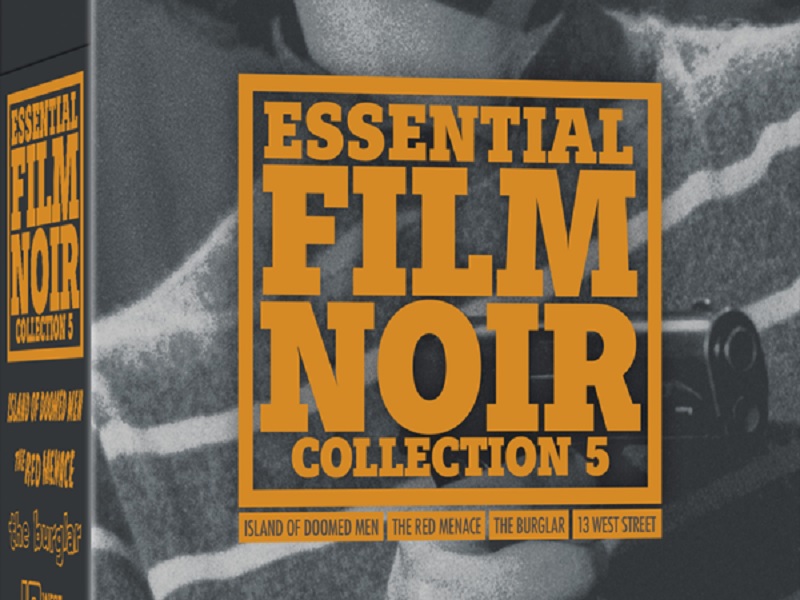
From Burglary To Teenage Gangs — ‘Essential Film Noir: Collection 5’ Reviewed
by Rachel Bellwoar
Jayne Mansfield, Peter Lorre, and Alan Ladd are just some of the stars you’ll find in this region-free noir box set from Imprint Films.

Charles Barton‘s Island of Doomed Men (1940)

To say that Island of Doomed Men isn’t an advertisement for becoming an undercover agent is an understatement. His first day on the job Mark (Robert Wilcox) gets wrongly accused of murder and, instead of his handlers stepping in and clearing the situation up, Mark goes to jail. That jail time does serve the purpose, though, of bringing him to the attention of Danel (Peter Lorre). Before he was killed that was the name the guy who was supposed to give Mark his first assignment mentioned and Danel’s racket seems to be using ex-prisoners as slave labor on his island.
Having established that backstory (with Mark even getting a number like he’s an agent on Get Smart), Robert Hardy Andrews’ screenplay completely drops that storyline to become your average prison escape movie. While the island setting draws to mind films like Island of Lost Souls and White Woman, Peter Lorre plays the antagonist a lot cooler than the lovably hammy Charles Laughton would, and Mark isn’t a worthy opponent for the actor.
Robert G. Springsteen‘s The Red Menace (1949)

There was a time Nina (Hanna Axmann-Rezzori) was proud to call herself a member of the Communist party. Now she and Bill (Robert Rockwell) are on the run, and it’s up to the voiceover narrator to deduce from who and why she’s running.
With a screenplay by Albert DeMond and Gerald Geraghty, The Red Menace is blatant propaganda but one that holds value as a historical document. Too absurd to be taken seriously, it also includes a tour-de-force performance by Betty Lou Gerson (the voice of Disney’s Cruella de Vil) as the party’s most loyal comrade who has to be a jealous shrew to balance out the fact that she’s a woman in a leadership position.
The female characters are treated horribly overall (at one point Bill says, “The party’s getting rough,” because Nora doesn’t capitulate when he tries to forcefully kiss her) and the film’s eagerness to put organized religion and traditional family values on a pedestal is blatantly biased. If former Communists were really allowed to put their pasts behind them so easily there would’ve never been a blacklist.
Paul Wenkos‘ The Burglar (1957)

Nat (Dan Duryea) has been training to burgle since he was a kid. When it’s finally time to put his organization to the test, impatience threatens to the tear the group apart, as Nat’s loyalty to Gladden (the always underrated Jayne Mansfield) and unwillingness to fence the necklace they stole too soon rubs his other team members the wrong way.
As refreshing as it is to see Mansfield cast as the good girl instead of the femme fatale (that part goes to Martha Vickers), Wendkos still finds ways to include her wearing a bathing suit. It would’ve been nice if her dramatic performance had been allowed to speak for itself without the obvious nods to her figure. The Burglar does make for an interesting entry in the sunshine noir subgenre and the ending benefits the most from the decision to shoot on-location (in this case at the amusement park in Atlantic City). With a screenplay by David Goodis, the film is also inventive about coming up with ways to package explication, like telling Nat’s backstory in a dream sequence.
Philip Leacock‘s 13 West Street (1962)

Set in an era when working too many hours was lionized instead of called out as exploitive, Walter Sherill (Alan Ladd) is so overworked as a rocket engineer that he forgets to put gas in his car one night and has to go out and look for a station. When a car almost hits him, Walter yells at the driver, resulting in the car reversing and Walter getting beat up by some teenagers. Unsatisfied with the way the police (led by Rod Steiger) are handling the case, Walter becomes obsessed with finding the boys himself, but will he stop once other people start getting hurt in the process? Bernard C. Schoenfeld and Robert Presnell Jr. have written a taut little thriller in 13 West Street and while the film conveniently develops amnesia in the very last scene, it otherwise holds Walter accountable for his actions.
Bonus Features:
Besides theatrical trailers and an old introduction to The Burglar by Martin Scorsese, The Red Menace is the only film in this box set that comes with a commentary and probably would’ve been the last film most people would’ve chosen. That being said, film historian Samm Deighan (whose book, The Legacy of World War II in European Arthouse Cinema, came out a few years ago) knows this period of history deeply and wields that expertise to the fullest.
There’s also a feature-length documentary narrated by John Huston from 1976 that uses a lot of real footage from the HUAC trials and a short film from 1950 in which the Hollywood Ten are recognized as individuals and which turns the tables on viewers, by making them consider what they would’ve done in the same situation.
Essential Film Noir – Collection 5 is available on region-free Blu-ray from Imprint Films.

