
Franchise Expansion (Or Implosion): ‘Evil Dead II: Dead by Dawn’
by Ben Martin
Franchise Expansion (or Implosion) is a column that looks at franchises that have new installments or releases forthcoming. In looking at a franchise, each entry in a franchise will be given a review and then be examined as part of the bigger franchise. (i.e., Was this sequel a worthy expansion of this franchise or was it an implosion of sorts?)

Horror franchises are notorious for losing their edge once enough sequels are produced. This quality is especially true for the horror series of the 1980s, many of which went from being horror to flat-out comedies by the conclusions of their respective runs. However, going from screams to laughter was never the true intention. That is, with one true exception — The Evil Dead franchise has not only mixed horror and comedy but it’s also vacillated between these genres more skillfully and with the same creative team involved on some level. Moreover, this franchise has also played with timelines. This brings me to this franchise’s second & most innovative entry and timeline with the first-ever requel, Evil Dead II: Dead by Dawn (1987)!

A sophomore slump is a notorious issue for many filmmakers, particularly writer-directors, and Sam Raimi (of the upcoming filmic adaptation of The Kingkiller Chronicle) was not exempt from such. Raimi and company experienced a similar drop into a career valley of sorts with their now nearly forgotten second film: Crimewave (1985). Unlike Raimi’s feature film debut, The Evil Dead (1981), it is a markedly different picture. Specifically, it is an absurdist noir comedy written by Joel and Ethan Coen, who made their feature debut as co-writers and co-directors with Blood Simple in 1984, a mere year before Crimewave. However, despite their unique tones, these two quirky noir films could not have been more different. I’ll say this for Crimewave: it’s a passion project for all involved.

As much as I like Raimi and The Coen Brothers, Crimewave did not work for me. Aside from respect for the art design by Gary Papierski and what all involved were attempting to do, this sophomore effort was simply an interminable bore. Oddly enough, it feels like a movie that would have been released in the wake of Batman (1989) in a misguided attempt to imitate that comic book film’s noir tone and success. But, perhaps Crimewave would have been more successful had Raimi been allowed to cast his original leading man, Bruce Campbell (of the upcoming TV series Hysteria!) in the lead role. Sadly, the producers and the studio that released it would not allow that. Thus, Campbell was given the role of one of the film’s antagonists, Renaldo ‘The Heel’. Since its release, Raimi, Campbell, and The Coens have essentially disowned the film, with Campbell saying jokingly, “Crimewave wasn’t released. It escaped.“
Following this sophomore slump, executive producer Irvin Shapiro (1906-1989) implored Raimi and company to return to their rustic horror roots to make a sequel to The Evil Dead. Shapiro needed a hit as badly as the rest of the crew since he had served as a co-executive producer on Crimewave. While most indie filmmakers would balk at the idea of doing a sequel so soon, Raimi was keen, as he had a different take in mind for an Evil Dead follow-up. It was to be entitled The Medieval Dead, which would eventually become the third film in this franchise, Army of Darkness (1992). At the time, though, the idea of The Medieval Dead proved too risky for the sequel’s producers and potential financiers. 20th Century Fox and Universal Pictures both passed on the proposed sequel; ironically, Universal would later distribute Army of Darkness. But no matter what the content of this sequel in review would become, “The King” himself helped ultimately get it through the gates.
Stephen King (Holly) was largely responsible for helping put The Evil Dead on the pop culture map with his famous poster quote, “the most ferociously original horror film of the year.” Being such a big fan of the original film, it’s no surprise that the author was excited when he heard Raimi and company were planning a sequel. As a result, King convinced film producer and founder of DLG Entertainment, Dino De Laurentiis (1919-2010), with whom King made Maximum Overdrive (1986), to finance the sequel. However, De Laurentiis, who had a reputation as a heavy-handed producer, only agreed to fund the project if it was closer to the original film. Raimi agreed to deliver a more straightforward sequel to De Laurentiis’ terms under one condition: less executive oversight.
Despite wanting the sequel shot on his soundstages at DLG in Wilmington, North Carolina, the producer accepted Raimi’s deferral with the caveat that the crew remain local. So, Raimi and company chose to shoot a few towns over in Wadesboro, NC (with a few pickup shots in the cast and crew’s native Michigan). As a result, most of the sequel was shot in the local gym and now temporarily closed J R Faison School in Wadesboro.
In this high-school gymnasium, the little and now infamous cabin in Morristown, Tennessee, was impeccably replicated by the crew. They did such an excellent job on this that I had no idea this film was shot in the state where I’ve continuously resided until a few years ago. I attended The Mad Monster Party horror convention in the nearby town of Concord, NC, where a vendor was selling photo ops in front of the cabin and pieces of said cabin. But more on MMP and its relevance to my personal experience with this franchise later.
Raimi brought in his short film collaborator and screenwriting pal, Scott Spiegel (Hostel: Part III), to develop a unique way to revisit the well-trodden woods. The pair didn’t want to do the same thing again. But, they had the brilliant idea to approach the same events from a different and more comedic perspective, thereby creating the first requel. Evil Dead II: Dead by Dawn picks up immediately where its predecessor left off and throws things into a time warp. As a result, Ashley ‘Ash’ Williams (Campbell) and his girlfriend, Linda (Denise Bixler), return to the desolate cabin with no memory of the demonic horror that befell them before. However, Ash’s memory is soon jogged by The Necronomicon as all hell breaks loose in the cabin in a bigger, badder, and more fantastical fashion than before!

Thankfully, for the cast and crew, bringing this re-imagining of the original material to film proved much easier the second time around. Well, that is for everyone except Campbell, who got put through the wringer physically, even more so than a few years prior. Albeit in a fun, loving, and possibly tortuous spirit by his director and old friend. But I’ll delve more into the star of this flick later, as he deserves his own section. No doubt, production on the film may have been made easier by the fact that much of it was shot in a much more controlled environment.
Post-production, however, would prove more difficult. As with its predecessor, the level of violence and gore in Evil Dead 2 was too much to garner an R-rating from The Motion Picture Association of America Ratings Board, even after numerous cuts were made. Thus, instead of taking the NC-17 route, the decision was made to release the film Unrated. However, despite staying on as a producer, De Laurentis could not legally attach his production company, DLG Entertainment, to the movie due to being a signatory of The MPA, which means that DLG could only release films that fell within the standard G-R rating spectrum. Since Raimi, Tappert, and Campbell were also producers, a faux production shingle called Rosebud Films was created to distribute the movie.
Like several other movies I’ve covered for this column, Evil Dead II is a picture with which I’ve had an evolving relationship. Now, that isn’t to say I dislike this requel. On the contrary, I have always liked it; I just never loved it like some folks do. Having seen both Dead by Dawn and its predecessor numerous times over the past 20 years, I’ve always preferred the straight-up horror of the original to the hybrid horror-comedy that is this film. I’ve never entirely understood why some hardcore fans of this franchise, or “Deadities” as they sometimes dub themselves, put the sequel on a pedestal. Sometimes, even going so far as to suggest you only need Evil Dead 1 OR 2. Then again, I can’t judge these fans too harshly as I, at one point, was among them in the inverse, always touting how I prefer the original film over the second.
This time around with Evil Dead II, though, I must have been in a particular mood or something. Because for the first time ever, I enjoyed it almost as much as its predecessor. I’ve always found the disparate tones of comedy and horror to be perfectly mixed, but it played better for me this time with its genre mixture. Part of my more amplified appreciation for the film this time around comes from my having a realization. In my opinion, Evil Dead II also mixes a subgenre into its blood-based cocktail of a picture: Fantasy Horror.
I’m not talking about full-blown Guillermo del Toro (Hellboy) style fantasy horror, but old-school fantastical rubber monster horror! No doubt the Deadities in the original film had their charm as they were created with rudimentary, disturbing makeup and claymation. The Deadities featured in the sequel, though, are whole other monsters. These Deadities by Dawn, if you will, are much more fleshed out and seem to have a basis in fantasy in their design. This quality is most likely due to using more rubber prosthetics, which is especially true of the design for Kandar The Destroyer. These more fantastical creations are headed up by Howard Berger, Robert Kurtzman, and Greg Nicotero (prior to the trio founding their legendary special makeup effects company KNB EFX), along with Mark Shostrom (A Nightmare on Elm Street Part 2: Freddy’s Revenge) fit perfectly into the tonal duality that this requel creates.

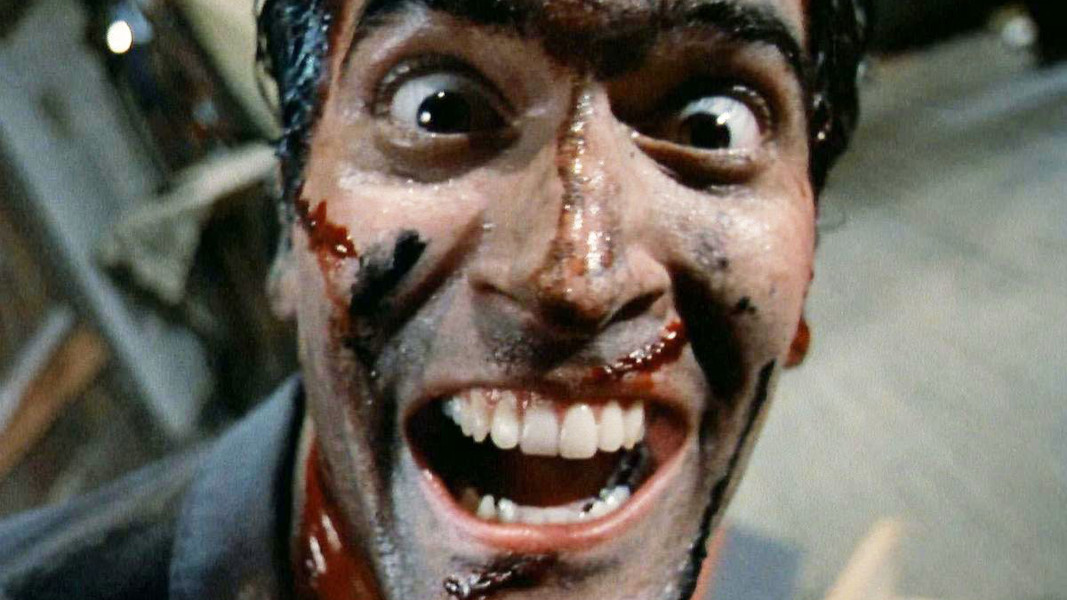
Another way in which Evil Dead II embraces this new tone is through its characterizations of existing and new protagonists. Campbell makes a star turn here as he develops what essentially became his persona on and off screen. Sure, he reprises the everyman Ash interpretation for the first quarter of the follow-up. Afterward, things take a turn. The leading man gives us the new, more verbose, likable jackass interpretation of Ash Williams audiences are now the most familiar in seeing.

Aside from having the character be a confident veteran when it comes to demonic possession, Campbell also brings a whole new physicality to the role. Not that the actor was in bad shape before, but in this ol’ Groovy Bruce is straight-up ripped! By all accounts, the actor put in the workout hours to earn that physique and a strict protein-only diet. The guy looks like a movie star and would be up to the rigorous physical requirements to headline any comic book movie from the era we’re in now. Campbell is great in this film, but unfortunately, that persona is not nearly as charming in person. I met him a few years ago at The 2019 Mad Monster Party: Carolina and, well, read about in the link.
With the brief exception of Linda, Ash is the only returning character. The rest of The Evil Dead‘s supporting cast was originally going to be included in the story. Upon consideration, however, Raimi and Spiegel feared that might make Dead by Dawn a little too close to its predecessor. They worried audiences might think they were watching the first movie again if all of the same characters returned in such a closely mirrored narrative. As a result, the new characters of Annie Knowby (Sarah Berry); Jake (Dan Hicks); Bobby Joe (played by Kassie Wesley DePaiva, who was initially credited as Kassie Wesley); and Ed Getley (Richard Domeier) are brought into play.

These new faces bring a lot of life to proceedings and interact well with our hero. Moreover, for supporting characters who serve as comic relief and horror genre archetypes, each has a distinct personality, thanks to the actors’ strong performances. Annie, in particular, is a great counterpart for Ash as Berry delivers a strong performance in her only film role to date. Kassie Wesley DePaiva also gives a solid performance as Bobby Joe. However, I’ll always be curious about how Holly Hunter (Batman v. Superman: Dawn of Justice), for whom the role was originally written, would have played the part. Understandably, though, Hunter declined as she had been offered the lead female role in The Coen Brothers’ sophomore writing-directing effort, Raising Arizona (1987). Interestingly, Raimi, Hunter, The Coens, and Frances McDormand (Good Omens) were all living together when they made these films, both of which became cult classics.

Ultimately, this is the film Raimi and company wished they could have made the first time out. As stated in the review for the original movie, Raimi is not naturally drawn to the horror genre. Hence, Evil Dead II is slapstick horror filled with the director’s more natural, comedic inclinations. Despite possibly seeming repetitive from the outset, Evil Dead II: Dead by Dawn is a very experimental Franchise Expansion. Not only did this film create the concept of the requel, but it’s also a re-calibration that puts the world its predecessor created in a whole new prism. And, last but not least, it sets up for a very different sequel that will follow it!

Evil Dead II: Dead by Dawn (1987) is available on 4K Digital HD Streaming, 4K UHD, Blu-ray & DVD.

Next time, this franchise will enter a new age with Army of Darkness (1992).

