
Characterization In The Buffyverse — ‘Angel’ Season 1, Episode 15
by Benjamin Hall
This is part of a bi-weekly series concerning the characterization of Buffyverse characters. The first installment in this series can be found here. Arguably the best place to begin reading this series is at the beginning, but that is up to each reader. As a reminder this column will cover major and some minor characters from the shows Buffy The Vampire Slayer (1997-2003) and Angel (1999-2004). Other Buffyverse media, such as the graphic novel Spike: Into The Light (2014) are not pertinent to this series. Also there will be no referencing real world events that have direct relation to either show in this bi-weekly series.

This week: Angel (David Boreanaz) faces a case involving Trevor Lockley (John Mahon), father of Detective Kate Lockley (Elisabeth Röhm). The circumstances cause Angel to remember his own father (James Kenneth Campbell II).
(Warning of spoilers from this point on!)
(Trigger warning for mentions of abuse)
Angel/Liam/Angelus is obviously the same person no matter which name he takes. Yes, there is a demon in charge when he is Angelus, but both Angel and Angelus are still just versions of Liam. This is illustrated to full effect with both this episode’s flashback and present day scenes. For example: he is a fool at best and an idiot at worst in both his past and present. It can be seen in the past with his short-term goals as both the human Liam and the fledgling vampire that will become Angelus. While in the present, coming across as mentally unstable while requesting invitation from Trevor Lockley results in the man’s death.
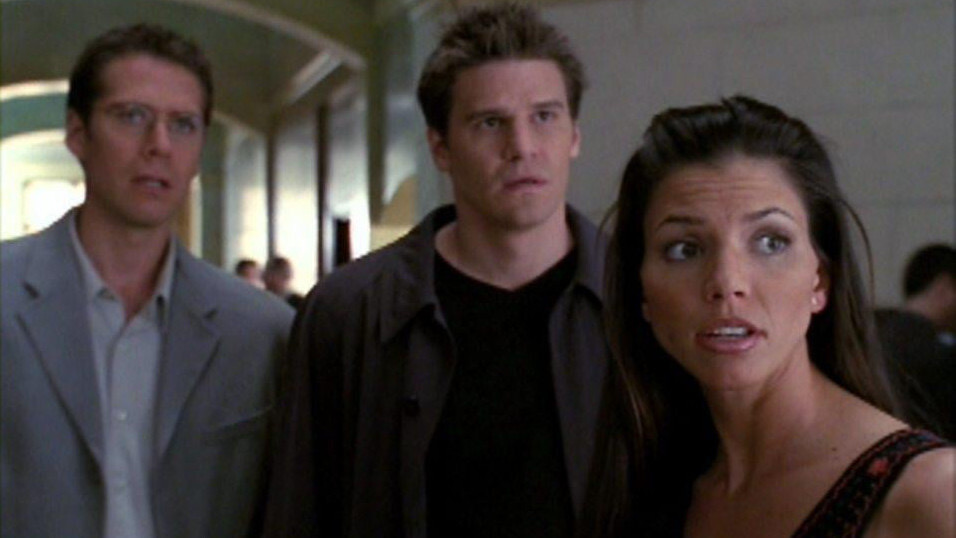
Cordelia Chase (Charisma Carpenter) is now comfortable around certain demon parts. Other than this, Cordelia only sees use as a gag character with the alarm system.
Wesley Wyndam-Pryce (Alexis Denisof) has a sexist moment when retrieving the dead demon in the tunnels with Cordelia. However, this is not extensive and is more to keep him a gag character. He also tries to provide some reasoning as to why Angel should not care about Trevor Lockley’s mistakes. Whether he is right or wrong to do so is up to the viewer. Finally, Wesley makes the mistake of referring to dissection as “vivisection” which are opposite things.
Kate seems to be having a case of denial at the start of this episode when it comes to the supernatural being real. She also seems to be too optimistic about her father changing his ways. This mainly occurs when she encounters him in the subway. It also persists during lunch when she fails to realize he is interrogating her. By the end of the episode, the denial and optimism is gone. One could say that the destruction of Kate Lockley occurs with this episode.
Trevor and Angel’s father are both abusive to their respective children. They also have trouble communicating that they do care for their children. In Trevor’s case, his abuse ties into his trouble articulating positive feelings toward his daughter. With Angel’s father, the abuse comes two forms. He wants Liam to act responsibly, but uses words that belittle and demean his son. He also employs physical violence. Unfortunately, these characters will see no more exploration within the series, and this means that they will remain just barely three-dimensional characters.
Darla (Julie Benz) really just plays the duo role of a huntress and seductress in Angel’s origin. Thus, there isn’t anything of substance that adds to her overall characterization.
The head vampire (Henri Lubatti), head demon Guy (Mark Ginther), Suit #2 (Michael M. Vendrell), the black robed priest (John Patrick Clerkin), the bar maid (Christina Hendricks), the Grounds Keeper (Bob Fimiani), the chamber maid (Eliza Szonert), the uniformed delivery person (Frank Potter), Angel’s mother (Glenda Morgan Brown), and Kathy (no credit) are all pretty stock in characterization. That said, the bar maid and the uniformed delivery person also serve to move the plot
This episode has a major theme revolving around fathers and their children. Specifically, fathers poorly communicating thoughts and feelings to their children. This is obviously demonstrated with the abusive way both Trevor Lockley and Angel’s father treat Kate and Angel, respectively. It is also seen in the way both fathers try to care. Yet, due to this being the last time viewers see either father, the theme is somewhat a waste. Not to mention that this theme’s heavy use in this episode reduces the characters who aren’t Angel, Angel’s father, Trevor, or Kate. Even worse: Angel and Kate are just puppets to the plot due to how this theme takes over this episode.