
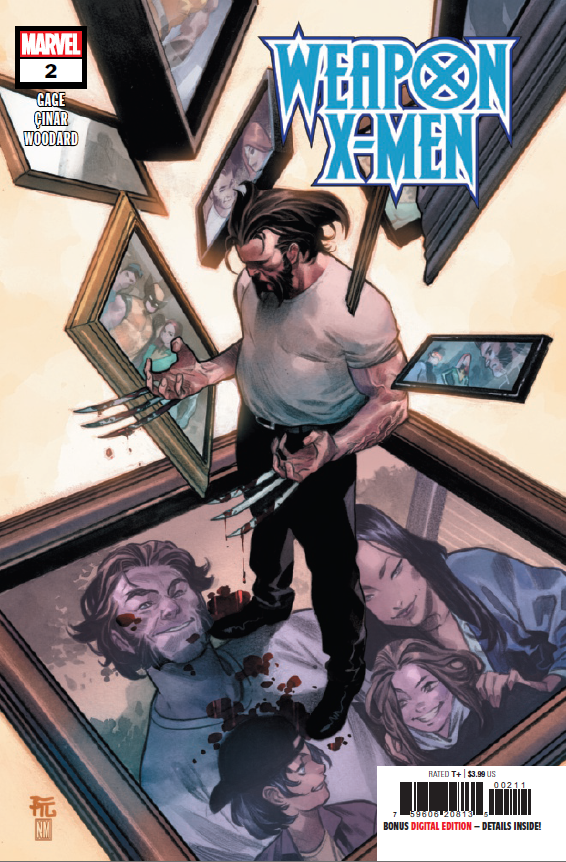
Better, But Still Not Great: Reviewing ‘Weapon X-Men’ #2
by Austin Gorton
Overview
Weapon X-Men #2 represents a marked improvement over the previous issue, but still struggles to rise above pedestrian art and routine plotting.
Overall
4/10Weapon X-Men#2 is not a great comic book, but it is a vast improvement over the series’ inaugural issue. Unfortunately, the large gap in quality between the two issues speaks more to just how bad the previous issue is than to the overall quality of this one.

The issue opens with a flashback to Earth-X Wolverine, as writer Christos Gage embellishes the established history of the character to provide him an origin of sorts. It is, of course, a tragic one, as Earth-X Wolverine reveals he gave up his powers and role as a superhero in a doomed effort to hang onto his Jean Grey.
As much as this peek into his past is appreciated as a way to make him more than just a goofy visual, it speaks to the disconnect that so characterized the first issue. Are we supposed to be laughing at this pot-bellied Wolverine with floppy hair, or sympathizing with him?
That question more or less gets answered throughout the course of Weapon X-Men #2, as “Earth-X” remains the POV character. Picking up the plot where it left off, Phoenix brings her team of stabby X-Men to her home reality in pursuit of Onslaught, and in doing so, Gage and artist Yildiray Çinar introduce additional alternate versions of the X-Men. Those include a retired Cyclops, his wife Madelyne Pryor, and their grown son Nate, who is engaged to marry Amiko, the foster daughter of Wolverine and his wife Amiko.
The whole thing serves the kind of It’s a Wonderful Life alternate reality beat that are the stock and trade of these kinds of stories. Earth-X gets confronted with an older yet happily married version of himself (“Age of Apocalypse” Wolverine gets in on the action here as well, lamenting the children he could have had with the Mariko of his reality). It also makes it clear that Gage wants us to, ultimately, feel bad for the Wolverines in general and Earth-X Wolverine specifically, thereby lessening some of the tonal dissonance of the previous issue.

In that regard, Zombie Wolverine, another big source of that dissonance, being dialed back makes Weapon X-Men #2 a better issue. Here, Zombie Wolverine settles into a more Deadpool-esque role that is as much about knowingly commenting on the proceedings as it is about comedic relief. Every story — even the darkest — needs an occasional release valve of humor, and Zombie Wolverine is being modulated better in that role amidst a story that is otherwise dripping in angst.
Gage is also having some fun with the alternate reality concept here. While there is the usual alt reality/future twists (Captain America is Luke Cage and Jessica Jones’ daughter Danielle, Illyana is the Sorcerer Supreme), events transpire to push the alternate reality towards something more familiar. The child of Cyclops and Madelyne is a properly-aged Nate Summers without any bionic implants. By the end of Weapon X-Men #2, he’s lost an arm, had it replaced with a bionic one, and is now using his powers to hold a techno-organic virus in check, just like “our” Cable.
To suggest that Gage is trying to make some kind of grander point about the consistency of certain events across a multiverse is probably giving him too much credit, but it’s nevertheless a fun beat.

To be clear, Weapon X-Men #2 still isn’t terribly good in and of itself. Çinar’s art continues to seem rushed, utilizing unexciting layouts and generic background that belie his capabilities. There’s a full page splash involving all the Wolverines attacking a dinosaur that is clearly meant to be the money shot of the issue. But it’s awkwardly staged, making the takeaway one of confusion rather than awe.
Gage also puts some more work into trying to sell the idea that a team of Wolverines with metal claws represents the best chance against a supremely powerful psychic and magnetic villain, but ultimately comes up short once again, with his argument basically boiling down to, “because stabbing.” The end result is an issue that is more cohesive than its predecessor while addressing some of the larger flaws of the story, but is still too workmanlike and flawed to succeed on its own merits.

