
Talking ‘Of Her Own Design’ With Writers Birdie Willis And Nicole Andelfinger
by Rachel Bellwoar
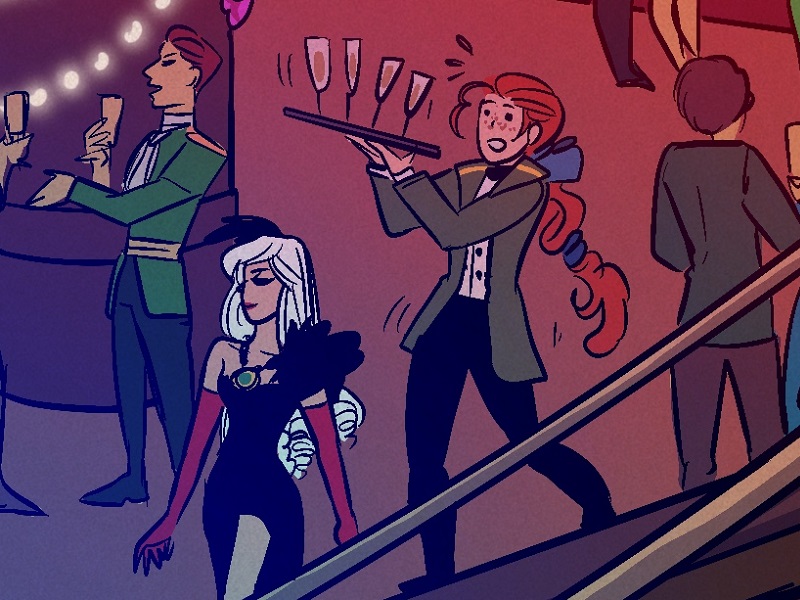
Brie is used to dealing with writer’s block but getting teleported into her own stories is a new phenomenon for the aspiring wordsmith from Of Her Own Design. Written by Birdie Willis and Nicole Andelfinger, each of Brie’s stories is given its own visual flair thanks to the involvement of multiple artists. With letters by Saida Tomafonte, and art by Vash Taylor, Fiona Marchbank, Linden Cahill, Eva Cabrera, Rowan MacColl, ans Laurent Reis, check out this interview with Willis and Andelfinger to learn more about the graphic novel and their advice for budding writers:

Rachel Bellwoar: Of Her Own Design really captures the reality and frustration of carving out time to write yet not being able to force the words to come out then. Was that your experience while writing this book, and how did you split the labor between yourselves?
Birdie Willis: I think it captures it so well because that was what I was experiencing at the time. All of my half (which ended midway through the pirate story) of Of Her Own Design was written when I was at a crossroads with my career. This is the last book I’ll be doing for the foreseeable future, and I think it was writing Brie that made me realize how much I needed to take a step back and do other work for myself. Nicole really shines in her half of this book. I feel like she brought life into Brie right at the turning point of her character arc and it’s truly a testament to the way writing doesn’t always have to be a solo endeavour.
Nicole Andelfinger: I picked up for Birdie about 1/3 of the way I believe, following Birdie’s outline up until the end. There were certainly parts of this book that I found myself struggling on, if only to find the right words! Brie’s talk with her parents in the second part was particularly important to me to get right, and I believe I went through three personal drafts of it before I submitted something I was happy with. In general, however, Birdie’s vision was so clear that this was one of those rare books where each bit was a JOY to write and came easily enough that I got to enjoy quite a bit of time futzing with it!
Bellwoar: Even when Brie isn’t physically writing she’s listening to audiobooks about writing and trying to brainstorm ideas. Are there any books or podcasts you credit with helping you to develop as a writer?
Willis: When I was in middle and high school, I was listening to CDs on my portable cd player while writing; headphones always in, curled in a corner somewhere. It would help me set a mood and tone for my writing and allow me to visualize the fictional worlds in my head. When I was writing my part of Of Her Own Design, I had been listening to a lot of podcasts about, really, everything and anything. It’s how I learn about new and interesting topics that might not be in my wheelhouse – for example, my wife is both an artist and holds a double major in biology and pure mathematics, so I listen podcasts like to SciShow Tangents, PBS Eons, Journey to the Microcosmos, and Tiny Matters to be able to discuss and understand her interests. It gives me a broader scope of knowledge to have and it’s never a bad thing to be educated! As far as books go, I love the illustrated Signs and Symbols Sourcebook. It’s a little on the nose for symbolism sometimes, but it’s a fun reference book to have and I’ve had my copy for a long time. I feel like it gives beginning writers a place to start the process of adding depth to their work.
Andelfinger: I’ll be honest, I’m actually not much of a podcast person! Listening to things is difficult for me; I’m very much a written word person as I tend to forget what I’ve just listened to rather quickly. That said, the best way I’ve found to learn is to read, read, read. The books I think of weeks later are the ones I ruminate on to figure out why it’s still sticking with me, whether that be dialogue or how the narrative was set up. Then, work on emulating in my own work.

Bellwoar: In real life context is everything yet not all books allow for readers to get the wrong idea about their characters. I’m thinking specifically of Brie’s relationship with her parents and how, without knowing their history, it’s not immediately clear why Brie reacts the way she does to them. Why was it important to you to let that information come out naturally instead of explaining everything right away?
Willis: You’re right! Context IS everything. So is nuance. The world we live in is rarely made up of the simple dichotomy of good or bad. But stories exist in a world of their own. Some stories are meant to simplify morals and meanings; to give a sense of right and wrong immediately so that the reader or listener can extrapolate and make larger, more relevant real-world judgment calls based on their knowledge. Other stories are meant to question what we know; to make us wonder about the life experiences we’ve had, the world we live in, or the choices we might make in another’s situation. Often those stories don’t present a conclusion that’s wrapped up in a nice neat bow. It becomes up to the reader or listener to make decisions and to sit with perhaps feelings of discomfort or curiosity that challenge them to grow and change. I could go on! But in my work I never want to spoon-feed information to my readers. It’s always more rewarding, in my opinion, when you can learn about the history a character has with another. Getting to know Brie is just like getting to know any new friend, you learn about their life experiences, goals, dreams, and problems by spending time with them. In doing so, you relate a bit more.
Andelfinger: All of us, I think, could consider ourselves an unreliable narrator when it comes to how we view our relationship with our parents at Brie’s age. The teens are that sweet age where we often think our parents just don’t get it, and their actions contradict how we view the world. Brie reacts in the only way she can to her parents, which is through her own lens. It’s not informed, but it’s exactly what half of us do so often in our lives, making assumptions with our emotions and our own logic guiding us. Because this book is about coming to terms with complicated emotions, I loved the idea of the information coming out naturally to the readers.
Bellwoar: Another complicated relationship is the one between Brie and her school bully, Viv. Later Brie is inspired to write a fantasy story about her. Why do you think fantasy was the right genre to unpack their relationship?
Willis: The relationship between Viv and Brie, though not based on a singular person, is rooted in a bit of reality for me, so if it feels like there’s a catharsis happening there, you’d be right. I don’t know if there was ever going to be another genre in which they could work on the unspoken things that had occurred between them. Fantasy can be both a realm of innocence and a realm of violence in the blink of an eye. That may be simplifying things a bit, but it’s the breadth and depth of fantasy as a genre that I felt could capture what needed to be said.
Andelfinger: Personally, I don’t know if I could have seen this story written in anything but fantasy. Friend break ups are difficult and devastating. It’s easy to reduce our issues with people into good vs. evil, and to find some solace in the break by seeing the other as someone clearly in the wrong. There’s a comfort in that. In reality, the reasons turn out to be messy and complicated, and we often are left with no clear answer as to why. Fantasy as a whole often finds an easy closure to the story in good triumphing; we get closure from it that leaves us satisfied and with an answer to the why. But the reality of a situation like Brie and Viv is never so easily solved in real life.
Bellwoar: Brie’s bumblebee stuffed animal becomes a bit of a talisman for her. What is it about that insect that you think reflects Brie’s personality?
Willis: Brie just wants to belong! She doesn’t realize how much she’s already a huge part of Holden and that she really is a part of her community – but I think that’s easily missed by anyone at her age, speaking from experience. But at the same time, when a hive becomes too large, it often splits into two and the part that splits off becomes a swarm that is seeking a new home. When scouting bees find a new place, they come back to their hive’s temporary home and do a little dance to tell their fellow bees what they’ve found and why it’s a good place to settle. I’d like to think that Brie, right now, is experiencing some kind of inner swarm. Something is becoming too much for her and maybe in the future she’ll either find a way away from her current community and life, or be at peace with the parts of her life that will move on and away. Either way, it’ll end up with a little happy dance. 🙂
Andelfinger: The fact that bees thrive in a community is honestly how I see Brie relating to the bumblebee! Writing can be a very isolating past time, and having that social connection is critical not just for writers but for anyone. At the beginning of the story, Brie is relatively isolated: she’s lost her best friend, her connection with her parents is shaky at best, and we can see the lack of social connection in the way Brie is just not able to write. It’s after she makes peace with what occurred with Viv, communicates to her parents, and connects with Kay that Brie is finally able to move past her writer’s block.

Bellwoar: Eventually Brie finds herself teleported into her own stories and realizing that not all of her dialogue sounds that good. How important do you think it is that writers take time to read their scripts aloud?
Willis: Oh incredibly important! If you’re writing a character, try and think about what words they’d use or turns of phrase they’d have – that’s important in creating distinct character voices. Otherwise your characters all just sound exactly the same, or you realize that you’re overcomplicating what could be said in two words rather than eighteen.
Andelfinger: Fairly important, to be honest. Dialogue can make or break a scene, and with comics especially where you don’t get to add descriptors to how things are said you have to be sure what’s being said is as impactful as possible. Nothing will kill a moment more than dialogue that sounds off for a character. Brie, for example, would never talk like Ambrose! Also, especially for comics again, dialogue should rarely explain the scene; the art should be showing while the dialogue should be moving the moment along.
Bellwoar: Is there anything readers should know about Ambrose, the bookstore owner who doesn’t make much of an effort to make Brie feel welcome?
Willis: Don’t judge a book by its cover! 😉
Andelfinger: Hmmm, just that if someone is offering you odd ink in a bookstore you barely remember existing, you should probably say no. Or at the very least stay away from the horror genre.
(I also wrote Ambrose as a trickster sort who thrives on chaos, so they never really were evil, per say. Just a very neutral being that enjoys enabling.)
Bellwoar: As the book goes on, readers get to see Brie’s confidence grow more and more. What was it like collaborating with the artists to chart that character progression?
Willis: I didn’t collaborate with the artists on this, but I think the story speaks for itself. If Nicole and I have done our jobs, then the artists should get the sense of that progression naturally. And if you noticed it, then I’m going to say I think we did alright!
Andelfinger: I didn’t have a huge hand in working directly with the artists on this one. But I will say that comics are always a delicate dance between words and images, and I have to say seeing each artist bring their personal flair to their section was an absolute DELIGHT. I’ll always appreciate how it felt like every artist got to blossom in their genre and show off their own passion for both the medium and the moment!
Bellwoar: Thanks for agreeing to this interview, Birdie and Nicole!
Of Her Own Design is on sale now from Maverick.