
Talking ‘The Night Mother’ With Jeremy Lambert And Alexa Sharpe
by Rachel Bellwoar
There are a lot of reasons the moon not moving might raise cause for concern. When you’re already prone to having nightmares and hearing whispers, though, the first that comes to mind is the moon being stuck means it’s always nighttime — not a great time for nightmares or whispers. This is the problem Melanie’s facing in writer Jeremy Lambert and artist Alexa Sharpe‘s graphic novel, The Night Mother. With letters by Becca Carey, find out more about Melanie and the titular Night Mother in the following interview with the creators below:

Rachel Bellwoar: When The Night Mother begins, people have already gotten used to the moon not moving and it being night 24/7. What made you decide to start there instead of when it first happened?
Jeremy Lambert: I think a big part of it was entering the world as Madeline sees it. As it currently is. It helps us get into a world where there’s quite a bit of necessary context and mythology as soon as possible.
There’s an option for a different opening out there that’s a bit more traditional — establishing the status quo and then a big shakeup, turning Madeline’s known world upside down, but in a trilogy of this length, that would at best be the ending of the first book if that was the case, and we would not even have met the Night Mother or Nura yet.
It just felt like the most organic starting place for this story and allowed us to present every key character from go, in the opening chapter.
Bellwoar: What has it been like coloring a story where there’s no sunshine?
Alexa Sharpe: It’s been an incredibly fun challenge. On every page, it’s really important for me to keep things visible in all that inky black night, while also making sure colors are fun and ever-changing throughout the story. Working on Night Mother has made me delve into the wide, beautiful spectrum of purples and blues.

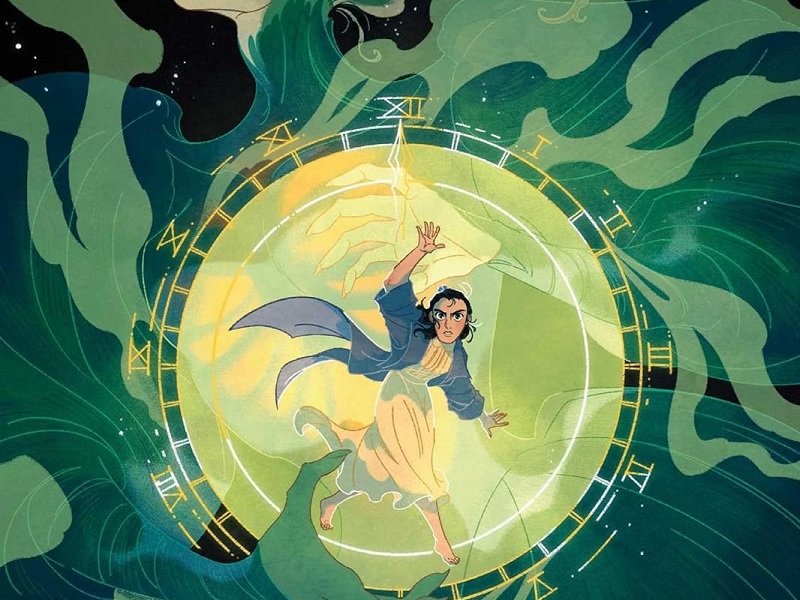
Bellwoar: Our first glimpse of the Night Mother is on the cover. Were you ever concerned about showing her too soon and not holding off for a reveal?
Lambert: I was, actually! But it felt right that she should be on the cover, even though my instinct is to take a lesson from Jaws and keep her off-page and do my best to engineer the right kind of reveal. Here, though, since the Night Mother is almost this mythic, fairy tale being, I loved Alexa’s cover in so many ways, but especially with just how much it captured that element but also just the entire story in how she designed it All this to say — as soon as I saw Alexa’s cover, anything other than “yes, 100%, this is it” left my head.
Sharpe: I just had this immediate, strong vision that she needed to be there, shrouded in shadow, towering behind Maddy. I went through a few other versions too, where she wasn’t on the cover at all, to try to keep it suspenseful. It’s meant to be a horror story, after all! But ultimately, I felt like she really needed to be there, close at hand but still mysterious and looming.
Bellwoar: Whereas Madeline’s nightgown goes with the whole being called to an adventure in the middle of the night aesthetic, how did you come up with the Night Mother’s look and Victorian style of dressing?
Lambert: I sent some general reference to Alexa and we had a few conversations but the real answer is it’s all her. Beyond some key elements that were these sort of grandiose, and once again folklore/mythic elements that I had mentioned to Alexa (her gown is a map of the cosmos, hair a tangled constellation, and eyes like the lights of faraway stars) she just took it and ran. I can’t convey enough that Alexa is the reason this book exists. The Night Mother is just so distinctively her design. It’s beautiful. I’m so lucky I get to work with her at all.
Sharpe: The Victorian era carries such whimsy and nostalgia in equal measure. When Jeremy first sent me the script, I just knew grounding the Night Mother in this era would be perfect. It’s a classic, bygone setting — but it’s not so far in the past for us, so it still feels warm and familiar. Victorian fashion also happens to be one of my artistic specialties!

Bellwoar: Even before it started being dark all the time, townsfolk were afraid to visit the island where Madeline lives and where the local graveyard’s located. How did you come up with that setting and was it always your plan to make Madeline so isolated?
Lambert: It was. It always started with the idea that Madeline was a little girl that lived in the graveyard. And that she helped bury the dead. Also that the townsfolk were afraid of that island, of the graveyard, of death itself. A lack of understanding, and really a lack of willingness to understand — that’s what’s worst. But removing Madeline and Barnabus (because of her father’s own fears and issues) from a community felt integral to both characters. And something that would inform who they are over the next volumes.
Bellwoar: Do you think fairy tales are better equipped than other genres to tackle dark and potentially scary subjects like death?
Lambert: I do. I’d include horror in that, as the two are inextricably linked for me. This is a book about death as much as it is about that moment in childhood when you realize all the adults and institutions around you can’t be intrinsically trusted. That was a big realization for me. To look to myself and my feelings and my gut. And for Maddy, she’s understanding death at the same time as all of this — especially alongside the duties of the Night Mother and certain souls that the current Night Mother has taken.
Fairy tales are a place where we can examine ourselves. Question ourselves in elemental ways. And I could only hope to provide a story like the ones that carried me through my own childhood, and high school, and college. And frankly, to this day.
Sharpe: Absolutely. I’ve always thought fairy tales are like a safe portal to view serious themes through. It’s like having a soft cushion or buffer, a sort of fantastical veil between yourself and what you’re reading. In fairy tales, you can confront things like darkness and death, but yet never lose sight of things like hope and whimsy.

Bellwoar: What’s been your favorite part about creating the mythology around the Night Mother (for instance, I especially loved the lullaby that went into the legend around her)?
Lambert: I’m so happy you loved the lullaby, that’s wonderful! I think one of my favorite parts might be coming up with all the ways this Night Mother, Iana, has warped her station and responsibilities and tried to figure out how to escape what she was essentially born into.
My favorite element of the story is honestly how similar the Night Mother Iana and Maddy really are. The parallels between them, and the key difference between them, are the very core of the story.
Sharpe: On the art side of things, I’ve had such a fun time interpreting Jeremy’s written vision for the Night Mother and her people, the Moonfolk. It’s been a treat designing their fashion and architecture — asking myself how they dress, how they live their lives. I really wanted them to toe the line between ethereally otherworldly, but yet also familiar. The moon is a close neighbor to earth, after all.
Bellwoar: The Night Mother is going to be released in three volumes. Was it difficult figuring out how to structure and break-up the story into three acts?
Lambert: It all started as one volume actually, but there were two sort of organic breaks in the story that our editor Sarah Gaydos noticed, and then we started talking about the initial pitch as not just one, but three books. Which again felt right for a few reasons. And then the difficulty came in figuring out how this story is going to be told structurally, especially with Book 1, which has to provide just enough context to ferry us off on this adventure with Maddy, but not bog us down, confuse us, or take too long to get to somewhere. And then it becomes an issue of how Maddy takes control, even if she feels like she doesn’t know what she’s doing, and finds her way.
Having just finished the script for the second book, it’s clear that each book is going to be pretty distinct from the rest, and that’s really exciting!

Bellwoar: Thank you for agreeing to this interview, Jeremy and Alexa!
The Night Mother Volume 1 goes on sale October 9th from Oni Press.
