
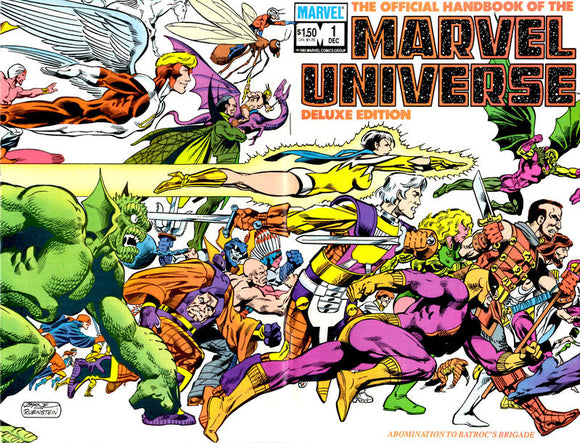
Comics We’re Thankful For: How ‘The Official Handbook of the Marvel Universe’ Forged A Love Of Fictional Nonfiction
by Austin Gorton

I still remember the first time I encountered the Official Handbook of the Marvel Universe. My middle school buddy Christian’s dad had a couple of long boxes in the basement of their house. This was shortly after I’d started getting into comics, having crossed from baseball cards to comic book cards to comics themselves. Flipping through those long boxes, I came across the first handful of issues of the deluxe edition of the Handbook. I pored over them with awe in Christian’s basement. The first chance I could, I tracked down as many issues as I could at my local shop. They were my keys to an entirely new world — a new universe.

Back in the Before Times, when reprints of old comics weren’t plentiful and the closest thing you had to Wikipedia was a stripped down electronic version of a set of encyclopedias on CD-ROM (look it up kids!), the Official Handbook of the Marvel Universe introduced me to the wider Marvel Universe beyond the scant few back issues I’d collected on my meager allowance. In doing so, they also set off my lifelong love of nonfiction writing about fictional stories, encyclopedias and guidebooks not of the actual world around me (though I loved those, too), but of the made-up worlds of my favorite stories.
The brainchild of Marvel’s then editor-in-chief Jim Shooter, the Official Handbook of the Marvel Universe (or OHOTMU for short) was originally going to be a stats-based repository of information, similar to the stats found on the back of baseball cards, but for superheroes (eventually, OHOTMU would serve as a primary source of statistics for the writers of the cardback info on early sets of the Marvel trading cards, bringing everything full circle). Under the direct editorial hand of Mark Gruenwald — a creator renowned by his knowledge and love of Marvel history and continuity and an almost feverish desire to make it all “fit” — OHOTMU would grow into something much more than a stat book, providing full narrative biographies of characters and their histories along with vital statistics and logic-based explanations of how their powers work (almost, in some cases, to the point of parody). Each entry was accompanied by an original full body shot of the subject, drawn by a murderers row of Marvel artists and all inked by Joe Rubinstein (whom Gruenwald selected believing he would be the best at subsuming his own style to highlight that of the varied pencilers without making the figures unrecognizable), along with reprinted panels from earlier comics.

A new, bigger deluxe edition followed a year after the original series wrapped (these were the issues I first encountered in my friend’s basement years later), and an eight-issue update in 1989. The project continued to exist in various forms (including an ill-advised “loose leaf” Master Edition in the early ’90s that went all-in on stats and ditched the bios and reprinted panels, and a really gorgeous set of updated hardcovers in the 2000s). Outside of nostalgia-based reprints of this preexisting material, however, it is unlikely we’ll ever see another update to OHOTMU. When Handbook-esque entries exist for free on the internet at the fingertips of readers — to say nothing of the stories themselves, with large swathes of the Marvel Universe’s history available to be read at the tap of button via Marvel Unlimited (or more illicit avenues) — the desire for a printed, curated historical record of this fictional universe is limited and, most importantly to Marvel, less commercially viable.
Which is a shame, because there’s a tactile pleasure to pulling a book off the shelf or a comic out of its mylar bag and diving into a fantastical fictional world via straightforward summations of that history. Reading and re-reading those old Marvel Handbook issues injected the knowledge into my brain far more efficiently than reading the comics themselves ever could have. And by diving into, say, the history of the Kree/Skrull conflict or the coming of the Celestials as though those events were part of a historical record long before I read the actual “Kree-Skrull War” story in Avengers or cracked open a trippy-ass Jack Kirby issue of Eternals, I was better prepared when I did encounter the comics. Not spoiled, but grounded — and thus better positioned to let the plot beats, characterization, and visual storytelling wash over me.
In much the same way that critical reviews can offer new insight into stories, this kind of “fiction as history” writing can offer different perspectives on stories. The act of summation is an act of choosing what matters most in a narrative or the life of a character, the details left out or included saying something you won’t get simply by reading the stories themselves. The sense that any given comic isn’t just a story unto itself but one more chapter in a sprawling, decades-long shared narrative is one of the unique structural features of superhero comics, one of the things that makes them so fun and fascinating, and little underscore that truth like the OHOTMU.

Of course, OHOTMU isn’t the only nonfiction work dedicated to chronicling fictional adventures. DC Comics offered their version of OHOTMU — Who’s Who — though that one never hit quite as hard for me; in part because of the design, which tended to background the art outside the main figure too much with a weird bit of pink colorization that didn’t hold up in back issues well, and in part simply because Marvel seemed to have the stronger pool of artists to draw from in the mid-to-late ’80s and, thanks to the dividing line of Crisis on Infinite Earths, a more cohesive shared universe. You can fill a bookcase with volumes dedicated to sharing every fictional detail of the Star Wars galaxy possible (I have such a bookcase). One of HBO’s biggest successes of the last few years is an adaptation of a book that is the history of the reign of fake kings and queens over a fake continent, written by an author who decided he was more interested in writing fictional history than in writing the fiction itself.
And I eat all that stuff up. Nonfiction about fiction combines two of my great loves — historical writing and fantastic universes filled with wondrous characters — into one thing. But no piece of fictional nonfiction has topped the Official Handbook of the Marvel Universe in my esteem, a comic that introduced me both to the nooks and crannies of the Marvel Universe, and to the idea that some stories are so big, so sprawling, and so interconnected because everything that happens in them matters, that they need dedicated comics of their own to chronicle all that inter-connectedness. To the idea that I could read stories, but also, stories about the stories.
What a world that opened up to me. What a universe.
