
Review — Factional Divides Make ‘Transformers’ #16 A Success
by Austin Gorton
Overview
Transformers #16 stands as an example of the series’ ability to remain fresh by mixing up its configurations of characters, against the backdrop of big screen robot punching action.
Overall
7/10One of the things this latest iteration of Transformers has done consistently to set it apart from previous incarnations — and keep it from getting repetitive — is break its core cast into smaller subgroups within the larger Autobot/Decepticon divide. Transformers #16 is a great example of that. It spans plotlines and planets, checking in with the various factions, while the central action of the comic comes from an intra-Decepticon battle. All of it before a final-page-reveal that threatens yet another massive shakeup to the established character dynamics.

(Spoilers for the last page follow. Proceed with caution)
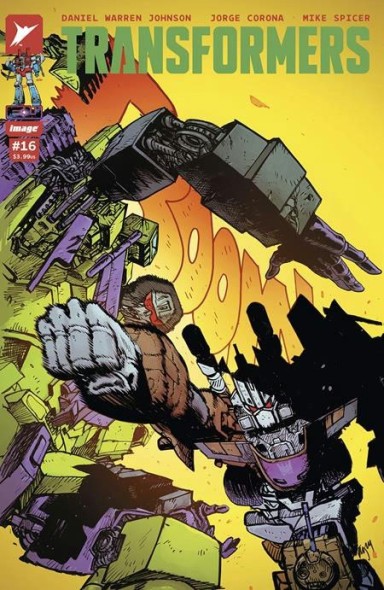
The cover captures this intra-party fighting in miniature, via its depiction of two massive robots, made up of littler robots, fighting. Whereas earlier in the series, Devastator (the gestalt form of the Constructicons) represented a major threat to the over-matched Autobots, on the cover and in this issue, the action is focused on Devastator fighting another Decepticon gestalt, the Combaticons’ Bruticus. Throughout, the two Kaiju Transformers’ battle is a stand-in for the conflict between Soundwave and fused-to-a-HISS-tank Starscream’s respective factions. One significant action aside, the Earthbound Autobots literally just get out of their way and watch the fight unfold.
As they’ve done throughout the series, writer Daniel Warren Johnson and artist Jorge Corona succeed in making the conflict more than just big robots mashing together. Even the evil Decepticons are humanized, with, for example, Thundercracker’s dismay at what happened to his Decepticon jet brother Skywarp, driving his actions and his relationship with both factions. Despite the relative rigidity of mechanical bodies and faces, Corona manages to imbue the figures with emotion — from the glee on Starscream’s face as Astrotrain smashes into Soundwave to the way Thundercracker’s mental state is perfectly clear just from the way he’s drawn overlooking the battle shortly before flying off on his own. Corona also makes the most of the big robot Sturm und Drang, slowing down the action by devoting a double page spread to a closeup shot of Devastator taking a Bruticus punch to the face that does the massive size of the combatants justice.

Both the “factions within factions” and “robots have feelings, too” vibes are present in Transformers #16’s Cybertron-set B-plot, as Cliffjumper makes his way across his war-ravaged homeworld to reclaim the sparks of his fallen comrades. In the process, he both challenges the cynical, war-weary Alita with a little Andy Dufresne “the power of hope” mindset, while also affirming that his ultimate goal is not about getting back to Optimus Prime and his faction of the Autobots on Earth, but rather to Carly. For Cliffjumper, his bond with her now supersedes all others, be it his loyalty specifically to Optimus or the larger Autobot war effort.
However, all this intra-faction conflict is poised to merely be an appetizer, as the issue concludes with a sequence that threatens to destabilize all the tenuous alliances even further. After Optimus Prime mysteriously experiences flashes of someone else’s memories and seemingly loses control of his Megatron arm, firing on the dam serving as the backdrop to the Devastator/Bruticus fight, the issue concludes with the return of Megatron himself. Appearing following his escape from Cobra-La in the Energon Universe one-shot, Megatron is discovered by Laserbeak, who lends Megatron his eyes, restoring the leader’s sight.

For an issue that is all about how the lines in the central Autobot/Decepticon conflict have blurred during their time on Earth, from Optimus wielding Megatron’s cannon to the Combiner teams fighting each other, choosing this moment to establish the next step in Megatron’s always-looming return is notable. Will his reappearance reform those lines, and return the series to a more traditional “good guys vs. bad guys” didactic? Or will Megatron’s presence destabilize things further, adding an anarchic presence that further upends the status quo? As of Transformers #16, the clock on finding out is ticking faster than ever.

