
Review — Facing An Uncertain Future, ‘Star Wars: A New Legacy’ #1 Succeeds By Looking Back
by Austin Gorton
Summary
Star Wars: A New Legacy #1 looks back at the breadth of characters and storytelling potential across Marvel Comics’ history with Star Wars and, hopefully, sets up the variety of tales to be published in the decade ahead.
Overall
8/10Ten years on from Marvel’s re-acquisition of the Star Wars license — an anniversary being celebrated by Star Wars: A New Legacy #1 — the line is in a curious position. Then, it was a tightly-constructed imprint of titles featuring the top tier artistic talents of the likes of the late John Cassaday and Stuart Immonen. Now, as it heads into its latest phase, the titles are more loosely connected, with each upcoming series taking place in its own era, decades apart, featuring artists who fall under the banner of “dependable” moreso than “superstar.” This issue, then, functions as both a celebration of what’s come before and a lament for what’s been lost.

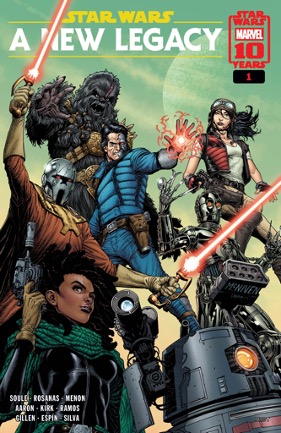
An anthology collection of three different stories, the centerpiece of Star Wars: A New Legacy #1 is “The Grand Imperial Jubilee” by Charles Soule and Ramon Rosanas. Set shortly before the events of the first Star Wars movie (and era largely unexplored by the comics), it features a cavalcade of original characters from the last ten years of stories. Plot-wise, it’s a relatively simple heist story, with Doctor Aphra (introduced in Kieron Gillen‘s Darth Vader series and star of two solo series herself) and Sana Starros (who made her initial splash under Jason Aaron as Han Solo’s wife) teaming up to steal a MacGuffin from the titular jubilee while Valance and Rik Duel (two original characters from the first Marvel Comics Star Wars series ported into the new canon) attempt to claim a bounty on Aphra.
Soule uses the extra space granted from the thin plot to pack the story with cameos and nods to the original characters from across the Marvel Star Wars canon, including but not limited to Domina Tagge, Grakkus the Hutt, Terex from the Poe Dameron series and Rik Duel’s partners from the old Marvel run, Dani the Zeltron and Chihdo. Rosanas, returning to the Star Wars universe after a stint on IDW’s Star Trek, provides his usual richly textured pencils with intricate, detailed backgrounds.

The second story, “For the Love of the Empire” by Aaron and Luke Ross, features SCAR Squadron, the squad of Stormtroopers who were recurring antagonists in the later period of Aaron’s Star Wars run. Thematic opposites of the Star Wars heroes (in that they are as firm of believers in the fascist ideals of the Empire as the Rebels are against them), Aaron leans into that setup with the story, showing the troopers coming to terms with the mounting spirit of rebellion spreading across the galaxy in the wake of the Death Star’s destruction. The story smartly plays with expectations while feeling especially relevant at the moment. If “The Grand Imperial Jubilee” speaks to the breadth of the comic book canon, “For the Love of the Empire” speaks to the ability of the comics to explore the smaller nooks and crannies of Star Wars‘ narrative and thematic landscape.
“Rogue’s Gambit” is the final story in Star Wars: A New Legacy #1. Written by Gillen with art from Salva Espin, it is the shortest of the stories and one largely played for laughs. Gillen reunites with the “dark mirror” supporting cast he established for Darth Vader in his eponymous series, in which Doctor Aphra, Black Krrsantan, Triple Zero and Betee are positioned as counterparts to Han, Chewie, Threepio and Artoo for Darth Vader. Leaning into that idea, it basically presents the “Chewie and Artoo play holographic space chess” sequence from A New Hope with their villainous counterparts, with hilarity ensuing as the more violent characters take things too far. It’s slight, but fun.

All together, the three stories in Star Wars: A New Legacy #1 succeed in celebrating the breadth of the original characters created not just in the last ten years of Marvel Comics, but across the history of Marvel’s Star Wars license. In doing so, it serves as a reminder of the potential for comic book stories set in that storytelling universe, whether through original characters, thematic exploration, or atypical tones. Hopefully, it will also serve as an effective stage-setter for the next batch of Star Wars comics.