
Daredevil Week: Ranking *Every* Daredevil Trading Card
by Austin Gorton
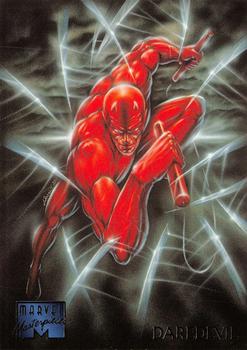
The early 1990s were a boom time for both comic books and sport cards. Starting in 1990, Marvel began cashing in on both at the same time with the release of the first set of Marvel Universe trading cards featuring heroes and villains from the company’s vast comic book universe. Subsequent sets followed, as well as spinoffs, including the premium “Marvel Masterpieces” sets, which featured fully painted art from the likes of Joe Jusko on thick, glossy cardstock, and character-specific sets, like the Fleer Ultra X-Men and Spider-Man sets.
While Daredevil never inspired his own dedicated set of cards, he was a fixture in many of the sets of this era. In honor of Daredevil: Born Again and in the spirit of the internet, here’s a ranking of all the Daredevil trading cards — at least, all the cards from that ’90s boom time.
#15 – Marvel Masterpieces Series 5 (Card 3) – 1996

The fourth and fifth Marvel Masterpiece gave some or all of its characters multiple cards, allowing different artists to share their takes on the character. This Boris Vallejo & Julie Bell card from the final Marvel Masterpieces of the 90s is from a “genesis” subset, which presents three cards showcasing the evolution of a character’s look. It’s not necessarily a bad card, but it’s not very Daredevil-y, either, rendering a lithe, agile character as a typical Vallejo-ian veiny muscle man.
Also, the poise makes it seem like we’re catching Daredevil when he’s about to drop a deuce.
#14 – Marvel Masterpieces Series 4 (Card 3) – 1995

Like the Vallejo piece, this Peter Scanlan card is a bit too muscle-y and zoomed in, suggesting little of the character’s athleticism or personality.
#13 – Marvel Universe Series 4 – 1993

The fourth Marvel Universe series took a novel approach to its after three fairly similar sets: each card was also 1/9 of a larger image, with characters grouped together by team or theme (like the Avengers, or cosmic characters) so that when the nine cards are placed in plastic card pages, they form one large image. While this results in some clever layouts and full page images, it has the unfortunate effect of devaluing the individual cards.
This Daredevil card is a good case in point: not a bad rendering from Ron Lim, but it gets shoved into the bottom corner of the larger image and has to share space with Shriek’s hair, so there’s less room for a full figure drawing or dynamic posing.
#12 – Marvel Universe Series 5 – 1994

Being released in the ’90s, there’s a handful of cards featuring Daredevil’s brief “armored” look. Not the strongest figure from from Mike Manley here, and the colors are somewhat muted, but the commitment to perspective is nice.
#11 – Marvel Masterpieces Series 5 (Card 1) -1996

Another bulky, overly muscled rendition, but both it and the “we just colored muscles” approach to rendering the costume work better with DD’s original, more circus-themed, togs.
#10 – Marvel Masterpieces Series 3 – 1994

A somewhat more dynamic riff on the armored costume from the Brothers Hildebrandt.
#9 – Marvel Masterpieces Series 5 (Card 2) – 1996

And the most dynamic version of it, from Vallejo & Bell, a card which almost seems to move as you look at it.
#8 – Marvel Universe Series 1 – 1990

The original Daredevil trading card is indicative of the first series of Marvel Universe cards: solid but not spectacular. Points for the “looking up at the character” perspective, but the coloring on the face that gives him a greenish hue, is indicative of how the production team was still figuring things out.
#7 – Marvel Masterpieces Series 1 – 1992

Joe Jusko‘s card from the first Marvel Masterpiece set is similarly solid-but-not-spectacular. The rooftop setting is appropriate, but the wintery setting a bit more random (though it does help the red of his suit pop).
#6 – Fleer Ultra Spider-Man – 1995

More broad-shouldered than Daredevil should be, but the perspective and liberal use of the billy club grappling mechanism elevates this Mark Texeira card.
#5 – Marvel Masterpieces Series 4 (Card 2) – 1995

This card, from Dimitri Patelis, stands out for trying to highlight Daredevil’s radar sense over his athleticism, something few cards do.
#4 – Marvel Masterpieces Series 2 – 1993

The best trading cards manage to tell a little story in their single, static image, and that’s what Tristan Shane does with this card, from the second Marvel Masterpieces set. It would rank higher but for the fact that the position of his left leg makes it look like it’s significantly shorter than the right (once you see it, you can’t unsee it).
#3 – Marvel Masterpieces Series 4 (Card 1) – 1995

Dave Devries gives us a dynamic rendition of Daredevil mid flip, one which also packs in a fair amount of emotion. The lighting here is also top notch, with DD obscuring the light from the street lamp below.
#2 – Marvel Universe Series 3 – 1992

A clean, simple but energetic card from Lee Weeks, one of the unsung DD artists. All the Marvel Universe Series 3 cards featured a similar layout to this, with a vaguely cosmic background interrupted by a more character-specific background inserted into a geometric shape. Done right — as in this card — and the effect makes it seem like the character is leaping out of the card at the viewer.
#1 – Marvel Universe Series 2 – 1991

The overall design from Marvel Universe Series 2 remains tough to beat, and John Romita Jr. — possibly the best post-Miller DD artist — turns in an almost movie poster-like card that manages to show Daredevil in action, highlight his radar sense, and express his character. The juxtaposition of the serious headshot with the little smirk on the running figure says it all, and while other cards also feature Daredevil on rooftops, the way JR Jr makes a point to show DD running on the edge of a building underscore how he truly is a Man Without Fear.
