
Talking Silver Sprocket’s ‘The Confessional’ With Paige Hender
by Rachel Bellwoar
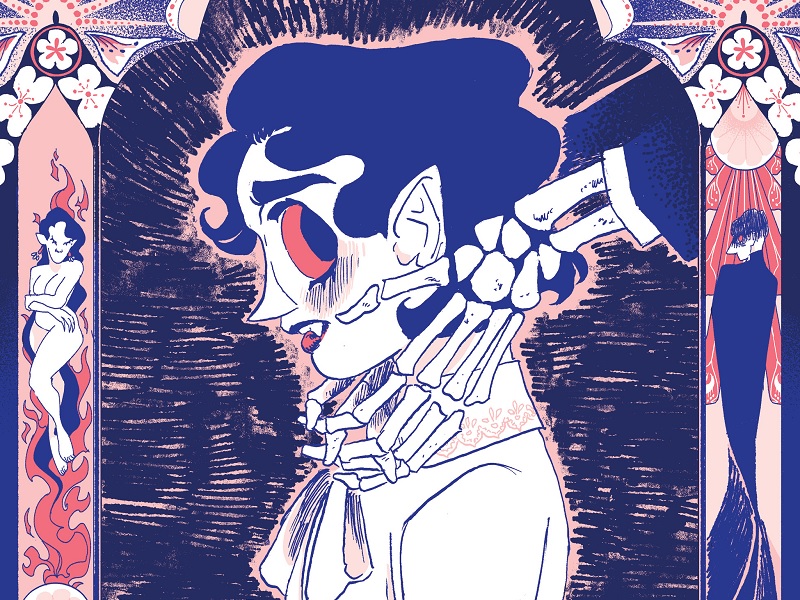
When a person (or vampire) is plagued by guilt, it only makes sense that they would want to turn to someone for help. The problem in The Confessional is that Cora has put her trust in the wrong priest. For more on Cora’s story, here’s what Paige Hender had to say about her graphic novel debut:

Rachel Bellwoar: Storyville sounds like it could be a fantastical place but The Confessional opens by grounding the story in real New Orleans history. As a Louisiana native, why was it important to you to set the story there?
Paige Hender: I think to understand a story, you need to understand the setting. The story of The Confessional could have gone in an entirely different direction had I chosen to set it in Dallas, or Chicago, or anywhere else. But the specific, unique history of Louisiana makes for a captivating setting. I want to say first off that before I started working on The Confessional, I had only visited the city twice and both times were as a child and post-Katrina. In a way, I used my research for The Confessional to catch myself up on history I hadn’t even thought about since grade 8.
To me, New Orleans is like the beating heart of the state, pumping resources snd culture up the Mississippi river and through tributaries and capillaries alike. It also helps that the modern vampire genre owes its life to fellow Louisianan writer Anne Rice, who has forever woven the Big Easy into bloodsucker lore. The Confessional opens by explicitly stating the cultural context that the characters live in; two years into prohibition, three years after the Axeman murders, and five years since the official closure of Storyville. This is a city wracked with fear and anxiety, and with no legal way to blow it off. Both the church run by Orville Thibodeaux and the ladies of La Chauve-Souris offer relief for all three of these problems while also indulging their own needs. Cora has to choose, just like everyone else in the city, how she wants to cope with her fears.
Bellwoar: The Confessional sees Cora develop a toxic relationship with a priest named Father Thibodeux. What was it like figuring out the turning points in their relationship and when Cora’s friends would start to grow concerned?
Hender: A young lady spending a bit too much time with a priest is already cause for concern, doubly so for a vampire. So I wanted the characters around Cora to be wary of him right off the bat, but not really vocalize it. Sort of like when you meet your friend’s new boyfriend and you really don’t like him but she just seems so happy to be with him that you bite your tongue.
As for their relationship, I was writing Cora with a very specific mindset. She’s the kind of person who recognizes injustice and will help others when she sees them mistreated or abused, but won’t think anything of it when she’s experiencing the same treatment. It’s that Catholic guilt, the feeling that you deserve whatever is happening to you because you must have wronged the world in some way. Add to this her vampiric nature, and she’s a character who is molded by her self-hatred and refusal to accept herself. And then along comes Orville, who not only confirms her worldview but gives her a way to atone for the crime of her existence by following his lead. So for her to break out of this relationship, she really needs to see what he’s doing to her from an outside perspective. She needs to recognize herself as the same as the victims she’s willing to stand up for, and therefore find the power to stand up for herself.
Bellwoar: The way you use the pattern of the dividing screen from the confessional booth during Cora and Father Thibodeux’s early interactions is incredibly powerful. How difficult was it to layout those scenes?
Hender: Thank you! But oh lord you do not want to see my inks for these scenes, they’re so messy. I always knew I wanted to use the pattern of the confessional grate as a repeated motif. Orville is a character who hides his intentions, so hiding his face in moments when Cora is laying her heart bare makes him a bit more of an ambiguous character in the early story. But since I drew everything in traditional inks, I couldn’t just copy/paste a pattern whenever I needed it. I could have just made a pattern digitally and made a note to myself on the inks where to insert it, but I wanted to be fancy and bespoke. So at the start, all the dividers and grate motifs were freehanded. After a while, I figured out a way to simplify the design that I liked so it didn’t take too too long. But then as I reached the end, I really disliked how all the grates looked a wee bit different from one another. So I wound up deleting all the grates early on in the book and digitally replacing them with one that I could copy from much later that I liked a lot better. This is also the pattern you see in the endpapers of the book. I really should have made that decision early on and spared myself quite a few work hours, but it’s my first book! I’m allowed to make some mistakes!

Bellwoar: With vampires, it’s not always as popular to show them transform into bats like Bela Legosi. Why did you decide to make wings part of Cora’s design?
Hender: The simplest answer for that is I thought it was cool. In reality, nothing about Cora’s “vampire form” is strictly necessary for her character. I’m someone who grew up on magical girl anime, so it makes a lot of sense to me for a character to physically transform to represent an inward shift. While vampires transforming into bats or wolves or what have you is a common enough piece of lore, I don’t see a lot of vampires with a middle form between those transformations. I got heavily inspired by the character of Irma Vep from Les Vampires (1915) and drew a lot of sketches of Cora in a similar outfit very early on in the story’s development. I remember making a note that I wanted Cora’s posture and body language in this form to be between a ballerina and a bird of prey. The simple forms really helped to emphasize her movement while she was hunting, so the idea stuck all the way to the final product.
Cora’s wings come in and out of her design as needed, the idea being that she can completely control how far she transforms and when. I definitely made a balrog joke at some point about whether or not Cora has literal or figurative wings, but they’re real. Her wings are alway[s] out when she feeds, and they go away in moments of humanity, or when she’s questioning herself, or when she’s not fully focused on the kill. The wings wound up serving an interesting visual purpose, as I allowed myself to stylize them as much as I wanted and to use them to frame Cora very dramatically in certain scenes. I maybe leaned a bit too much into the “It’s magic. I ain’t gotta explain shit.” mentality, but this is a very self indulgent book! And if I want my vampire to have a magical girl form, she’s going to get one.
Bellwoar: I really enjoyed the backmatter and seeing how much you had fleshed out each character’s backstory. Given that we don’t get to spend as much time with some of them in this graphic novel, could you see yourself returning to the world of La Chauve-Souris?
Hender: I’m so glad you enjoyed it! I wanted Cora’s world to feel really lived-in, and part of that was knowing what the people around her were up to at all times. So I spent a lot of time just thinking about all of the other vampires, what brought them to New Orleans, etc. I can’t see myself doing another full-length graphic novel in this world – the story comes to a pretty natural conclusion – but I’ve been thinking about doing some little zines or mini-comics for some of the background characters just to get the stories out of my system. Like I’d love to write about how Dolores and Greta met and fell in love while the latter was stuck in a circus freak show. Or Madame Mercredi’s first few centuries of life alone after her tomb is uncovered until she meets a surrogate daughter in Lydia. Or the Trinh siblings, who were turned less than a day apart because Ambrose misunderstood the whole situation and thought Rheese was in way over her head and basically jumped into the deep end to save her, only to realize that she knew exactly what she was getting into. And now they’re stuck together for eternity. There’s a lot to talk about there! It’s just a matter of how much time I have to devote to them.
Bellwoar: In learning about how old these characters are and where they were born, we also get a better sense of their personal fashion choices. Was that a fun part of the research process?
Hender: Oh most definitely. I adore historical fashion from all periods and all regions. Most of the bonus material in the back of the book is just me putting the characters in different outfits like I’m playing dress-up with my funny dollies. I tried to stay away from the beady, fringed flapper look as much as possible so that I could squarely set the story at the start of the ’20s. Greta is the only character to wear fringe dresses in the book, and even then she’s in performance costumes. Just about everyone’s casual clothing was referenced from contemporary magazine advertisements, ranging from the late 1910s to the early 1920’s. Certain characters prefer the older silhouettes, with Dolores specifically always being a decade behind fashion trends due to her inability to let go of the things she loves. In early sketches, Marie-Jeanne’s style and energy is much more obviously inspired by Josephine Baker. Cora’s hairstyle and general look was inspired by a beautiful portrait of Clara Bow. For Cora’s outfits, I looked at yearbook photos from women’s colleges at the time. I wanted her to wear the simplest outfits to emphasize her lack of worldliness compared to the other girls. Her outfits also have a bit more of a stylistic/artsy flair, like her cloche having upturned ends and the big bows on her blouses. This was just so she’d stand out a bit more as a main character.
There’s definitely some anachronism with the outfits, but I ultimately decided that I wanted the costumes of The Confessional to represent the characters first and the setting second. So Madame Mercredi and Rheese wear pants more often than skirts, and Dolores sticks to her Edwardian silhouettes despite how odd that would seem to anyone on the street. My one regret costume-wise is not putting the girls in more headgear. Hats, headbands, and hair accessories are such an iconic part of 1920s fashion and even if I don’t personally like drawing them, it’s a shame that I left them out of the book almost entirely. You asked if that was a fun part of the research process, and I think the fact that this is my longest response by far answers that question pretty nicely.
Bellwoar: Thanks for agreeing to this interview, Paige!
The Confessional goes on sale today from Silver Sprocket.


