
‘Andor’ Is Back And Better — Or At Least As Good As — Ever In Season Two’s First Three Episodes
by Austin Gorton
By the time the first season of Andor wrapped, it had established itself as a critical success. Moments like the prison escape (“one way out!”), Luthen’s (Stellan Skarsgård) monologue of personal motivation, and Maarva’s (Fiona Shaw) call to action from beyond the grave became worthy entrants in discussions of all-time great Star Wars moments. The sheer amount of creative achievement present in season one, combined with the fact that the series is drawing ever closer to its narrative endpoint (2016’s Rogue One: A Star Wars Story), has led much of the anticipation going into its second season to be less focused on “what will happen next?” and more on “will it be able to maintain, or even exceed, the highs it reached in the first season?” Fortunately, at least as far as the first three episodes — “One Year Later”, “Sagrona Tima”, and “Harvest” — are concerned, the answer is yes.
Spoilers Below!
Reportedly, all twelve episodes of Andor‘s second season break down into four discreet three episode arcs, and as a result, Disney+ is releasing them three at a time. The first batch of three episodes pickup one year after the events of the first season, when in the wake of his mother Maarva’s funeral, Cassian Andor (Diego Luna) pledged his allegiance to Luthen and the cause of Rebellion. The episodes are roughly split up across three main storylines (as well as a fourth that essentially serves as B-plot to the rest): Cassian’s mission to retrieve a prototype TIE Avenger, the wedding of Mon Mothma (Genevieve O’Reilly)’s daughter, and the efforts of Cassian’s found family and fellow Ferrix-refugees to escape an Imperial audit on the farming world of Mina-Rau where they’ve sought refuge.
All three plotlines remain largely separate (though Cassian is the common link amongst them, his status updates slipping into the Mon Mothma plotline while he eventually swoops in (literally) to the Mina-Rau plot by the end of “Harvest”), but all three, in their ways, showcase the themes with which the series is concerned: the ways fascism exerts its control both large and small, the points where that oppression breaks complacency into rebellion, and how much one is willing sacrifice after that point.
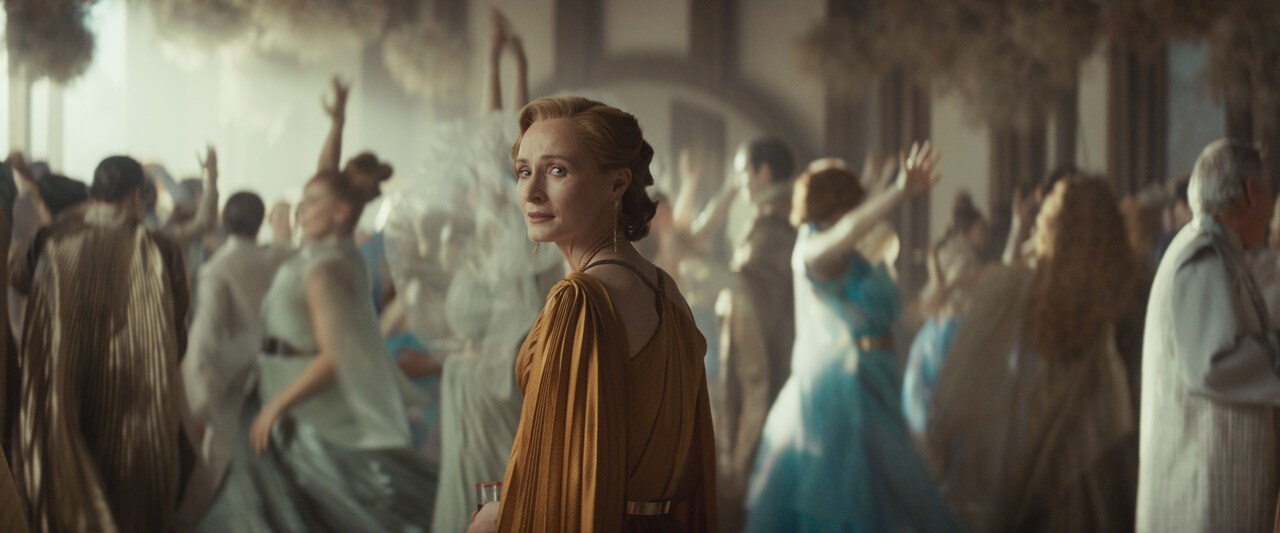
It’s present in all three of the main storylines, from Cassian’s conversation with Imperial technician Niya (Rachelle Diedericks) in the opening sequence, to the way the stranded members of the Maya Pei brigade turning on each other with the slightest provocation, to the speaks-to-the-moment-to-an-uncomfortable-degree way the Ferrix refugees attempt to use the Imperial demand for wheat as cover for their illegal status. But it is present nowhere more than in the Mon Mothma wedding plotline, a narrative far removed from the overt oppression and hardship of the other two, yet revelatory in the way it highlights complacency and privilege. While the wedding guests enjoy drink and merriment, across the galaxy, rebels are fighting to stay free and eating fart melons in a jungle filled with monsters.
Yet in her own way, Mon Mothma is feeling the weight of the Empire, the careful house of cards she’s built around herself to help support the efforts to oppose the Empire at risk of falling down around her as she stands in stark contrast to her hedonist husband and social order of her homeworld. By the end, she may well have reached her own breaking point. She pounds shots and slides onto the dance floor, desperate to escape, however briefly, the noose of her circumstances tightening around her neck.
How much longer can she keep her feet in both worlds, and enjoy the comfort of her public life along with the moral superiority of her private one? Viewers familiar with the nooks and crannies of Star Wars history will know, from the Deedra Meero (Denise Gough) subplot involving the efforts to destabilize the planet Ghorman, that if Mon Mothma hasn’t hit that breaking point yet, it’s just around the corner.

If one wanted to quibble with these first three episodes, one could. For one, any hopes that the series’ more languid pace — particularly in its early goings — last season might be accelerated as it draws closer to Rogue One and must cover a larger gap of times are dashed, at least by these first three episodes. They all largely take place over the course of three days — it seems the second season’s approach to the necessary time jumps are to speed up between three episode arcs, then slow down again for the actual story. And, plot-wise, not a lot actually happens; Cassian’s entire story arc for this premiere could be described as “steals a ship and goes home”, and doing so would only be slightly uncharitable.
Cassian himself is another weak point — or at least potential weak point — for this second season. The arc of the first season is largely Cassian’s. It is the story of his progression from a self-centered provacateur to a dedicated capital-r Rebel. But that’s more or less what he is in Rogue One, as well. Which means there’s seemingly little progression for the character to make over the course of this second season (certainly, he doesn’t undergo any significant growth as a character in the course of these three episodes). Which isn’t an inherently bad thing — there are plenty of other characters in the show that have the room to develop in interesting ways. But it’s a rarely a good look when the title character is the least interesting character in a show.

But all of that is, mostly, larger concerns for future episodes. If what is coming in the remainder of the second season of Andor matches these first three episodes in terms of theme and craft, then there’s no doubt the entire Andor endeavor will take its place amongst the Star Wars greats. Early in “One Year Later”, Cassian tries to comfort Niya. Speaking from experience about her decision to fight the Empire, he tells her, “you made this decision long ago. The Empire cannot win. You’ll never feel right unless you are doing what you can to stop them. You’re coming home to yourself.”
It’s a brief moment; there’s no swelling orchestration to underscore it, no slow zoom or lilting Shakespearean cadence to signal its importance. But “you’re coming home to yourself” is on the same level of “one way out!” or “what is my sacrifice?” or “but I’ll tell you this, if I could do it again, I’d wake up early and be fighting those bastards from the start!” in terms of serving as an expression of what ideas matter most to this show.
And it establishes quickly, in the opening minutes of season two, that Andor is back, as good — or even, maybe, better — than ever.

