
Previously On X-Men: Goth Makeovers, Wonky Time Travel And More In This Week’s X-books
by Austin Gorton
There’s a lot of X-books out this week, y’all. Let’s get right to it.
Uncanny X-Men #15 by Gail Simone and David Marquez

More is revealed about Haven House and Henrietta as the Outliers and X-Men alike travel deeper into the Dark Artery.
- One of the robo Sentinel dogs from earlier in the series wakes up and makes its way to Haven House.
- Not surprisingly, it turns out Gambit is aware of the Dark Artery and Haven House’s connection to it, and by the end of the issue, all the rest of the X-Men have been looped in.
- That means there’s a ton of exposition in this issue, involving Haven House, the Dark Artery, and a newly-introduced realm called Penumbra, a kind of Hell for people who have betrayed mutants in their life, as well as the various roles of Man-Thing and Henrietta in guarding the various gates/doorways to the different places.
- When Gambit is asked why he hasn’t told the X-Men about all this before, he just says it’s, “not an easy conversation to have” and he might be talking about all this exposition.
- Shuvahrak, the overseer of Penumbra, wants Deathdream to replace her, leading to the Outliers entering Penumbra to stop her, which requires them to adopt new goth looks.
- When the X-Men ultimately follow the Outliers into Penumbra to help them, they too adopt some badass goth looks. (Ed. Note: Damn, Marquez is good at this.)

- It’s not clear what Shuvahrak is or how she/it fits into Penumbra (which is said to have been created as the result of a mutant curse). Between this and the ur-thunder god over in Storm, there’s a lot of vaguely defined god-like entities running around the X-books at the moment.
- During an ensuing fight with the souls in Penumbra, Jitter adorably admits she’s in love with Calico.
- Back in the past, Henrietta meets the then-current residents of Haven House, all mutants, who calm her down and prevent her from killing the the Service agent who killed her friend George. They then offer to kill him for her, but she decides to spare his life, one of those classic “right decision that will ultimately bite her in the ass” moments.
This is really laden with exposition but David Marquez continues to shine, and is able to keep what are basically scenes of people talking visually-engaging.
Deadpool/Wolverine #5 by Benjamin Percy and Joshua Cassara

Wolverine learns the truth about Stryfe as O.N.E continues to scheme.
- Page 2 is set in “the past” and shows three panels of non-X-Men superhero fights. I can’t place the Spider-Man and Punisher scenes to specific stories/eras, but the Avengers one is clearly from the Harras/Epting “Leather Jacket” Avengers of the early 90s, and quite possibly a representation specifically of Avengers #360 (when the team fought the Gatherer’s evil alternate Vision). I wonder if Percy and/or Cassara are fans of that era? (Ed. Note: Spidey appears to be from the early 2000’s when J. Michael Straczynski and Paul Jenkins were writing Spidey, right around the time Spectacular Spider-Man was relaunched with a new #1. Punisher is pretty generic, but might be Garth Ennis/Steve Dillon Marvel Knights era.)

- At one point Stryfe references the “time of the X-Cutioner”, with X-Cutioner getting a fancy font, which seems like Percy riffing on the fact that Stryfe was the central villain of the “X-Cutioner’s Song” crossover in 1992.
- Stryfe’s reaction to meeting Maverick (finding it pitiable that a mutant would be working with O.N.E) makes more sense given the revelation at the end of the issue.
- O.N.E Director Talyn continues to look and act way more like a super-villain than the representation of the O.N.E elsewhere (which is to say, as a pretty down-to-Earth government agency) would suggest its director to be.
- The big revelation at the end of the issue is that Stryfe is actually Apocalypse-in-Stryfe’s body.
- This harkens back to the Adventures of Cyclops and Phoenix miniseries, in which Stryfe was cloned in the first place and raised to serve as the eventual host body of a dying Apocalypse.
I’m intrigued to see how Percy and Cassara reconcile Apocalypse’s post-Krakoa status quo with this reveal, but I continue to enjoy their riffs on a very specific slice of X-Men history. Frankly, the title characters are the least interesting thing in this book.
Cable: Love and Chrome #5 by David Pepose and Mike Henderson

Cable must battle Cicada and time itself to prevent the destruction of all reality.
- If you thought things got timey-wimey last issue, they get even wilder in this one, with Cable chasing Cicada through multiple eras and directly crossing paths with his past self.
- The eras they end up in include the Marvel 2099 timeline, Russia during World War II, and prehistoric times (where Cable is briefly eaten by a dinosaur), which always makes me wonder if the composition of the atmosphere back then was such that people could even breathe it, and 3077, which is where the series began.

- Cicada/Avery ultimately ends up saving present Cable from his past self in a face-turn that doesn’t feel quite earned.
- In the end, Cable manages to save both Avery and reality by resetting the timeline such that Avery is alive (and not infected with the TO virus) but has no idea who Cable is, a very classic “snatching defeat from the jaws of victory”/the hero wins but also loses kind of ending.
I’m not sure how all the time travel stuff here squares with the rules of Marvel time travel (or even Cable’s personal timeline), and I fear in the end, this mini is likely to get relegated to footnote status in the grand scheme of Cable stories, but overall it was a lot of fun, and I can’t complain about a story whose climax involves two characters fighting across time.
Magik #5 by Ashley Allen and German Peralta

Illyana must face the consequences of her pact with Liminal as the final seals are breached and Darkchild ascends.
- The end of the series’ first arc concludes with a couple of key developments. First and foremost, the three weeks Liminal gave Illyana are up, and in the course of re-entry into the real world, she is confronted with her Darkchild persona and essentially reconciles with it (the idea being that Darkchild isn’t some exterior demon but rather a part of Illyana’s past that she needs to accept, and she does). The merged Illyana/Darkchild which then confronts Liminal essentially fulfills the prophecy of Cal’s grandma from issue #1.

- Liminal also escapes into the real world, and ultimately gets trapped inside Cal, in what seems like an effort to create a parallel between Illyana and Cal. Dani Moonstar then leaves to take Cal to the Society of Eternal Dawn.
- It’s brought up again that Liminal doesn’t remember much of his past.
- Illyana understandably tries to stop this from happening, wanting to spare Cal the kind of “grappling with his dark side in the form of demon” childhood she experienced.
- At the end of the issue, Illyana returns to Alaska and gets pep talk from Cyclops, in a reprise of their pancake scene from issue #1.
- While demarcating distinct teams of X-Men has been a bit tricky since the late 00s Utopia Era, Cyclops is correct that by this point in time, he and Illyana have been on a lot of X-Men teams together.
Rogue: The Savage Land #5 by Tim Seeley and Zulema Scotto Lavina

Rogue, Magneto and Ka-Zar bring the fight to Zaladane and save the Savage Land…for now.
- Zulema Scotto Lavina is back on art to finish up the series, and the issue is better for it.
- Following up on the cliffhanger from last issue, Magneto seems to argue that Rogue’s empathy is affecting his power, making it fluctuate. But, like, just her emotional empathy, that somehow being around a person who cares about other people somehow affects his powers? It’s a really weird beat, especially given that this story is meant to come not long after Magneto spent an extended period of time working with the X-Men and teaching the New Mutants, people who generally also have empathy.
- Rogue defeats Worm (and breaks his control over everyone else) by submitting to his power and then overwhelming it due to the sheer volume of other minds in her mind (ie all the people whose powers she’s absorbed through the years), but that’s not really how Rogue’s power works at this point in time. Her absorption (of powers and memories) is temporary, and passes with time. The fact she permanently absorbed Ms. Marvel’s mind and powers was a one-off thing, and Uncanny X-Men #269 (the issue which directly leads into this miniseries) pointedly removed all of that.

- To varying degrees of success, the issue concludes with an effort to synch up with Uncanny X-Men #274, which is where the Rogue/Magneto/Ka-Zar Savage Land story picks up. On the one hand, we see Nick Fury and SHIELD arrive in the Savage Land, with Zaladane’s efforts to destroy the Savage Land in this miniseries serving as the event which drew the attention of the world as seen at the start of Uncanny X-Men #274. On the other hand, Ka-Zar’s wife is freed from Worm’s control and is seen with the rest of the heroes at the end of the issue, yet in Uncanny X-Men #274, she’s still under Worm’s control and residing in Zaladane’s citadel.
I’m still not sure this miniseries managed to justify its existence, but in the end, it’s much more of a “sure, that’s fine” than an abject failure, and the art especially grew on me.
Wolverine and Kitty Pryde #2 by Chris Claremont and Damian Couceiro

The Mystery of the Giant Snow Samurai is interrupted by an attack by Ziggy Trask and her mini Sentinels.
- The snowy tableau and giant samurai turn out to be some kind of illusion (Wolverine, Kitty and Mariko just end up trashing Kitty’s room), but the injuries they suffer in the fight are real.
- If nothing else, this miniseries is giving Claremont a chance to write Wolverine and Mariko as a couple, something he never really found the time to do back in the day.
- Wolverine sitting cross-legged on the bottom of the pool meditating (since he’s less buoyant due to his metal-laced bones) is a fun image.
- The Couceiro art still isn’t clicking for me, but there is a fun sequence where Wolverine and Mariko are discussing their relationship and different alternate scenarios are depicted in the reflection of the windows behind them.

- Whether intentional or a happy accident, Kitty’s desire to just live a normal life and the appeal of hanging out with Amiko and her friends expressed in this issue isn’t that different from the present day Kate’s mindset in Exceptional X-Men, who, in the wake of the events of “Fall of the House of X” and the fall of Krakoa, is aggressively trying to live a normal, non-superhero life.
- The Mini Sentinels that attack at the end of the issue are a relatively deep cut of continuity, even for Claremont; they debuted in a story Claremont wrote (with art by New Mutants co-creator Bob McLeod) in X-Men Gold, an anthology one-shot released in 2013 to celebrate the X-Men’s 50th anniversary.
- They are the product of Ziggy Trask, who pops up on the final page. A character from Claremont’s alternate reality X-Men Forever series (which chronicles a world where Claremont didn’t leave the X-men in 1991), as far as I know this is the first appearance of Ziggy in the “main” continuity.
There’s a lot going on here (giant phantom ice samurai?), but Kitty’s angst and the Wolverine/Mariko stuff, along with the familiar rhythms of Claremont’s dialogue, keep it all grounded.
Giant-Size X-Men #1 by Jackson Lanzing, Collin Kelly and Adam Kubert
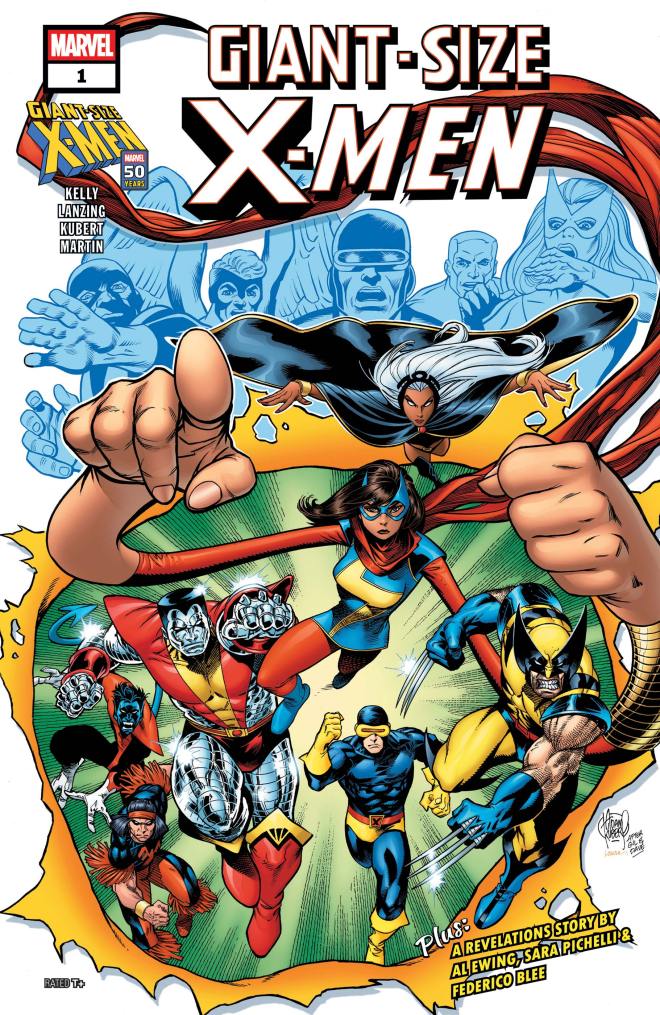
Ms. Marvel gets pulled into the past on a journey through X-Men history and a mission to stop Legion from rewriting it.
- This issue kicks off the X-Men’s summer anniversary celebration of the 50th anniversary of the original Giant-Size X-Men #1 from 1975 and the launch of the “All New, All Different” X-Men.
- It opens in the far future, with an unseen narrator speaking to Mother Askani, the leader of the Askani Sisterhood who brought Cable into the future; Mother Askani is the end point of Rachel Summer’s personal timeline.
- A group of (presumed) mutants in possession of Krakoa’s fossilized head attack a mysterious figure who turns out to be Legion aka David Haller aka Professor Xavier’s son.
- Legion was last seen operating as Nightcrawler’s sword (it was…a thing) during “Fall of the House of X”, though he has a history of mucking around in time and rewriting history, having launched “Age of Apocalypse” back in the 90s.
- In the present, sometime after NYX ended, Ms. Marvel gets pulled back in time while talking to Bruno (who is basically her “guy in the chair”).
- She lands during the events of Giant-Size X-Men #1, specifically the point between when the original X-Men have been captured by Krakoa, Cyclops has escaped, and Professor X has gathered the new X-Men but before the new X-Men journey back to Krakoa to rescue the old ones.
- Cyclops recognizes Ms. Marvel from their time together in the Champions; this is reference to the long-running late 2010s storyline where the original five X-Men were pulled out of the Silver Age and hung around in the modern day for a number of (publication) years before returning to their original time. The only problem with Cyclops (and Xavier, for that matter) recognizing her here is that when the O5 went back to their original time, it was done in a way that locked their memories of their time in the present away until they got older (ie reached the present day time). It was a neat way to both preserve established continuity but also preserve the character arcs the O5 underwent while in the present, but it means in situations like this, the O5 should still have no memories of their time in the future.

- It’s fun to see Adam Kubert drawing these characters in their classic looks (and drawing character he doesn’t often get to draw, like Sunfire and Banshee), but he uses a lot of sideways spreads in the back half of the issue that are more annoying than impactful.
- Ms. Marvel speaks to Krakoa using the Krakoan language developed during House of X, saying it was Krakoa’s language which Doug Ramsey/Cypher taught to the rest of the X-Men. Except it’s not; Doug is the only person who can talk directly to Krakoa, and the Krakoan language was created by him to serve as language for mutants. Krakoa in this comic should have no idea what the heck Ms. Marvel is saying to it.
- Ms. Marvel calling Krakoa a Giant Size X-Man is admittedly pretty cute.
- The issue concludes with the Ms. Marvel/Legion leading them into the events of “The Dark Phoenix Saga” (specifically early in X-Men #136), as the tour through the X-Men’s greatest hits continues.
This whole thing is kind of a mess. I’m a sucker for time travel/retrospective stuff, but between the continuity flubs (the Cyclops knowing Ms. Marvel thing really, really bugs me) and the use of Ms. Marvel as the POV character (which feels like both a product of Marvel’s continued efforts to shoehorn Ms. Marvel into the X-Men instead of letting her be her own thing and Lanzing & Kelly using her just because NYX got cancelled so why not?), it’s tough to get caught up in the story.
