
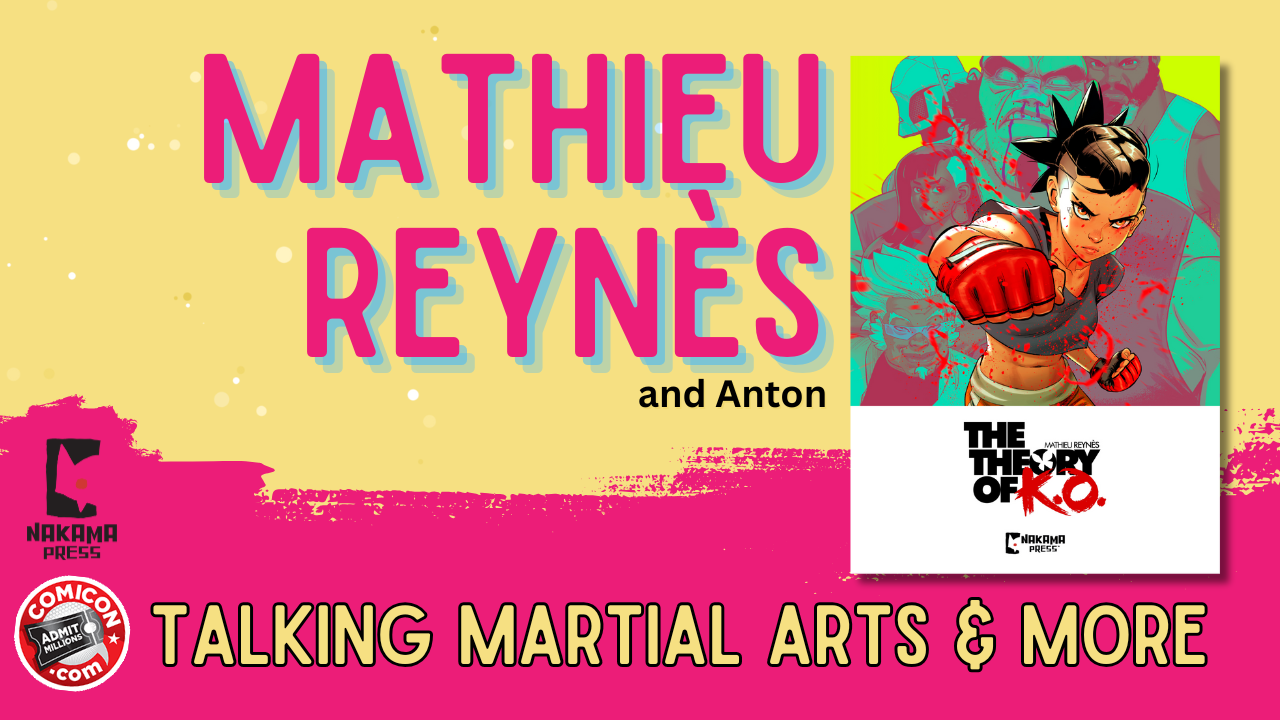
Anton Talks ‘The Theory Of K.O.’ With Mathieu Reynès
by Anton Kromoff
Welcome to the table,
When Mad Cave Studio sent me a first look at The Theory of K.O. — one of the titles from their new global storytelling imprint, Nakama Press — I got about a half a page scroll into the email before I contacted our fearless editorial team and told them I had to cover this book.
While a review of this fantastic graphic novel is incoming, I also had the opportunity to sit down with the creator of this delightful offering, Mathieu Reynès, and discuss this absolutely epic story.
You can find the full interview below.

Anton: Before we dig too deep into the story full of social commentary and solid body blows, can you tell our readers a bit about yourself?
Mathieu Reynès: I’m French and I live in the southwest of France, on the Atlantic coast, between the forest and the ocean. I’ve been a comic book author for almost 25 years. For a long time, I worked in collaboration with various writers and artists, but for the past ten years or so, I’ve been writing and drawing my own stories. Some of my books are already available in the USA — for example, Water Memory, for which I was only the writer, and the Harmony series, where I’m the sole creator.
Alongside that, I’m also a drummer in an amateur rock band, and I practice martial arts — we’ll probably get a chance to talk more about that later.
One last thing about me: I’m a vegetarian.
There you go, now you know everything.
The brilliant use of color, the dynamic pose, the guy with the robot head (more on Special Agent Echo in a bit) in the background … everything screamed “Anton…you will enjoy this!” While the cover sold me immediately, how would you describe The Theory of K.O. in a handful of words to someone who was on the fence about picking it up?
M: It’s hard for me to summarize my own series — I’m always afraid of saying too much and spoiling the surprise for the reader. I’d say The Theory of K.O. falls somewhere between Dragon Ball and Gunnm (Battle Angel Alita). It’s a speculative, almost dystopian series. Society has split in two, following numerous economic, health, and ecological crises.
To put it simply, there’s the modern world on one side, driven by consumption and economic growth, and on the other, a world more connected to nature, where people prioritize local and responsible economies.
Beck, the heroine of the series, grew up on a small island, raised and trained by her Sifu (martial art Master), completely cut off from the rest of the world — which he always told her to distrust. One day, her Sifu disappears. Left on her own, she decides to go looking for him. As she follows his trail, she eventually enters the underground world of combat sports. Along the way, she’ll discover the world she’s never known and start learning more about her Sifu … and about her own origins. This series is, above all, a coming-of-age journey.

I want to talk about page one. Not the brilliant kneeling image of our protagonist, Beck, or the table of contents, or the special thanks page, which is delightfully heartfelt. Instead, that first page! Where we see an image of the earth, and above it is one of the most thought-provoking passages I have seen in a while. The passage reads…
“We do not inherit the Earth from our ancestors, we borrow it from our children.”
Mathieu! I was expecting some kind of fist-fighting action romp, and from page one, you give me brilliant social commentary and beautiful existential philosophy on the nature of our world! What inspired this story? How did this whole thing come into existence?
M: With this series, I wanted to explore themes that matter deeply to me, not just limit myself to an adventure or action story. Even though martial arts and combat sports play an important role in the plot, I also wanted to talk about ecology and scientific ethics — to take a step back from our current world and imagine a possible future for our society.
I’m afraid for our future, and I feel ashamed of what we’re doing to the planet and to other living species. We’re sawing off the branch we’re sitting on, and if we don’t act very soon, it will surely break.
I’m not trying to lecture or moralize — just to share my concerns and convictions, to offer something to think about while still keeping the story fun and entertaining. Maybe plant a few seeds… (That word Seed is actually very important in the series.)

The world-building you manage to accomplish across a handful of pages at the beginning of the book is monumental. It hits so close to home, mirroring world events and social movements across all corners of the globe. From viruses causing pandemics that have been unlocked in melting icecaps and mismanaged by those with wealth who think they know more than those who are scraping by, the prologue of this work feels like it will serve as a time capsule of current events, if there are future generations around to enjoy it. Did you always have this setting in mind for the story, or did the tone of current events influence something you were already working on?
M: I’m aware that the introduction of this first volume is quite dense in information, but it felt important to establish that context.
I started writing the script before the arrival of COVID, and it was already dealing with a global health crisis. Then COVID happened — and it completely disrupted my story, as reality began to outpace the fiction I was writing! The media, the lies, the conspiracies, the so-called experts contradicting themselves from one day to the next, the restrictions, some people’s fear, others’ anger, everyone’s sense of helplessness, the race for vaccines… Using that context as a starting point quickly became obvious, and it gave the story more credibility, since we were all living through it. And we still are, aren’t we ?

Now, a bit about myself to explain what I am about to ask. I grew up in and out of hospitals. I had a multitude of surgeries and procedures as a child, and the majority of my interaction with the outside world, at least the parts that were pleasant, up-and-to-a-point, was through books, novels, and comics. Our protagonist of Theory of K.O., Beck, has a similar upbringing, although hers seems way more enjoyable. She was raised on an isolated island by a warrior scholar who taught her all manner of fighting techniques and provided her with a library of books to read. What inspired Beck and her origins?
M: I was a very shy and introverted child. I spent a lot of time alone, cut off from the world, drawing, reading comic books and manga, or watching TV. One of my idols was Bruce Lee — even though he died before I was born, I watched his films dozens of times. I was fascinated by his speed and fluidity of movement. I wanted to practice martial arts, but I was too shy and insecure to try.
It wasn’t until I turned 40 that I finally had the chance to start — and it completely changed my life. My teacher sensed my enthusiasm and motivation, and he helped me progress faster and further than the other students. He taught me a lot, both in the martial and philosophical aspects. Today, I assist him in class. I’ve also started teaching and passing on what I’ve learned to other students.
There’s a lot of me in Beck’s character.
A: The martial arts and hand-to-hand combat in The Theory of K.O. feel so authentic. Do you watch or practice any other hand-to-hand techniques?
M: I practice martial arts regularly (Viet Vo Dao, Tai Chi, and various traditional weapons), so I’m familiar with quite a few techniques. But more importantly, this practice helps me bring a certain logic to the way I design fight scenes — the flow of movements, blocks, and defenses.
I often strike poses in front of a mirror or record myself with my smartphone to capture the motion. Of course, I’m no expert, and I’m not 20 anymore, so thankfully there’s YouTube and Instagram for the more acrobatic references! These days, we have easy access to demonstrations from real athletes in the field.

A: Where did you draw inspiration for Beck’s fighting style?
M: Beck mainly uses techniques drawn from Kung Fu and Viet Vo Dao (two fairly similar martial arts), but also incorporates elements of Taekwondo and Muay Thai.
A: During an altercation, we get introduced to Special Agent Echo. Echo’s design is fantastic in every conceivable way, feeling to me like a fusion of old-school Shaw Brothers films and something out of Jet Set Radio Future. Where did you conjure up the inspiration for such a delightful and dynamic-looking character?
M: It’s funny that you mention this character. In fact, he’s taken on a much bigger role in the story than I originally planned in the first draft of the script. That often happens — some characters assert themselves naturally and force me to adjust the storyline to give them more space.
But it’s especially in volume 3, which I’m currently working on, that I really start developing this character.
I wanted a hybrid character with a very modern design — someone you can’t quite tell if they’re human or android — but who practices traditional hand-to-hand combat. He’s a special agent who doesn’t use firearms, only close combat. There are many influences behind this character: Gunnm, Appleseed … and also Judge Dredd, for his obsession with enforcing the law at all costs.

A: There is so much social and global worldbuilding that happens in between these pages, but I would be a fool to not call out the absolutely delightful fashion that you have managed to craft here. Normally, I find outfits and clothing in comics a little off-th- wall. Beautiful to look at, but nothing I, myself, could see being comfortable. The clothing in this book all looks so natural, so real. Where did you draw your fashion design elements from, because I need to go shopping for a new wardrobe inspired by this book?
M: I draw inspiration from streetwear fashion and martial arts outfits — it’s a mix of all that. There’s also a slight vintage or cyberpunk vibe at times. A retro-futuristic style. I think that in the future, with rising temperatures due to climate change, people will tend to wear loose, light, and comfortable clothing.
I have fun changing Beck’s outfits regularly throughout the story — after all, she’s a young woman discovering the world … and fashion!
A: Beck’s fight with Bolton introduces the concept of enhanced humans. Can you give us a bit more on what exactly would fall under the umbrella of an enhanced human? Would it be someone with a prosthetic leg? A pacemaker? What is the threshold that takes one from human to enhanced through body modification?
M: For me, the enhancement of the human body truly begins when the modifications — whether mechanical or genetic — are aimed at pushing performance beyond human standards, rather than compensating for a disability or deficiency. It starts when humans, driven by pride, attempt to go beyond the natural limits of their bodies through artificial means.

A: Without giving too much away, the story ends on a cliffhanger, leading us into lands unexplored by the reader. We also get a bit of what I feel must be a nod to what comes next with the quote…
“There are no truths, only beliefs.”
An absolutely genius way of hooking us for the next installment. Without giving us spoilers, what can we expect next for Beck?
M: Volume 2 takes place in the modern city of New Eden. Through Beck’s eyes, the reader will discover the other side of this divided world — its rules, its advantages, its flaws, its promises, and its lies. Several new characters will be introduced in this installment, and the reader will get to know Darwin Drake, one of the main characters of the series, in greater depth.
Beck will be faced with important choices — and as the saying goes: to choose is to give something up.
A: The Theory of K.O. is the kind of thing I would buy action figures and merchandise for. As a game designer, I have started working on small homebrew rules for the world because I want to keep enjoying it after I have put the book down. Where can our readers follow you in the digital space to keep up with the progress of the next chapters and all the other amazing work you are sure to be doing?
M: Thank you very much, I really appreciate it! I’m glad you enjoyed the first volume. I can’t wait to hold the English version too.
For now, I’m only active on one social media platform: Instagram.
I don’t post as regularly as I’d like — mainly due to lack of time and because I can’t share too much work-in-progress without spoiling the story — but it’s the best place to stay updated and see some of the color illustrations I share from time to time.
I reply to all messages, and I always welcome feedback on the book — whether positive or not (though I do prefer the positive ones!).
On the website www.theoryofko.com, you can find more about the series. You can read part of volume 2 (in French only), or visit my shop. You’ll also find responsibly made clothing from the series at the link.
Anton: Mathieu, I mean this from the bottom of my heart, The Theory of K.O. is one of those rare once-in-a-lifetime stories that I have no idea where it is going, but I know it is going to stick with me forever. I am so grateful you decided to put the time and effort into crafting it, and I can not wait to see what comes next. Thank you so much for taking the time to talk to me, and hopefully we can talk more soon.
Mathieu: Thanks again, Anton, it was a real pleasure talking with you. Volume 2 is scheduled for release next year with Nakama Press, if I’m not mistaken. I hope you’ll enjoy it just as much — and that it will leave you eager to read what comes next. I can already tell you that the cliffhanger at the end of Volume 1 is nothing compared to the one in Volume 2! 😉 I hope we’ll get the chance to talk about it again.
Until next time, check this book out it for sure rocks!
