
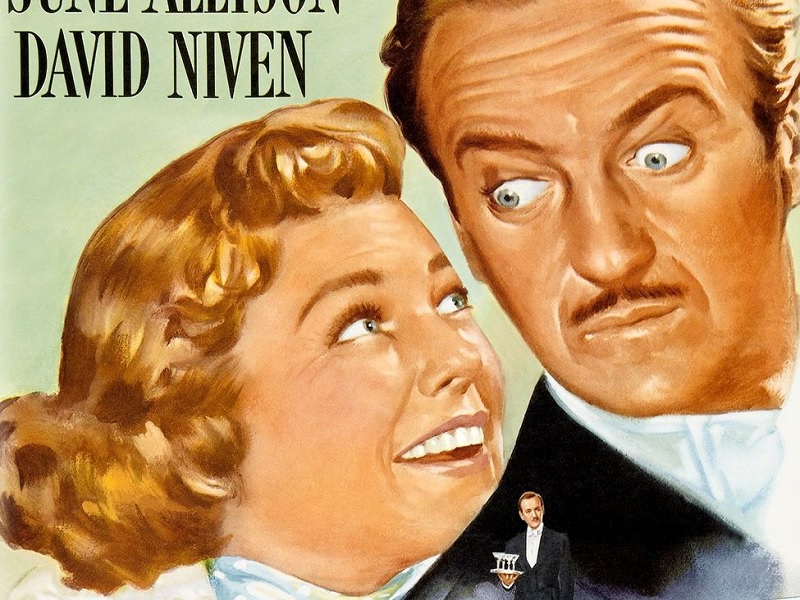
The Other ‘My Man Godfrey’ — Thoughts On The ’50s Remake
by Rachel Bellwoar
The compulsion to remake movies that never needed to be remade is far from a modern impulse. It was happening in the 1950s, too, with films like Henry Koster‘s My Man Godfrey (1957), a remake of Gregory La Cava‘s screwball comedy from 1936. Some remakes are easier to embrace than others (and often the ones that find fresh ways of approaching the material fare best), but the shadow of La Cava’s Godfrey hangs so heavily over Koster’s that it’s basically set-up to fail. The best it can achieve is being decent (which it is!), but it was always going to pale next to the original, plus some changes to Koster’s Godfrey make it feel toothless and without the social impact of La Cava’s.

In La Cava’s Godfrey, Irene (Carole Lombard) and Godfrey (William Powell) meet because Irene is looking for a “forgotten man” so she can beat her sister (Gail Patrick) in a scavenger hunt being hosted by the rich uppercrust (if the tactlessness of the items being searched for doesn’t already make that obvious). She later hires Godfrey to act as her family’s butler and chaos ensues.
Right off the bat, Koster’s Godfrey takes the punch out of this first interaction by having his Irene (June Allyson) be looking for an “animal” instead of the more insulting “forgotten man.” He also has her find Godfrey (David Niven) under the pier, alone, instead of as part of a homeless community living at the city dump.
Like the best cover artists, Allyson doesn’t try to copy Lombard. Her Irene sometimes feels more stable and put together than Lombard’s (who felt more zany and immature) but it’s a good performance from an actress who sometimes feels discounted or treated like the person who got hired because Judy Garland or Margaret Sullavan wasn’t available (her Jo March will always be my favorite of the Little Womens). Her matching costumes by Bill Thomas are sleek as well.
Unlike Niven, Allyson was the first choice to play Irene in this remake. As film critic Simon Abrams explains in his commentary, O. W. Fischer was originally slated to make his American film debut with this picture (and is the reason Godfrey was rewritten as Austrian), but when he was fired after two weeks of filming, Niven took over. His Godfrey comes across as a lot more stuffy and harsh than Powell’s. Maybe Powell’s Godfrey was more undercutting with his remarks that he knew would go over his audience’s head, but Niven’s Godfrey feels just as conservative as his employers. Here, for instance, it’s very clear that he’s on the run or hiding from someone (from his reaction to the boat at the pier). It takes a while to realize Powell’s Godfrey has a secret.
Niven’s attire and Navy cap look a lot less shabby (unlike La Cava’s Godfrey, Kostner’s film is color, too, which makes a difference). Most integrally, though, Powell’s Godfrey was critical of the rich, whereas Niven’s Godfrey can seem indifferent. Instead of addressing the homeless crisis in America, Kostner’s My Man Godfrey trades that storyline out for one about immigration — but one which approaches the topic from a place of privilege. This is the remake’s biggest flaw and while there are other characterizations that could be debated (a scarf does not an eccentric personality make and Misca Auer would’ve run circles around Jay Robinson, who plays Mrs. Bullock’s protégé in this version), it’s this change by screenwriters Peter Berneis, William Bowers, and Everett Freeman that feels the most egregious.
The only change that’s wholeheartedly for the remake’s better is the addition of Eva Gabor‘s character. In the original film, Godfrey is recognized by an old college chum (Alan Mowbray). Gabor’s Francesca fulfills that role here and electrifies every scene that she’s in.
My Man Godrey is available on Blu-ray now from Kino Lorber.
