
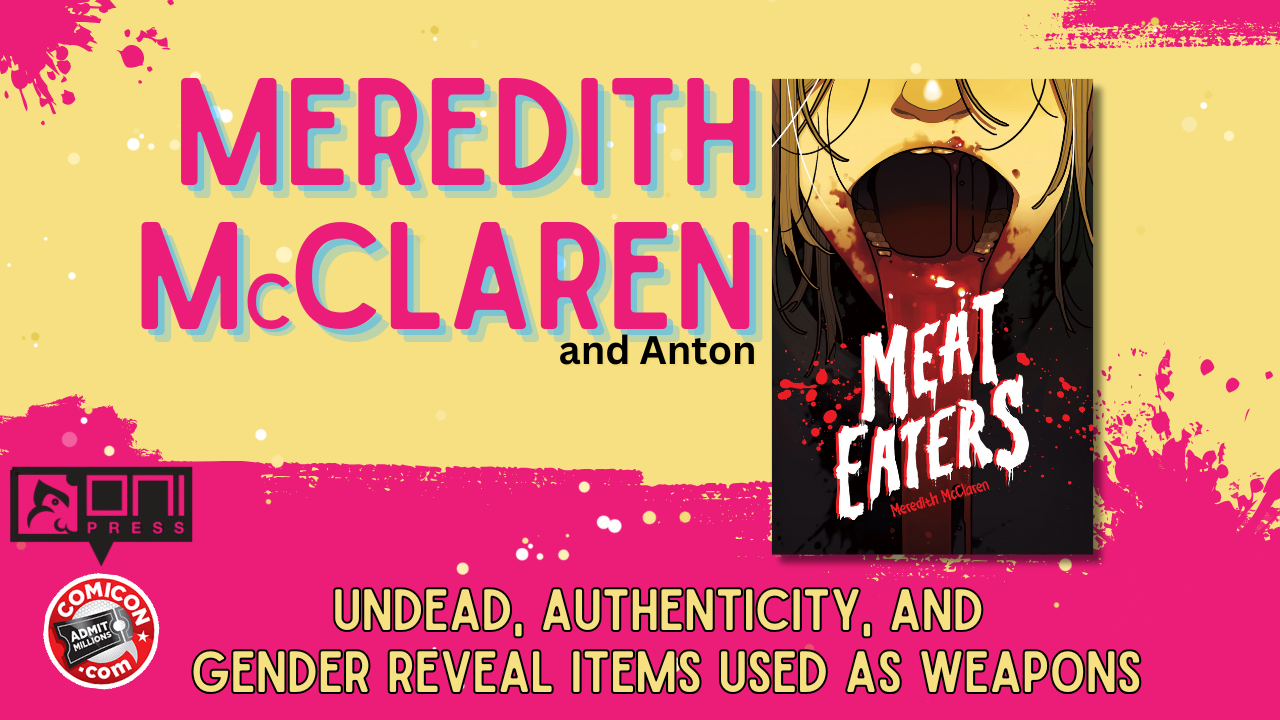
The Vulnerability Of Ghouls — Meredith McClaren Talks ‘Meat Eaters,’ Monsters, And More
by Anton Kromoff
Welcome to the table,
Meat Eaters is easily one of my favorite comics of all time. It’s authentic, beautiful, horrifying, and fun all blended in a way that is nothing short of life-affirming and memorable to a degree that it haunts me like a ghost I never want to leave. You can check out my full review at this link.
Below you will find my interview with the creator of Meat Eaters, the wildly talented artist, author, and baker, oh yes, she can throw down in the kitchen, Meredith McClaren. I’ve known Meredith for ages, and her work has never disappointed. While she has crafted some truly wonderful works, Meat Eaters is a revelation and has rightfully anchored itself in my “You must read this!” conversations, a place I’m sure it will have for ages to come.

Anton: Hey, Meredith! It’s always a delight talking to you, and being able to do so in this capacity is quite fun. I feel like we’ve known each other for ages now, but can you please tell our readers a little bit about yourself?
Meredith McClaren: Hello hello! (This is a bit different, isn’t it? ^_^)
My name is Meredith McClaren. I’m a comics creator out of the American southwest, where it is too hot to do anything but sit inside and doodle. I tinker around with lots of different genres but find myself in the fantasy/supernatural realism space most of the time.
Anton: When I say Meat Eaters is one of my favorite horror/supernatural books ever, I’m not being hyperbolic. The main character at one point fights a massive werewolf with a gender reveal popper from Amazon. If someone put that in white font, Arial Bold, on a black background and said, “This is all you get to know about this comic,” I would pre-order immediately. It’s so unhinged in all the best possible ways. What inspired you to tell this story of slightly unstable, yet very lovable, monsters stuck in a small town?
Meredith: This is very high praise indeed! I’m really blown away by how much everyone has loved MEAT EATERS. (I honestly don’t know how gender reveal items haven’t made it into the weapons category more…? They obviously wreak destruction on a very real and regular basis.)
But to get to your question. I’ve wanted to do something with the less glamourized undead for a long time. There’s something about being stuck in a body that is rapidly becoming unrecognizable that I feel is… honestly relatable. Especially as one goes further down the passage of life.
You could say the same thing about werewolves, of course. The loss of control. But with werewolves there’s a whole power fantasy crouched in. I think a lot of people would take the good and the bad if given the opportunity to be a werewolf. And then vampires get to be sexy all the time these days…
But with a ghoul or zombie entity, there’s no allure to it. The only promise there is that you’re falling apart. And unfortunately, I think that’s a state many of us are more than familiar with.
Anton: Relationships where everyone knows everyone and has since they were kids really drive a lot of the interaction in this story. The setting feels so authentic and relatable, even with the strange supernatural elements that lace the edges of its reality. Is the town of Twill and its inhabitants based on a real-world place?
Meredith: Only barely.
I’m really truly pleased that people find the setting of Twill relatable, because I’ve spent MOST of my life in city settings. The closest I’ve come to a small environment is maybe while I was in Savannah, GA for school. And it only really felt that way because I didn’t have access to a car. Mostly I just tried to find something true from the insular environments I experienced growing up and pushed that outwards. It helps that I’m very self-contained socially. So even though I live in a big city, I have my fishbowl.
That I have managed to make Twill resonate in any sort of way to the people who HAVE grown up in smaller settings is a huge compliment. Though, if I’m lucky enough to dive into Twill again, I think I would benefit from holing up in a small town for a little bit to get a better grasp.

Anton: Ashley, the protagonist of this bloody tale, is a ghoul. I feel like I have spent countless hours between game design and my own research for fun categorizing the various undead folklore and mythos of the world, and ghouls are easily in my top three favorites, alongside lichs and revenants. With ghouls, in my humble opinion, very rarely getting the attention in pop culture spaces they deserve, what drew you to pick a ghoul as a protagonist?
Meredith: I touched on it a bit earlier, but ghouls feel… vulnerable, I think? Yes, they’ll kill you and eat you. They are monsters. But they don’t get to benefit from the same power fantasies of other undead creatures.
I’m usually drawn to the unlikely characters. The ones that don’t have the advantages. The ones that have to try harder or be smarter. The ones you don’t expect to win. They’re not weak, they’re just, you know, not ‘special.’ And I think other people are drawn to those characters too, because it makes you feel like doing something extraordinary, something powerful, is within reach. You can be ordinary and still do the remarkable.

Anton: I’m going to get a bit existential for a second. Ashley is accompanied by two werewolves, Motley and Harrison, who are, without a doubt, the most endearing characters I’ve encountered in quite some time. Both seem fairly comfortable in their shiftable skin, navigating life as supernatural creatures with relative ease, but Motley, the more vocal of the two, seems to be in this headspace where she is becoming disillusioned with the messaging that comes from popular media. Parties are not always “fun.”
Some beers taste awful regardless of how much the branding makes you think it’s “the best.” Motley has this feeling that she is becoming her own person, a transition that, seemingly in the confines of this story, is way more difficult than becoming a toothsome furrball. Was the social commentary intentional, or am I just projecting my own struggles with not always enjoying things as much as the ads tell me I should?
Meredith: It was definitely intentional. I went through a lot of my middle grade and high school years thinking I would ‘get’ something when I finally went to college. Something would click. And I’d want the parties, and the romance, and the beer. The stuff television and books were telling me it was normal to want. It was very sobering to get to college and realize I was the same person there as I was when I left home.
And I think it’s part of the maturing process that’s talked about less. Not just finding the stuff you like but accepting the things that don’t do it for you. It’s difficult, especially when you’re being told from multiple influences, that ‘this’ is what ‘everyone’ wants. Makes it feel like you’re an outlier. Makes you feel a little less normal.
I wanted a space to say: ‘This is not as unusual as you think.’

Anton: There is a one-sided conversation of closure towards the end of the book that hit me like a ton of bricks. I didn’t see it coming. It made me cry. It’s so emotionally raw that it haunts me, probably more than any monster or mythos could. While this is a story of coming-of-age characters, skin-ripping body horror, and light-hearted zombie jokes, there is such a deep emotional center that lives at the core of this work.
I’m not going to spoil anything because I really want people to go pick up this book and experience it for the journey it is. I do want to ask, though, was the “origins” of Ashley’s current existence always the way it plays out in the story? Or were there other versions of how she became what she has become that got scrapped for the version that landed on the page?
Meredith: There were other versions. In one of the very early iterations of the story, there was a very clear intentional reason why Ashley became a ghoul. But that was a very different story and would have gone in a very different direction. When I finally got to THIS Ashley, the themes had shifted a bit. There’s a theme of ambiguousness to this Ashley’s world that required different kinds of answers. Or non-answers.
(When people read it, they’ll hopefully get what I mean.) I don’t know. I’m not sure how to talk about it without giving anything away either. Except that it suits the narrative at play that ‘sometimes bad things happen for no real good reason. And sometimes there’s no real good reason that you survive it either.’ Isn’t that frustrating?

Anton: This story is very small in the geographical sense, but the world feels very rich and lived in. Is there a possibility of us getting to see more stories told in this setting in the future?
Meredith: I have definitely tinkered with more ideas. There’s always a lot more to explore.
I’m told it’s polite to wait a minute before inquiring about a sequel, though. 😉
Anton: Okay, I’m almost out of time for now. Before we wrap up, thank you for taking the time to talk to me. Your work and perspective have been, are, and will always be something I look forward to. Before we go, could you tell our readers the best place they can keep up with you and your work?
Meredith: I always love talking with youuuuuu!
And yes!
I’m on Instagram and Bluesky at: @iniquitousfish.
Tumblr is: https://meredithmcclaren.tumblr.com/
And Patreon is: patreon.com/meredithmcclaren
Anton: Meat Eaters, published by Oni Press, is now on sale wherever rad books are sold. Until next time, Thanks again!
M: Thank you!
 Until next time, I can’t state this enough. Meat Eaters is brilliant, beautiful, and brutal. It breathes, it is, it exists in a way that elevates not only horror storytelling in sequential form, but also has some deeply profound moments that leave you with the sense you have glimpsed something authentic in a world that tells you what you should be drinking, or eating, or doing. This is a work of art.

