
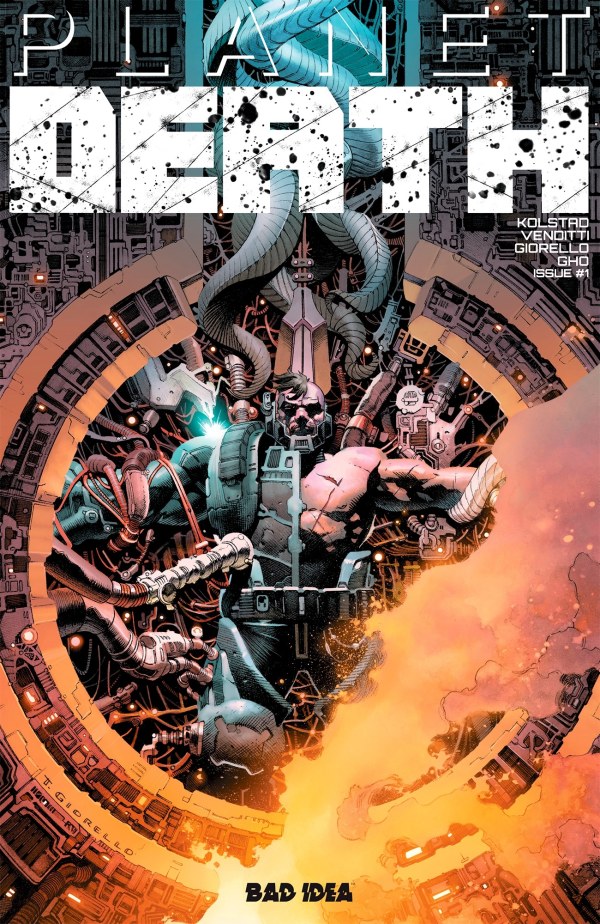
‘Planet Death’ #1 Review — Big On Gorgeous Visuals, Light On Plot
by Austin Gorton
Overview
Planet Death #1 is one of the best looking comics in a long time, with detailed linework, rich, subtly deployed colors, and smart layouts. That’s all it is — developments in plot, character and theme are rudimentary, at best — but it’s enough for now.
Overall
8/10Like the prescient zero issue which preceded it, Planet Death #1 is a comic with exceptional visuals and very little else. In terms of plot, character, and theme, there is the barest of barebones developments. But every single panel and page is a feast for the eyes. That is not going to be enough to make this series a success — but the art alone is good enough to earn it the benefit of the doubt, and make this first issue a success.

The plot — what there is of it — is straightforward enough. An attack force of space marines arrive in orbit around an alien world, descend on the planet in a scene out of Band of Brothers or Edge of Tomorrow and are quickly annihilated in the face of overwhelming opposition, leaving one sole survivor to complete the mission — robotically repeated throughout the issue by the soldiers as “destroy the weapon, return home.”
What little we learn about the presumed protagonist — one of the soldiers named Scott — we learn in the course of a three-panel flashback. He has a wife and daughter and, at least, memories of an idyllic home. Shakespeare, it’s not.

But in addition to the art, there’s glimmers of hope even in the barebones plot and characterization. The origins of the conflict, what drove humans to invade this alien world and so obviously underestimate their foes, aren’t detailed, but by deploying those tropes, Planet Death #1 at least uses our familiarity with these kinds of stories to at least suggest some directions this story may go.
The weapon/home mantra is repeated so often and so mechanically that it’s clearly programmed, implying some level of indoctrination in the soldiers. Combined with the talk of “regen baths” and the fragmented memories of the troops, it’s clear that not all is as it seems. The imagery of ships arriving on the shores of an “other” locale and spewing similar-looking soldiers at a less homogenized Other defending their home world taps into the iconography of Imperialism — whether the story is ultimately, pro or anti-imperialism, it’s too early to tell. None of this is heavy in the text, but it’s there. Any port in a storm.
But the selling point of the issue — and what makes it worth reading — is the art from Tomas Giorello. Planet Death #1 is one of the best looking comics I’ve read in a long time. Every panel is packed with detail, from the innerworkings of the ship as the naked soldiers are dropped into their battle suits assembly line-style to the varied mix of alien designs and weapons in the horde that meets the soldiers on the ground, to the way Giorello manages to make all the human soldiers look the same but just different enough that we can still follow our protagonist.
He also varies the pace of the action, alternating between large splashes for maximum impact with smaller sequential panels that keeps the whole story from unfolding too fast. You want to slow down and pour over each panel, and the layouts support this inclination, rather than fight it by just throwing everything into a successive series of full page spreads.

Art alone isn’t enough to make a good comic book story — no matter how great that art is. If the entirety of Planet Death turns out to be as thin on plot, characterization and theme as this issue, it will be hard to laud it as a success. But as a first issue, the starting point of the series and a table-setter for the kind of story this is going to be — i.e. an art-forward one — this works, even as it is light on everything else.

