
Previously On X-Men: “Age Of Revelation” Is Nigh in ‘X-Men’ #22
by Austin Gorton
Sentinel graveyards, cosmic shenanigans, aborted handshakes and more in this week’s X-books, as “Age of Revelation” looms ever larger.
Astonishing X-Men #37 by Tim Seeley & Edoardo Audino
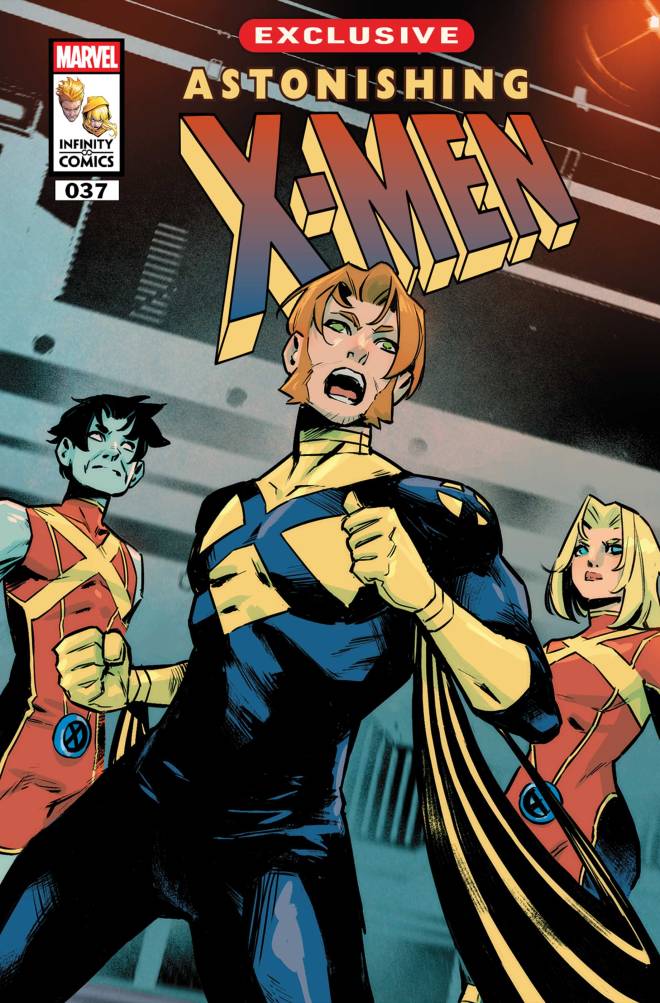
Banshee foils Changeling’s attempts to trigger a nuclear war.
- Changeling’s whole plan is predicated on a ridiculous amount of stupidity; he gains access to the military base using the face of a former SHIELD agent, who, despite being known to be deceased — for twenty years — to the general in charge still has full access to the base? Even for comics, this stretches credulity.
- I do like that the general in question has a relatively moderate view on mutants, acknowledging that they can both be good and bad while remaining hopeful that the good will help stop the bad.
- Changeling’s rant about the number of mutants scattered and looking for a place in the wake of Krakoa’s fall fits broadly into the whole gist of “From the Ashes”, for what it’s worth.

- In the end, a defeated Changeling/Morph is left in military custody; I wouldn’t mind Seeley using him again in this series (or the character popping up elsewhere).
A perfectly fine conclusion to an utterly ludicrous plot. Playing around with Silver Age villain Changeling is right in my wheelhouse, but I would have liked it been done in service of a story with fewer leaps in logic.
Emma Frost: The White Queen #4 by Amy Chu & Andrea Di Vito

With the unexpected help of Mystique, Emma sets her sights on Sebastian Shaw.
- Emma running into Esther Morgan — a former rich girl now living on the streets — opens the issue on an oddly melancholy note, though the idea of a mutant with a useless power (Esther can change the color of water) is always fun.

- I believe this is the first time we’ve seen or heard of a Hellfire Club in Las Vegas. Similarly, its head, Azzedine, is appearing for what I believe is the first time.
- The Sentinel graveyard where Emma gets dumped is likely a testing ground for Sebastian Shaw’s Sentinels (which, as Mystique points out, he is producing for the government at this point in time).
- This is the first real justification the plot has provided to justify the series being set after Uncanny X-Men #138 vs some other point in Emma’s villainous past, as by Uncanny X-Men #151 she is aware of Shaw’s role in the creation of new Sentinels.
- Mystique and Destiny’s (off-panel) appearance working against Shaw fits for this era as well, coming at the height of their pro-mutant, anti-human, “let’s assassinate Senator Kelly and kick off Days of Future Past” leadership of the Brotherhood of Evil Mutants.
It’s fine. The push back to Shaw from Mystique gives the story some much needed direction and narrative thrust, but it feels less like an organic development and more like a case of the final issue looming.
Spider-Man & Wolverine #5 by Marc Guggenheim & Kaare Andrews
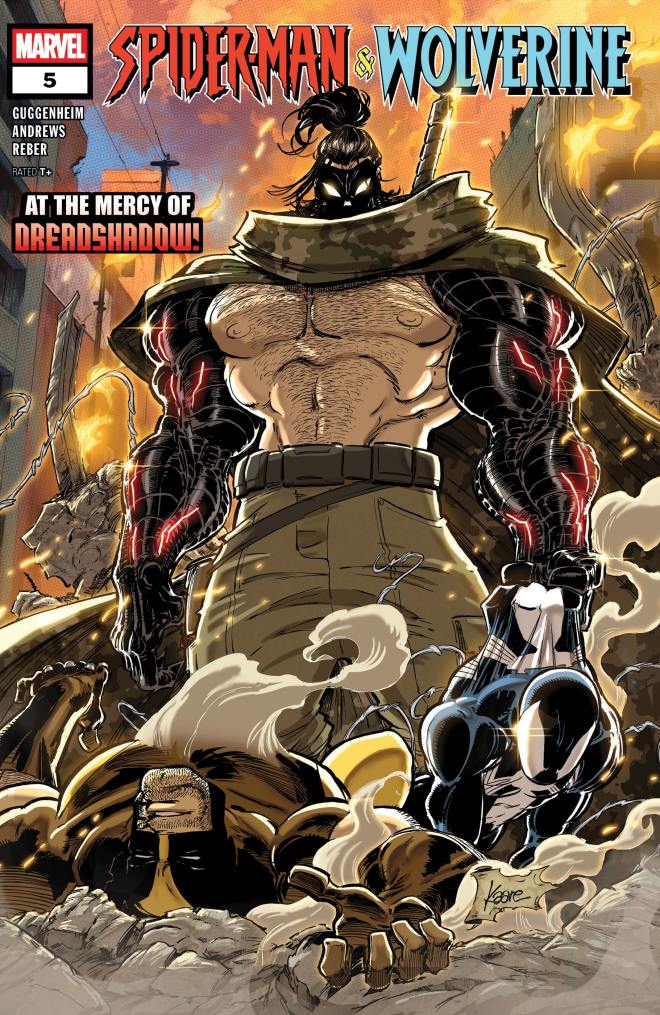
Dreadshadow is defeated as new truths about Spider-Man and Wolverine’s past are revealed.
- It’s not like anyone expected Wolverine to die in this series, but the “he’s been shot by bullets made of the one thing that can kill him!” cliffhanger gets resolved awfully easily – it doesn’t even get addressed until halfway through the issue when he tosses off a line about his healing factor working against them.
- When Dreadshadow shows up and Spider-Man says, “ugh this guy again” speaking for the readers.
- It turns out Dreadshadow is a SHIELD agent whose daughter was killed when a super-villain Spider-Man and Wolverine stopped but didn’t kill later escaped custody. Which as these things go is fine, but it doesn’t really explain how he got his 90s metal arms or why he doesn’t want his costume to involve a shirt.
- The Enforcer — the villain who killed Dreadshadow’s daughter — is a relatively minor late 70s villain probably most well-known for being one of the victims of the Scourge of the Underworld; he was killed in Iron Man #194.
- As with recent in-universe cosplay in Uncanny X-Men, the flashback to Dreadshadow learning about Wolverine and Spider-Man’s scenes features images that would only be known to people reading their adventures, not anyone in-universe (such as Wolverine being crucified on the cover of Uncanny X-Men #251 or Spider-Man lifting heavy debris off himself in Amazing Spider-Man #33).

- Wolverine declares that he doesn’t, “have the first clue what point you’re trying to make” about Dreadshadow; funny, but it’s rarely a good idea to underscore how your villain’s goal makes no sense.
- Of course, in the end, Wolverine is exonerated of any wrong doing in the deaths of Spider-Man’s parents by the uncorrupted footage of their plane crash, while the question of Teresa’s parentage (first raised in Giant-Size Amazing Spider-Man: Chameleon Conspiracy #1) is brought up again.
- We also get a tease of a possible Doc Ock/Kraven/Mysterio/Omega Red…uh, Frightful Four, I guess?
The book’s first arc/trade paperback collection (I guess this is an ongoing series?) concludes in a manner consistent with its earlier issues: art-heavy and largely nonsensical. Even Guggenheim seems to be shrugging his shoulders when it comes to whatever point this story is trying to make. But if Andrews’ art is your thing, it gets the job done, and while Dreadshadow doesn’t seem to be a parodic character, it’s hard not to enjoy him as an avatar of gonzo early Image creations, especially given the way Andrews’ style is channeling a similar energy.
Storm #12 by Murewa Ayodele & Mario Santoro
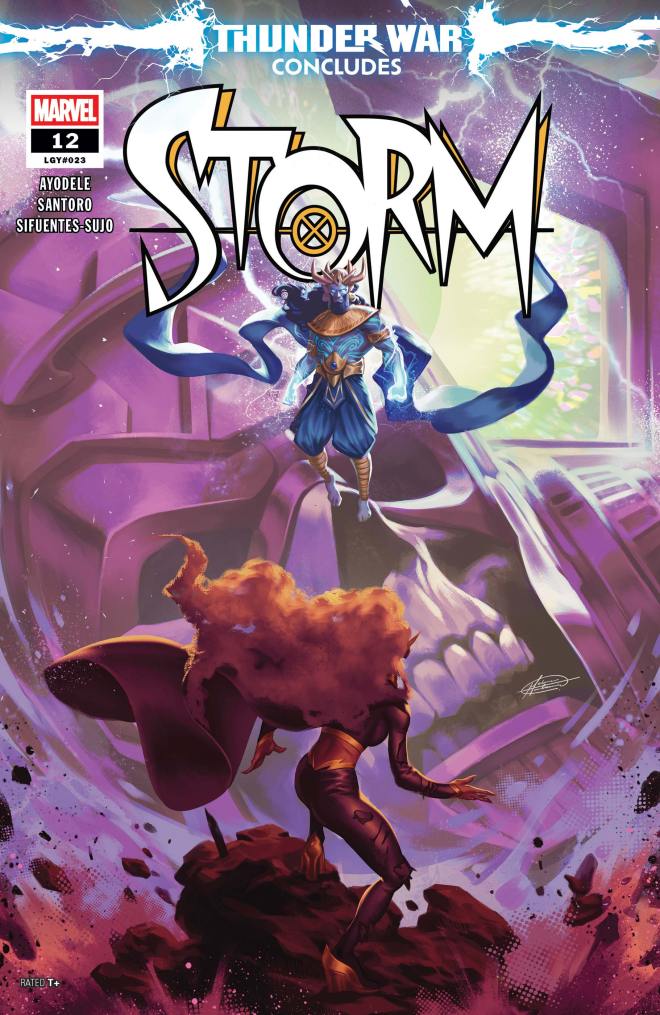
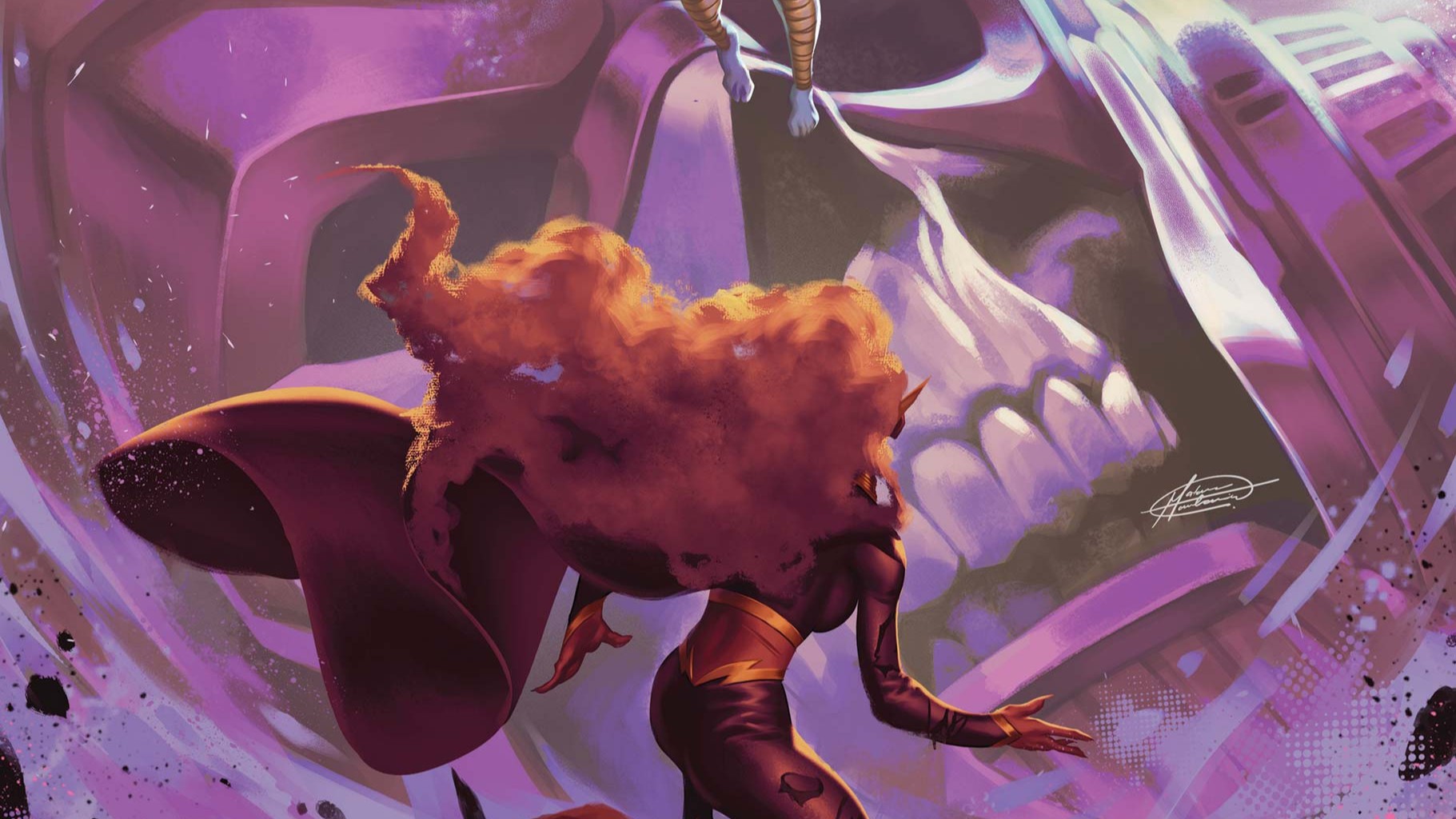
The conclusion of “Thunder War” — and this “season” of the book.
- Lucas Werneck is still MIA, and the issue suffers for it.
- Zombie versions of Gorr the God Butcher, Sentry and Martyr are all seen hanging around Death’s realm as she deals with Doctor Voodoo in the opening pages.
- We also see Armor feeding hippos at Storm’s sanctuary, the Alaska X-Men playing baseball, and the Louisiana X-Men having some kind of boil (crawfish) as the Storm/Harada fight rages. On the one hand, Ayodele uses this to explain why the X-Men aren’t helping Storm (Rogue says she’s got it), but on the other hand…shouldn’t they help her?
- This issue once again deploys the technique of using sound effects that are description of the moves being deployed in the fight (like “jawbreaker!” as Hadad punches Storm in the jaw).
- Things get even more metatextual than usual whenever Marvel God aka The One Above All gets involved, with The One Above All effectively standing in as collective representation of Marvel creators and Eternity talking about the “House of Ideas”, with Hadad angry about his discovery that all their lives are but “comical books” in an endless library to be marveled at.
- The One Above All points out that some of Eternity’s creations have found ways to converse with him; we can see the Fantastic Four, Thanos and Adam Warlock, and someone wearing a jacket and cargo pants (Starlord? Maybe Bruce Banner?).

- Storm notes that she’s been trained in various martial arts by Black Panther (her ex-husband), Wolverine (her longtime X-Men teammate) and Shang-Chi (not sure when specifically that would have occurred).
- This marks the final issue of the series; it will return as Rogue Storm for “Age of Revelation” and then survive the general “From the Ashes” culling to come back after that with a new #1 issue in January, which Ayodele is likening to the series’ second season in the letters page.
- As such, the sequence involving Brother Voodoo in Death’s realm is meant to setup the next big arc, the “War Above All”, with Death looking to overthrow The One Above All, angry about the death of Oblivion (who is Death’s twin). Curiously, Incredible Hulk #29 recently concluded with the Mother of Horrors kidnapping Doctor Voodoo so that she could overthrow The One Above All as well; it sure seems like Marvel could use some professional editors).
- In the end, the “Thunder War” as told across the twelve issues of this series roughly breaks down to being the result an ongoing conflict between Eternity and Oblivion, two manifestations of opposing states of being, involving trials by combat overseen by The One Above All and carried out by champions fighting in their stead which led to the creation, by Eternity, of the Elder Gods and the Storm Gods in turn, all in an effort to win out over Oblivion. Eventually, one of those Storm Gods, Hadad, became host to Eternity and grew in power such that, angry at the realization that all existence was a fictional construct, he challenged The One Above All himself and was imprisoned in Oblivion. Sometime later, Storm gets drafted when the latest Eternity/Oblivion challenge requires Eternity to select a new champion and he chooses Storm, possessing her. Eternity then proceeds to use Abaraxas to assassinate Oblivion before their trial (because he keeps losing); this backfires when Abraxas fails and Oblivion releases Hadad as punishment. Hadad then kills Oblivion and continues his mission of trying to destroy all existence using a horde of Black Winters (which were stopped only by Oblivion in his previous attacks). With the other Storm Gods mostly siding with Hadad in a fit of pique over Eternity choosing a mortal as champion over them, Storm is forced to fight Hadad as Eternity bargains with the One Above All, who eventually gets him to take a different approach with Storm, giving her access to his power to use against Hadad rather than merely controlling Storm as a vessel. Storm thus defeats Hadad because she’s, essentially, awesome, but rather than imprison him in a pocket dimension, Eternity resumes full control and kills him, after which Storm manages to somehow eject Eternity from her body once and for all.
That all sounds a lot cooler and straightforward laid out than in the jumble of flashbacks, flashforwards and present day events depicted across the series — and even that summation is leaving out a lot. The big climax in this issue (and honestly, some of the earlier plot beats) is also hampered by the serviceable art by Santoro, which does the job, but reduces what is meant to be a grand, sprawling conflict into a standard superhero punch-’em-up, with little of the artistic verve of some earlier chapters. The final declaration of Storm’s awesomeness (and her ongoing disdain for the role of Eternity’s champion) aside, the plot also curiously makes Storm something of a bystander in her own book, in which things happen to her but she is rarely the one driving the action. Ultimately, the character arc of this story belongs to Eternity; he’s the one who learns the lessons and comes out of it different than when he went into it. Storm is just along for the ride, as much a vehicle for the story the writer wants to tell as a vessel for Eternity’s power.
That said, Ayodele clearly does have a story to tell, and a take on the character and the cosmic side of Marvel that feels personal (or at least, distinctive). Even if I don’t always agree with that take or enjoy the storytelling approach (which seems designed to be as obtuse as possible, to minimal benefit), this first volume of Storm is at least consistent in being one of the few “From the Ashes” trying to do something other than “exist.” Still, it would be nice if the next volume of the series was less “petty feuds of personifications of abstract concepts” and more “Storm riding war hippos.”
X-Men #22 by Jed MacKay & CF Villa – Book of the Week
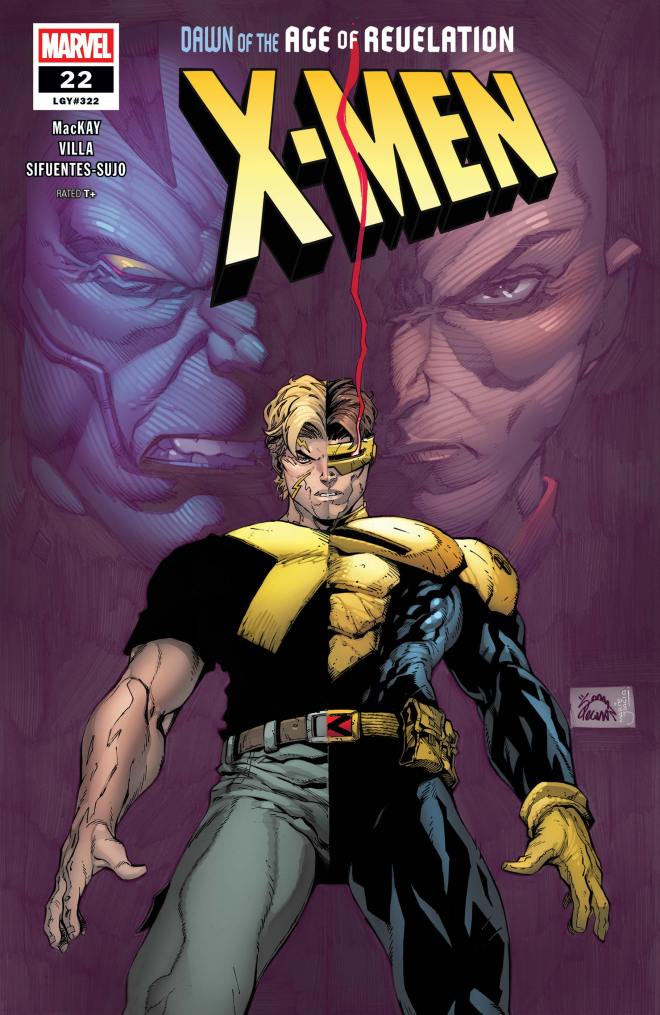
With the X-Men dealing with the fallout of Cyclops’ encounter with Agent Lundqvist and the recent battle with the Upstarts, Doug Ramsey shows up on their doorstep — just as the “Age of Revelation” begins.
- Cyclops clocking that Illyana is putting on airs when she springs him from jail as a cover for the fact that she led a questionable mission in his absence last issue is a nice bit of continuity with her solo series (however accidentally), which played around with the idea that her “too cool for school demon sorceress routine” is something of a mask she wears.
- Fitzroy mocks the X-Men for falling so low as to imprison their own kind, as though that’s not something they’d done as recently as the Krakoa Era, in which Temper — to whom Fitzroy is talking — amongst others were sentenced to the Pit (a prison) for extended periods of time (they also had a brig on Utopia, and kept Sabretooth in a cell in the mansion throughout the mid 90s for a decent chunk of time, to name a few other examples).
- Fitzroy is being given to King Bedlam as payment for his Hellions helping the X-Men in issue #10. He wants revenge on Fitzroy for killing Tarot, one of the Hellions (whom Fitzroy killed in Uncanny X-Men #281-282) who was established as having been a childhood romance of Bedlam’s in X-Force #87-90. Yet that story also featured Tarot being resurrected, after which she died and came back a few more times, which makes Bedlam still carrying the grudge against Fitzroy here a little odd.
- We get an appreciated bit of fallout from Juggernaut’s relatively cold-blooded killing of Ocelot last issue (he says here he did it to end Ocelot’s threat, but he’s clearly rationalizing to cover the fact he was goaded into it by Ocelot).
- That said, the general notion of the X-Men not killing, ever, is long out of date, even if it is being espoused by the New Defenders Era Beast.
- The “Second Iron Night” Cyclops references here is presumably the 3K X-Men story from issues #14-18, when Magneto used the Sentinel as armor to fight a kaiju.
- Villa’s work on this book has often felt like a perfectly cromulent placeholder for when Ryan Stegman needed a break, but its particularly effective here in making a very talk-heavy issue visually engaging; it also a little bit of a looser, less cartoony style to it, even somewhat approximating Pepe Larraz in a few places.

- Cyclops says that the X-Men have never been a democracy before launching a vote on Doug’s admittance to the team; all else aside, the X-Men were famously democratic not that long ago, when they held three annual (in real time) elections amongst the citizens of Krakoa to appoint a roster of X-Men, each election being featured as part of the Hellfire Galas and being marketed online (Glob dressed up as Steve Kornacki!), with the final one kicking off the “Fall of X” as Nimrod massacred the last newly elected roster.
- Doug comparing his relationship to Apocalypse with that between Cyclops and Professor X is a good way to get Cyclops to believeably buy-in despite what we know is coming in “Age of Revelation”.
- The closing panels involve the mind of future Cyclops landing in past Cyclops’ body, making “Age of Revelation” a sort of reverse “Days of Future Past” where the effort to prevent the horrific alternate future from coming to pass unfolds in the future rather than the present.
- Notably, Xorn’s telling of Revelation’s history in the earlier Age of Revelation one-shot shows Cyclops and Doug shaking hands when Doug joins the team, an action interrupted here by the arrival of future Cyclops’ psyche, so we’re already seeing divergences in the “original” history unfold.
- Not surprisingly since AoR is largely spinning out of MacKay’s story, but this is really the only issue to directly setup the new event on a level similar to the previous “Age of Apocalypse” lead-ins.
- This series will become Amazing X-Men for the duration of the event.
Easily the best AoR lead-in, both in terms of, you know, actually leading into it and making it somewhat intriguing by tapping into what we already know of the event to dramatize this pivotal make-or-break moment for the ensuing timeline. I can quibble with MacKay’s knowledge of X-lore a bit here but he’s at least putting in some effort to establish the stakes and conflicts of “Age of Revelation”, and Villa turns in some of his best work yet.
