An Interview With The Co-Editors Of IDW’s ‘The Twilight Zone’ Series
by Rachel Bellwoar
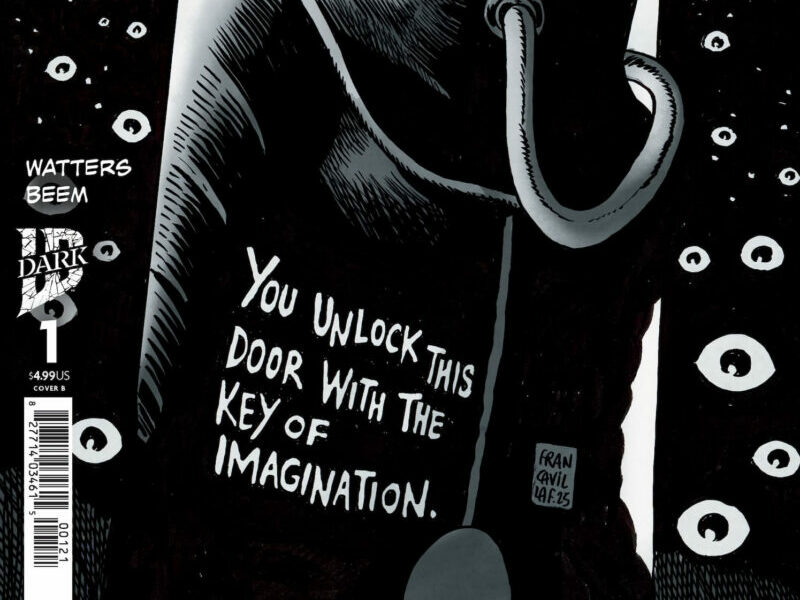
Perhaps no anthology series has had the impact and longivity that Rod Serling‘s The Twilight Zone has had. True to the spirit of the original show, IDW’s new four-issue anthology series launched last month with a story by Dan Watters, Morgan Beem, and letterer Sandy Tanaka. For more on what fans can expect, check out this interview with co-editors, Nicolas Niño and Ellen Boener, below:

Rachel Bellwoar: The very nature of anthology shows is every episode can be different but do you think there are certain traits that all Twilight Zone episodes share?
Ellen Boener: When you talk about what makes something The Twilight Zone, you have to talk about the “twists.” The twist can’t just be a reversal of expectations. It needs to unravel the human flaw at the heart of the story. Either the protagonist or the world around them is flawed and the twist is (ironically) untangling that mistake for the audience by revealing its true context. Another key thing about the 1960s TV show for modern audiences is nostalgic escapism. We can escape into the long-ago black and white world while confronting human flaws. The genius of the original show was its ability to dissect society while hiding it with a distorted sci-fi lens. It was born out of necessity to avoid censorship in the 60s, but it honed the storytelling into its iconic subtle tone.
Nicolas Niño: Extraordinary things happening to ordinary people and how they react — that’s ultimately what the show is. Seeing a regular person gaslit by a monster on an airplane wing is scary because that person reacts how most people would. They go insane! That relatability is the real key to The Twilight Zone’s longevity. Tastes, technologies, methods of storytelling, have all changed in the 60+ decades since the show’s debut; and it still finds fans because each episode is about one person and their understandable reactions to impossible scenarios.
Bellwoar: How was it adapting a television show for comics?
Boener: TV and comics are kindred spirits in my mind. They’re both episodic storytelling formats that are inherently visual. Anthologies are effective in both mediums. The narration was easy to translate too. However, it was crucial for us to find ways the comic could expand on what the TV show was able to do. We aren’t limited by a props and make-up budget. Our artists can take these stories wherever they want and include as many wild creatures as we can think of. Comic visuals have “unlimited sfx” compared to a ’60s TV show. So we pushed it to the limits!
Niño: It’s been really fun! Mostly, because we’re not so much adapting anything as we are continuing it. Our goal with this series was to develop a comic that could act as a spiritual sequel to the original show.

Bellwoar: For this series, did you want to focus on original ideas or will there be issues that remake old episodes?
Boener: We focused on original ideas for this series because we wanted it to feel like new episodes picking up from where the show left off. Remakes are a possibility, but the original episodes are so excellent it would be tough to top them. We want this anthology to explore The Twilight Zone in a way that’s unique to comics.
Niño: Our goal wasn’t to remake or retell old episodes and — more importantly — it’s not a selling point for any of the creators on this series. Each of these creators was excited to tell their own Twilight Zone story, to play in the sandbox of the show. Truthfully, I think that’s the best way to pay homage to the show and entice fans of The Twilight Zone and of comics.
Bellwoar: What about the decision to make all the issues black and white– was that always a given?
Boener: Making the issues black and white was one of the first things we decided. It didn’t even feel like a choice really! I instinctually felt that “Of course! That’s how the show looked. That’s how the comic should look.” The trick was figuring out how much of the comic we could make grayscale. Comic covers and ads are famously colorful, but we knew that if we were going to do it right, everything from cover to cover had to be black and white.
Niño: One hundred percent. Doing the series in black-and-white was the first thing Ellen and I discussed, and it was never a question. The black-and-white art signals to the reader what kind of Twilight Zone project this is. The series doesn’t reimagine the concept or break any core tenets of the franchise for the sake of being different. It’s a project that taps into the spirit of the original show. From there, we got so excited to work on a comic that looks so different from most western comics.

Bellwoar: How involved were you with putting the creative teams together for each issue?
Boener: Nic and I were mindmelding for the entire casting process. We were tossing names back and forth for months. It was so fun to brainstorm all the writers and artists we’d want to see take on the series. There was a long wishlist of creatives and I hope we get all of them on issues eventually!
Niño: Assembling the team was all Ellen and me. It’s the most fun part of an anthology; evaluating who you’d like to work with and who is best suited for the project. My favorite part of this job is casting. Getting to facilitate more great comics by the best cartoonists in the industry is so cool. It’s why, if someone is too busy to participate, I can’t be that disappointed—it means they already have comics in the pipeline!
Were there any episodes of The Twilight Zone that you rewatched in preparation or that you consider to be personal favorites?
Boener: I was absorbing as much of the show as possible while we worked on the comics. Rewatching “Eye of the Beholder” specifically jumps out to me. It’s one of the most visually striking episodes and the script is so tight. Simple, iconic, classic Twilight Zone.
Niño: I totally threw on a bunch of my favorites. “To Serve Man,” “The Hitch-Hiker,” “Nightmare at 20,000 Feet.” They were episodes that left an impression on me, watching as a kid. Even when it wasn’t making them hideous (like in “The Hitch-Hiker”), The Twilight Zone told a monster story so well. Another favorite is “The Night of the Meek.” Those sweet episodes were always surprising and I’d love to see a Christmas issue some day.
Bellwoar: A holiday issue would be amazing. Thanks for agreeing to this interview, Nicolas and Ellen!
The Twilight Zone #1 is on sale now from IDW Dark. Issue #2 by Tom Scioli (Godzilla Monsterpiece Theatre) goes on sale November 19th.