Oh Those Summer Nights: ‘A Summer Place’ Reviewed
by Rachel Bellwoar
Warner Archive provided me with a free copy of the Blu-Ray I reviewed in this article. The opinions I share are my own.
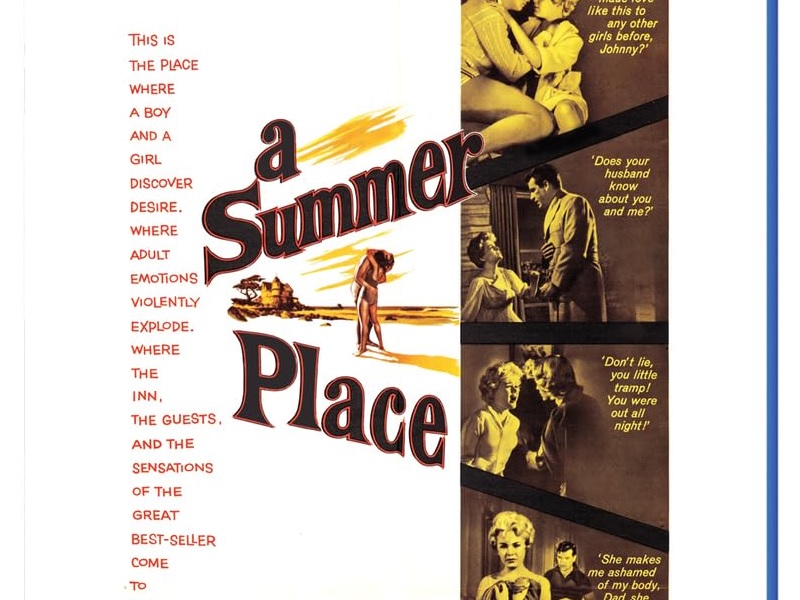
Healthy father-daughter relationships can be hard to find in movies (and in life). It’s the last thing I expected to find in Delver Daves‘ A Summer Place (1959), which sells itself as a sudsy melodrama full of illicit affairs where both the adults and kids are causing scandals left and right and A Summer Place is that movie, too. I mean, between Arthur Kennedy dressing up like he’s Noël Coward but straight and Constance Ford refusing to crack a smile and calling mother (Gertrude Flynn) for help this is melodrama cranked up to the nines (and that’s before Ford finds herself some red lighting, because what house doesn’t have at least one lamp with a red light bulb?). That Richard Egan would be the voice of reason in this film is a twist I couldn’t have seen coming but, indeed, A Summer Place is nothing if not a challenge to expectations around what a 50’s film should be.

Sandra Dee is quintessential ’50s, for example. Sandra Dee telling her father (Egan), without any prompting, about the time she caught one of the neighbor boys watching her undress and kept undressing anyway – that’s still shocking in 2025, let alone in a decade that’s supposed to be well-represented by Leave It to Beaver.
Maybe if Dee’s Molly was trying to get a rise out of her father it would seem less surprising. Those words out of a teenage Elizabeth Taylor or Natalie Wood wouldn’t raise as many eyebrows, but the problem is less Molly’s oversharing than that this feels like oversharing and not a father having built a strong enough rapport with his daughter that she feels safe to come to him with anything. Because that’s what makes these moments stand out, too. If Molly’s dad got mad at her or used these conversations to shame her than it would feel ’50s again real quick (and Molly’s mom (Ford) is more than happy to fill that void with her reactions, so both extremes are represented) but he doesn’t pass moral judgement at all which, to be fair (and as will be revealed later) he has no room to judge, but that hasn’t stopped people before.
But I’ve gotten ahead of myself. What, exactly, is A Summer Place about? Basically, Molly’s dad has decided to bring his family to Pine Island for the summer — a place he hasn’t been since making it rich and where everyone knows him as the former lifeguard (and won’t let him forget it). In other words, Molly’s dad is Gatsby — new money who still holds a torch for one of Pine Island’s [married] residents (Dorothy McGuire). She, of course, has a son (Troy Donohue) Molly’s age and they hit it off immediately. And then there’s Molly’s mom (Ford), who even the island alcoholic (Kennedy) thinks is a racist monster and who Molly’s dad gets to eviscerate in the film’s best monologue. It’s messy, and if the film is ever disappointing it’s that, in all its modern thinking, it shows just how taboo divorce was that the stigma around it infects even the people one might expect to be more sympathetic (so not really the film’s fault – it’s just being honest about the times).
In any case, if you’re on the fence about A Summer Place, this is A+ melodrama. Even with the Christmas tree slap included, the trailer doesn’t sell it enough and it’s worth gambling on if you’re already predisposed to liking melodramas of the Lana Turner or Susan Hayward variety.
A Summer Place is available on Blu-ray now from Warner Archive and to purchase from Movie Zyng.