
Thought Bubble 2025: Conflict In Comics — Sometimes Violence Is The Answer
by Olly MacNamee
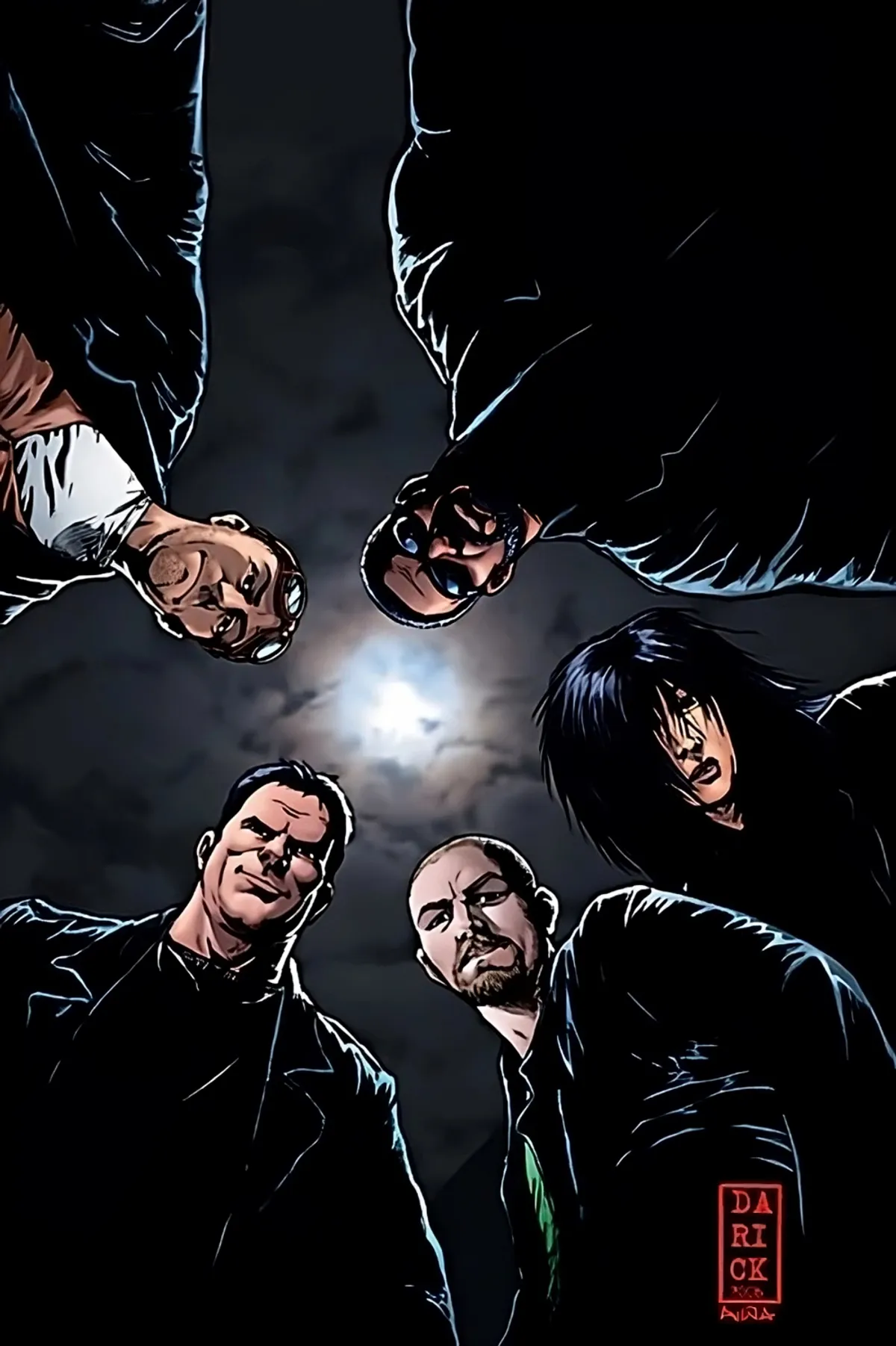
With the escalators out of action there was something of a delay to the start of this interesting, jovial and bloody panel. But, as I was sharing a lift with three of the panellists, Garth Ennis, Al Ewing, and Si Spurrier, I knew I wouldn’t be late. Below are the highlights, paraphrased. But hopefully, it captures the essence of their conversation and the points they made. All done in jest and with good cheer from the audience.

What is your favourite body part to destroy?
Ewing: I like destroying heads. I wrote a story recently with a severed head in a character’s lap. But I was asked to tone it down.
Ennis: I loved Hookjaw as a kid, and I like it when the violence all explodes at once.
Spurrier: A jaw being ripped off is always my favourite.
When do you feel you’ve gone too far? If at all?
Ewing: One of the jobs of the editor is to draw the line. But violence can get too boring if it’s overused. Or, anytime the story suffers.
Joking about the excesses of violence associated with Avatar Press (publisher of Crossed), Ennis joked…
Ennis: I think we found our own limits when I worked at Avatar Press, long before the publishers did.
Spurrier: If the gore is to horrify the audience, then there’s no limit. But, if you’re using violence to make a point you have to be more careful. In superhero comics, if you’re wrong, you get beaten to shit. It’s what 90% of superhero stories are all about. And as a parent now, I think more on this nowadays.
…
If you watch, for instance, a Tom & Jerry cartoon and it’s fleeting, then it’s fine. It’s not lasting. But if Tom were ever killed, there would be a funeral, etc., then that’s something else. It has long-lasting consequences. It can still be funny, but not so much. It’s lasting violence, lasting consequences.

Ennis: I think 2000 AD’s propensity for violence has contributed to a change in violence in comics in the States now, too, as two generations of writers have been influenced by this UK weekly.
Ennis: I wrote The Punisher as a Tom & Jerry cartoon. It’s all part of my disrespect for superheroes and dragging them through the mud, whenever I can.
Talking about a time he had writer’s block, Ennis continues:
My wife and I were walking through Central Park, and I explained that I was stuck for an idea for Frank Castle. She put me onto an article about human trafficking. It was one of the only times I wanted there to be a real-life Punisher in that moment. So writing ‘The Slavers’ storylin (a story that sees Frank violently let loose on human traffickers) for The Punisher was very cathartic.
Spurrier: We constantly tell our children to turn the other cheek, but there is something we find satisfying in the stories that do show the victim turning against the bully violently.
If you are using violence, it should be for ethical reasons within the context of superhero comics.

Other takeaways:
Ewing spoke about his work on DC’s Metamorpho: The Elemental Man. While he felt they wanted the Ewing who had written The Immortal Hulk, and injected a bit of horror into the story, what they got was an Ewing who loved the Silver Age Bob Haney Metamorpho stories. So, not the same level of violence they were hoping for.
Ennis: Violence is just one of the tools we use in storytelling. It’s not necessarily the most important element.
Spurrier: It can help with pacing. But there are often better tools to tell your story.

