
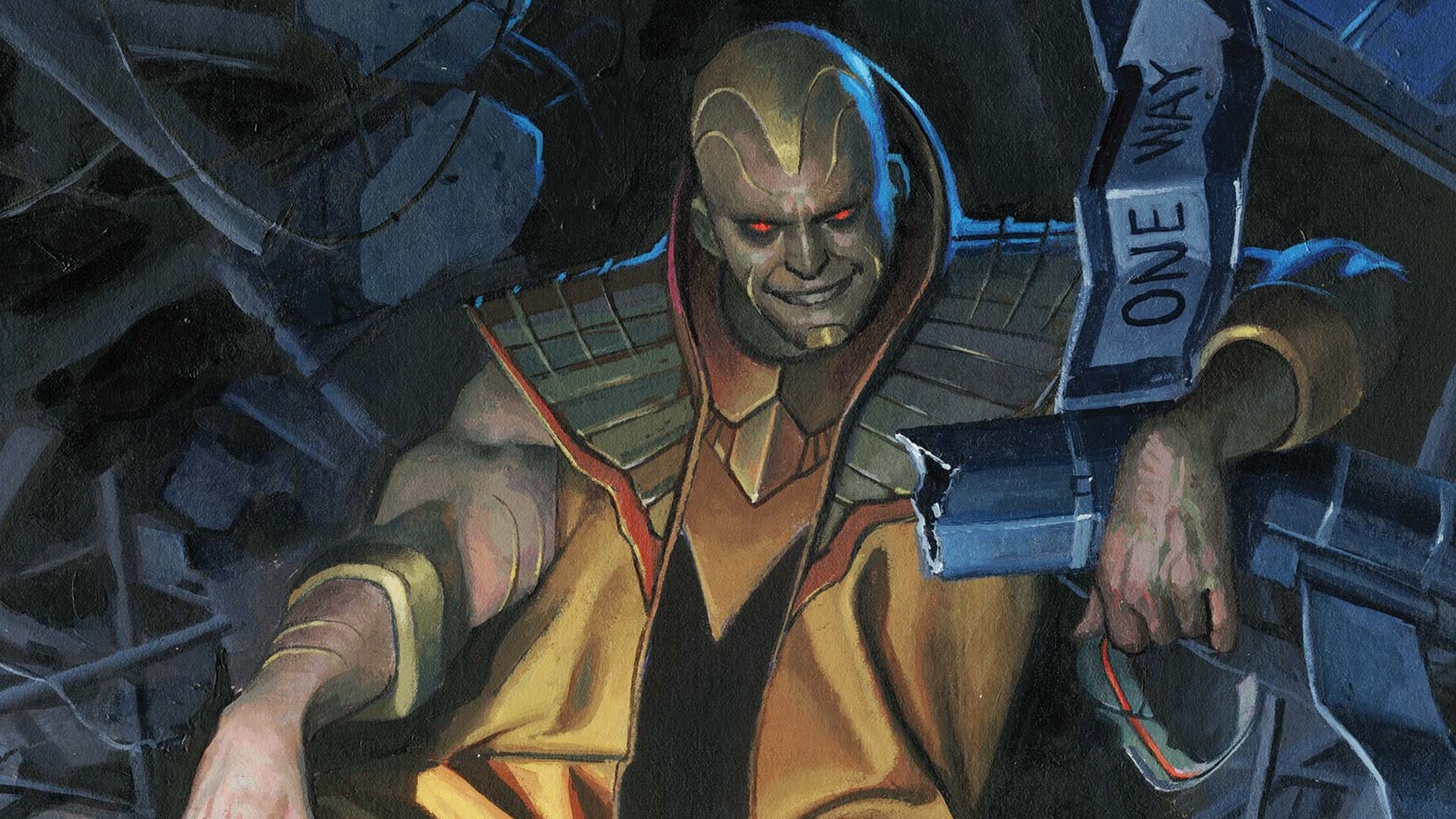
Previously On X-Men: ‘Book Of Revelation’ #3 Finally Puts Doug In The Spotlight
by Austin Gorton
Obviously, this would be impossible, but it would be really nice if Marvel could have distributed its “Age of Revelation” series more evenly so that we got a better mix of the bad and the “good-not-great” in a given week; last week’s batch kinda stunk, while this week’s batch mostly fall into that latter category.
Avengers #33

By Jed MacKay and Javier Pina.
More details on the journey of the Twilight Court from their apparent death to their reappearance in the previous issue.
- The opening scene in the Pirate Timeline shows deceased Celestials, the massive space gods who created the Eternals and the Deviants.
- It also shows the Twilight Court claiming Kang’s Damocles Base, a giant spaceship shaped like a sword that was introduced in Kurt Busiek‘s “Kang Dynasty” story in the early 00s; it’s revealed to have served as the foundation of the Impossible City.
- The Twilight Court is shown to have plucked the Infinity Stones from the eyes of a dead alternate reality Doctor Doom, who died in Timeless #1.
- Artur provides a rundown via dialogue of the Twilight Court’s various achievements which, like the Tribulation Events, feels like things we might have seen dramatized to some extent if MacKay’s run had been longer.

Dedicating the entirety of the penultimate issue of the story arc and of MacKay’s run to the Twilight Court sure is a choice. I’m not sure it’s a smart one, but it’s a choice.
The Last Wolverine #3
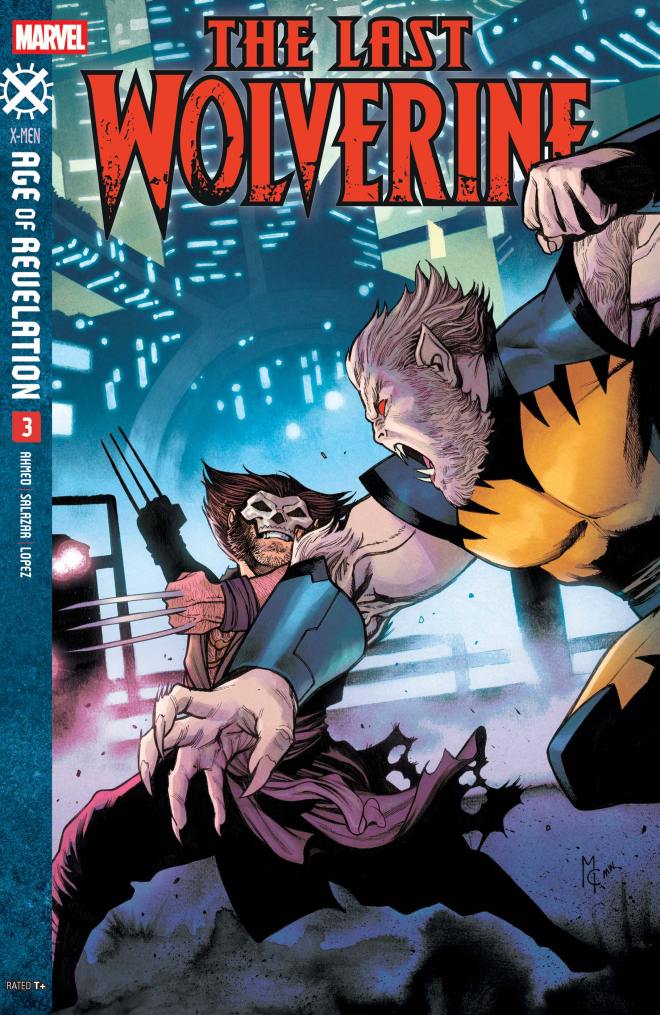
By Saladin Ahmed & Edgar Salazar
Leonard sacrifices himself to save Wolverine.
- The recap page says that Leonard’s full name is “Leonard Two Bears.”
- The Muramasa blade seems to be glowing here; as far as I can recall, it’s not a lightsaber.
- The way it’s used here is broadly consistent with its use when it was introduced — able to slice through adamantium and create wounds that Wolverine’s healing factor can’t heal (though he’s also not bleeding out).
- Wolverine losing his left arm here is maybe meant to be an homage to “Age of Apocalypse.”
- Nightcrawler is having heart problems because he’s old (“middle-aged”), which is another example of this event sometimes acting like it’s much further in the future than it is. Present day Nightcrawler is more or less in his late 20s, so ten years in the future, he’d be in his late 30s, which seems a bit young to have a serious heart condition for no other reason than age.
- Leonard keeps talking about how the “radiation” is making it harder for him to control his bestial side; I’m not sure why? Philadelphia didn’t nuked, and the X-virus isn’t radioactive — part of the whole deal over in Radioactive Spider-Man is that radiation helps keep the virus at bay.
- When Wolverine arrives on the scene, his appearance is heralded by his shadow with the word “snikt” cut into it, which is a fun visual technique.

- Dragoness is amongst the Seraphim who appear in this issue; the rest all seem to be random new characters.
- Nightcrawler is quoting Ecclesiastes 7:1 when he says, “the day of death is better than the day of birth.”
- Not only is Leonard giving in to the monster within him in order to save Wolverine poetic, the way he chucks Wolverine off a building to save him parallels the flashback in the first issue when Wolverine did the same to Leonard.
- The closing image shows the people whom Wolverine wants to avenge by taking out Revelation: Leonard, Heather and Kurt on the left and Magneto, Angel and Xorn (all of whom he killed under Revelation’s control).
This is the kind of tie-in series we’d get more of in a tighter, more-focused event, one which you don’t have to read to follow the main story but which fleshes out a little corner of the world (ie Wolverine appears as the Angel of Death elsewhere, this is the book that deals with that and what it means). Ultimately, it’s all pretty perfunctory in terms of execution, but if this is the last we see or hear of Leonard it makes for a decent capstone to his arc, and in the grand scheme of “Age of Revelation” tie-ins, in which the vast majority have nothing to do with the broader story, this stands as one of the better ones.
Omega Kids #3

By Tony Fleecs & Andrés Genlot
Quentin learns he’s been trapped in a psychic illusion and overcomes his pride in his students to stop their murderous rampage.
- The issue opens with a text block explaining what a psychic relay programming is, and it sticks out for being the only time such a technique is deployed, though it might have been fun to stuff like that pop up throughout the series, little snippets of Quentin’s textbook, so to speak.
- Genolet’s art in this series has been one of the highlights of the event, but it seems a little less sharp here.
- It takes the Omega Kids way too long to realize the classic-looking X-Men attacking them are psychic projections.

- Quentin mentions that amongst his various memberships, he was an Avenger; this is a reference to the third volume of West Coast Avengers from 2018, when he joined a group of Avengers including Hawkeye, Clint Barton, and Gwenpool.
- This is another “everyone dies” ending, with the Omega Kids wiped out and revealed to simply be the latest iteration of the concept.
Another not-great-but-solid series in sum; it struggles from failing to make the new kids all that memorable/distinct, but in the end, it doesn’t really matter, because this is a Quentin story overall. And from that perspective, it works — Quentin being both horrified by their actions and proud of how well he must have taught them encapsulates his character nicely, and the twist, that this is merely the latest batch of Omega Kids, builds into the idea that it’s Quentin, not the kids, who matter.
Of course, it also struggles from not actually building up to anything related to the overarching story, despite having some pretty direct ties to Revelation and his operation, so it’s ultimately much better as a “Quentin Quire character study” than a “Age of Revelation series.”
Radioactive Spider-Man #3

by Joe Kelly & Kev Walker
Peter finally accepts that Aunt May has to die, ten years after she transformed into a giant, mindless monster.
- The flashback, in which Peter seeks out the help of Doctor Octopus with Aunt May’s condition, references the unique relationship between Doc Ock and May, notably in Amazing Spider-Man #131, when they almost got married.

- J. Jonah Jameson being referred to as Peter’s stepbrother is a reference to May’s marriage to Jonah’s father in Amazing Spider-Man #600, which made Peter and Jonah cousins but led to Peter jokingly referring to Jonah as his stepbrother, since May was like a mother to Peter.
In the end, this stands as a surprisingly touching treatise on parental loss and letting go, with particularly strong art from Walker. That said, it’s hardly the first time we’ve got a “Peter goes to ridiculous lengths out of refusal to let go of Aunt May” story (*cough* “One More Day”), and the extent to which May is presented as a danger to others here makes Peter’s refusal in this situation border on insanity. Still, given its clear arc and strong art, on the whole, this is one of the better “Age of Revelation” series in total.
Rogue Storm #3

By Murewa Ayodele & Roland Boschi
Storm sacrifices herself to trap Eēgūn but manages to resurrect Rogue Red.
- The claim that Ayesha sank Atlantis is new; usually that gets attributed to the Celestials, but it’s been mucked with enough through the years that yet another explanation/cause is hardly new.
- Ashake is Storm’s sorceress ancestor, first established in New Mutants #34. There, she said she walked the “shadow path,” though the implication was it simply meant dark (or darker) magic. Here, the Shadow Path is a complex ritual that allows humans to commandeer the power of gods.
- It gets glossed over a bit with all the out-of-sequence storytelling, but it’s Storm’s absorption of Eēgūn that caused her to trigger all the worldwide cataclysmic weather as Eēgūn fought for control.
- This issue reveals while the ghost of Daniel Drumm has been hanging around with Storm in the present day (as a result of a promise he made to his brother before his brother died battling Eēgūn.
- During Rogue Red’s deathbed recollection of previous events, the shot of Storm and Rogue together is from Uncanny X-Men #185, shortly before Storm loses her powers taking a shot meant for Rogue.

- That’s Shuri, T’Challa’s sister, who turns up in the shots of mystical protectors.
- Revelation shows up in that same sequence (representational), as its explained that Eēgūn’s removal of magic users helped fuel Revelation’s rise, which is this series’ tacit connection to the larger event.
Like Unbreakable X-Men, this book ultimately is less about “Age of Revelation” and more about Ayodele further exploring his themes and favorite character in an alternate future setting. As usual, his penchant for out-of-sequence storytelling obscures the plot a bit (this all works when laid out in chronological order but is harder to follow jumbled up and told across three issues), but the more finite runtime reigns it in a bit (which bodes well for his upcoming Storm: Earth’s Mightiest Mutant miniseries). The art is also good.
X-Men: Age of Revelation #7

By Alex Paknadel and Eduardo Audino
Three years after the X-Virus is released, Glob gets drawn into the conflict with Revelation.
- This new story is apparently about the radicalization of Glob Herman, and will be the last of the “Age of Revelation” tie-ins. It’s unclear at this time if the series will continue after that.
- The googly-eye Albert is a new character.
- Radian aka Christian Chord, however, debuted in Grant Morrison’s New X-Men as part of Quentin Quire’s Omega Gang (along with Glob). Curiously, he appeared as one of Revelation’s Seraphim in Iron & Frost, using the name “Phaser” (which is the name he had when he was one of the tech-enhanced New Warriors).
- Quentin is in full Omega Kids mode already at this point in the timeline. The two mutants with him are unidentified (though the guy looks a bit like Hellion).

- The sequence of Glob falling down the waterfall is a good use of the scrolling “infinite” window format.
- That is apparently the “Age of Revelation” Punisher at the end of the story.
As with the previous “how did Illyana die?” story, “how did Glob become so militant?” seems like a question whose answer is some combination of obvious and irrelevant, but the out-of-left-field idea of pairing a still-nice Glob with Punisher has some juice.
X-Men: Book of Revelation #3 – Book of the Week

By Jed MacKay & Netho Diaz
Revelation learns the truth about Elbecca.
- Revelation’s comment about he once loved computers and programming is a nod to his earliest appearances, when he befriended Kitty Pryde over their shared love of computers and video games.
- He also admits that he doesn’t really buy into all the biblical trappings in which he’s adorned himself, which is broadly consistent with what we’ve seen of him in private.
- We find out Warlock isn’t present in “Age of Revelation” because Doug had to use him in the X-virus to make it work; the fact that Doug doesn’t know whether Warlock sacrificed himself of his own volition or not is a nice touch.
- Elbecca letting slip the “mutant weapon” instead of “mutant power” term (something which was used consistently in X-Men Red) is a well-deployed tell, reminiscent of the “three fingers” reveal in Inglorious Bastards.

- Similarly, Revelation being unable to control Elbecca because he included her name in his command and that’s not her name was a fun reveal.
As always, this is the one must-read book outside of Amazing X-Men in terms of actually advancing the overarching plot of the event, which is why this still works even though, like Amazing X-Men, doesn’t really conclude even though this is the final issue of the series.


