
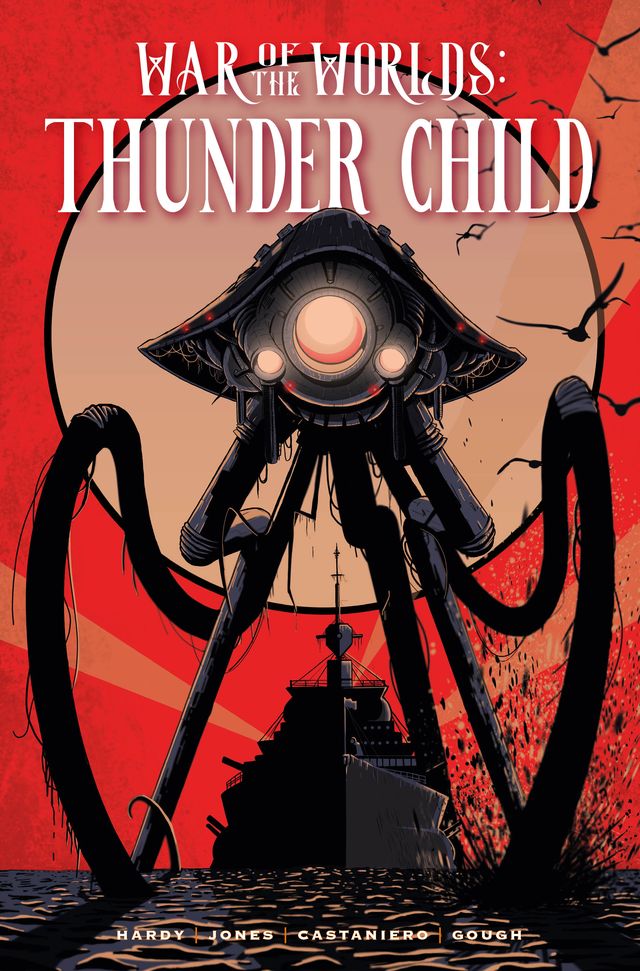
The Most Metal Name For A Naval Vessel – Discussing ‘War Of The Worlds: Thunder Child’
by Tom Smithyman
H.G Well’s novel War of the Worlds has been told and retold in multiple media for over a century. Titan Comics will add another interpretation to the list June 2nd when it releases War of the World: Thunder Child. Written by Rob Jones and Matt Hardy, this new story is a companion piece that runs parallel to the original novel. It tells the tale of H.M.S. Thunder Child, a torpedo ram that encounters the alien invaders. In an exclusive interview with Comicon, Jones and Hardy discuss where the idea for their story came from as well as their commitment to be true to H.G. Wells’ source material.

Tom Smithyman: War of the Worlds is a classic in every sense. Did you have any concerns that you might be messing with such a well-known story?
Rob Jones: We went into this not wanting to retell War of the Worlds or update it to a modern setting. We wanted this book to be a companion piece to those who love Wells’ original work, or for those who may have fond memories of Jeff Wayne’s musical version. Obviously, we wanted to treat the source material with respect and didn’t set out to make any changes to the story.
Matt Hardy: Yeah, there have been many terrible adaptations, so we intentionally set out not to make another bad one! Ours is a parallel story that sits alongside the events of Wells’ novel. We don’t contradict or reinterpret Wells’ work in any way. We just take a minor plot point from the original novel and flesh it out. Thankfully that formula seems to have worked. Hollywood, please take note.
Smithyman: What was your first exposure to War of the Worlds? H.G. Wells’ original novel? The infamous radio broadcast? One of the films? That crazy syndicated TV show?
Hardy: I studied Wells’ novel at university, so I tend to approach it from a literary perspective, mixed with a love of some of the excellent radio adaptations we’ve had. Rob came at the story from a more emotional and personal connection.
Jones: Yeah, for me, it was listening to my father’s L.P. of the musical version in the ‘90s as a kid. Richard Burton as the narrator, the classic rock vibes of so many of the songs, the sadness of Forever Autumn rolling into the pumping, energetic, and pulse-pounding Thunder Child always captivated me. It would be a song I would routinely come back to over the years. It was pervasive in my house and something I had somehow always been aware of without really knowing the exact time when I became cognizant of it.
Smithyman: H.M.S. Thunder Child is a fantastic name for a naval vessel. How did you come up with it? Is it based on an actual ship?
Jones: Ha! We wish! The H.M.S. Thunder Child is an all-H.G. Wells’ name! It is the most metal name for a naval vessel. It is described as an ironclad — a type of torpedo ram. The problem was, they became obsolete the moment they came off of the assembly line. Having the last hopes of mankind on the shoulders of an under-prepared vessel, ill-equipped to deal with the technologically superior Martian threat is pretty badass.
We did come up with the name H.M.S. Lightning Warrior, a sister ship, captained by ex-members of the Royal Indian Navy who had joined the Royal Navy after British rule was subjected to India. Hopefully, that’s equally badass!
Hardy: Yeah, H.M.S. Thunder Child is taken directly from War of the Worlds by H.G. Wells. It’s not in the novel a lot, barely more than a paragraph. Weirdly, I swear blind that I got the name H.M.S. Lighting Warrior from the research I did about all the different versions of the Thunder Child’s fate. I had a clear memory of that. But after we wrote our book, I couldn’t find any mention of it online anywhere — so I guess we did make it up after all?
Smithyman: The novel, while terrifying in its own way, famously ends with the Martians dying of a common Earth disease. Without giving anything away, are we going to get an alternate take on that unexpectedly low-key ending?
Jones: Well, our book does end with two of our heroes sitting in the cockpit of a stolen, retrofitted Martian tripod, smoking a victory pipe and delivering a huge stack of dirty handkerchiefs…
Hardy: Dammit! We should have ended on the Kings Royal Sneeze Regiment driving the Martians back into space using their super-snot cannons … OK seriously, we very much reference that very famous ending with the Martians and the common cold. It’s something that can’t be ignored. But it’s a very small part of our particular take on the story. Our ending is the Thunder Child’s ending — it’s final fate. Everyone knows what happens to the Martians, we want to show what happens to the ship and our crew.
Smithyman: Let’s talk collaboration. How do the two of you divide up the writing responsibilities? And how do you work with artist Kevin Castaniero?
Jones: That’s super easy. I get Matt to write the words and I do all the spaces … Actually, as silly as it sounds, it is a super easy thing for Matt and I. We have written together on other titles, and have known each other for years. It was during lockdown I messaged him, possibly drunk, definitely just in my underwear, with simply the words “Thunder Child!!!!!” He ignored me for a little while, or acted like it never happened, then we started talking about the idea of creating a story about the most criminally under represented part of H.G. Wells’ novel, the last stand of humanity against the Martian invaders and noble sacrifice of the H.M.S. Thunder Child.
Kevin threw himself into the project with so much passion. We asked for sample pages and he came back with nigh on the entire book laid out. He has been integral to ensuring the themes we use, the story we tell, works. Whether in huge action set pieces or in quieter, more character-driven moments. Kevin, as much as he is this grizzly Californian wild bear man, has this beautifully “European” look to his artwork, and his character work and designs are second to none. We gave him descriptions of our motley crew and he just came back with such a great selection of characters, that each truly embodied everything we wanted out of them.
Then when we got Simon Gough on colors. Again, he brought the goods. The way he used tone, shade, and hue throughout the book really enhanced everything. Both were super easy to work with and really gave their all to the work they produced.
Hardy: Everything you liked about the story, I wrote that. All the stuff you didn’t like — that was Rob 🙂 But the stuff that everyone agrees they adore — that stuff is Kevin and Simon’s art.
Smithyman: The original novel is told from the perspective of an unnamed writer who is wandering around England chronicling the invasion. Here’s your chance to make history — give the guy a name and tell us why you chose it.
Hardy: Yeah, I’d genuinely prefer not to name him. As I think we’ve made clear, we’ve set out to and reflect Wells’ original work — and to overwrite or change anything wouldn’t seem right. Sometimes things work as they are — and don’t need any additional layers or interpretation.
Jones: I am also going to give the wimpy answer and say it should probably be left as an unnamed character. The fact is, it’s being written from the first-person perspective, without ever naming himself, means you are, in some ways, able to project yourself into the mind of the narrator, really immersing yourself into the story.
Or, if you really want an answer, I would say his name is Herbert. And I choose Herbert in honor of the great H.G. Wells. The story has had such lasting cultural impact, and I feel any other name would be blasphemy.
Smithyman: Herbert it is. How appropriate. I’m looking forward to reading your story!