
Commentary: ‘Goat’ Creates A Real Animal City
by Frank Martin

Utilizing anthropomorphic characters has been a favorite for children’s films since animation began. There’s something warm and fun about taking animals and turning them into relatable, human-like characters. Of course, this brings into question the kinds of worlds such creatures live in. Various stories have utilized everything from a completely naturalistic setting to something more akin to a modern city. The film Goat blends these two concepts together to create what feels like a true urban environment derived from nature.
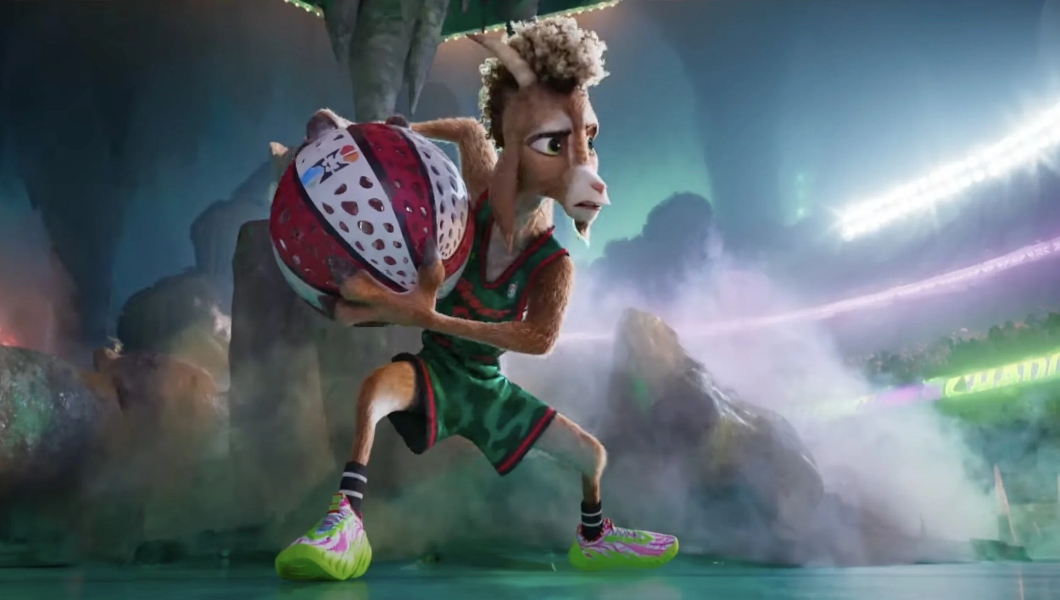
In this anthropomorphic world, a sport similar to basketball called “roarball” dominates the culture. It is typically played by animals that are called “bigs.” They are larger than others that have an advantage on the court. The story focuses on Will Harris (Caleb McLaughlin), a goat that is considered a “small.” He’s never played roarball before, but Will has a dream to be the first and joins his local team, The Thorns, in order to help them to the championship.
The film spends a significant amount of time focusing on Will’s city, Vineland. It wants to give the impression that Will comes from humble roots and achieved his success through hard work and community. This gives the audience a lot of time to see the city for themselves. It is not a purely urban environment like Zootopia. This city also doesn’t completely exist in nature. Instead, the city is a massive blend of urban and natural elements, creating a sense that the city sprung up from the jungle itself. The city has a real grittiness to it with graffiti and cracked pavement. At the same time, it also has vines and trees throughout, often using them as part of the city’s infrastructure. It feels like a true animal metropolis in a way few other animated films have been able to capture.
Goat is now in theaters.