
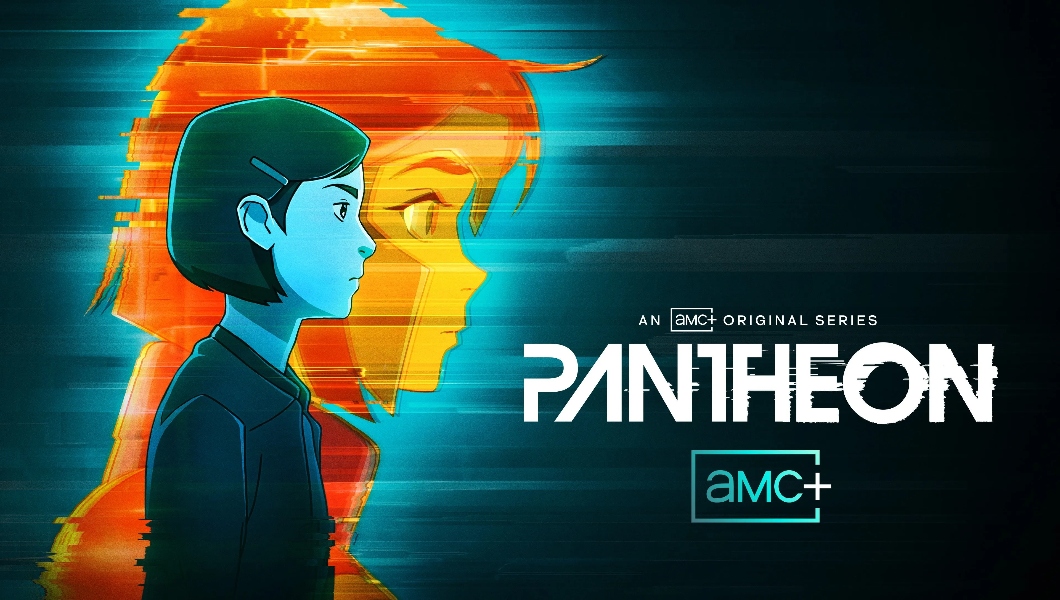
Commentary: ‘Pantheon’ Is ‘Black Mirror’ From A Different Angle
by Frank Martin

As artificial intelligence continues to dominate the current landscape, it’s going to become more prevalent within the stories told in film and on television. Of course, AI has always been a huge component of science fiction storytelling. But as the technology inches closer to our real world, the ways it will be utilized in stories will start to align more with modern thinking. In terms of dystopian and visionary sci-fi stories, Black Mirror has always been at the forefront of that discussion. The animated show Pantheon, meanwhile, dives head-first into an aspect of advanced technology that Black Mirror has tangled with on more than one occasion: uploaded intelligence. The series just comes at it from a different angle.
The program is set in a world where uploaded intelligence is real. In contrast to artificial intelligence — which is a man-made brain — uploaded intelligence is an actual human consciousness turned into digital information. One of the pioneers of the technology, David (Daniel Dae Kim), is faced with a terminal illness. Before his death, he uploaded his consciousness to a server owned by his company. Like other consciousnesses, David is put into a digital space where he relives the same day over and over like he is at work. He is given tasks to complete like it is his job, and since time moves differently in the digital space, he is able to complete a lot of work in a short amount of time in the real world. Eventually, David finds a way to break the loop and reach out across the internet to his family.
Uploaded intelligence was the feature of several Black Mirror episodes. Two of which, “USS Callister” and “White Christmas,” utilize the technology in very different ways. In “USS Callister,” digital clones of individuals are inserted into a space fantasy video game against their will. In “White Christmas,” digital clones are also made against their will to be digital assistants — essentially slaves for their real life counterparts. Black Mirror focuses on a dystopian aspect of the technology, but Pantheon has a much more nuanced approach. There are elements of abuse these digital individuals experience, mainly in regards to the workplace. However, there is a fair amount of hope, as well. David’s family has to grapple with this newfound life he has found after death. There is a lot of philosophical baggage to deal with, and Pantheon handles it with much softer gloves than Black Mirror’s bleak outlook on life.
Pantheon and Black Mirror are now streaming on Netflix.