
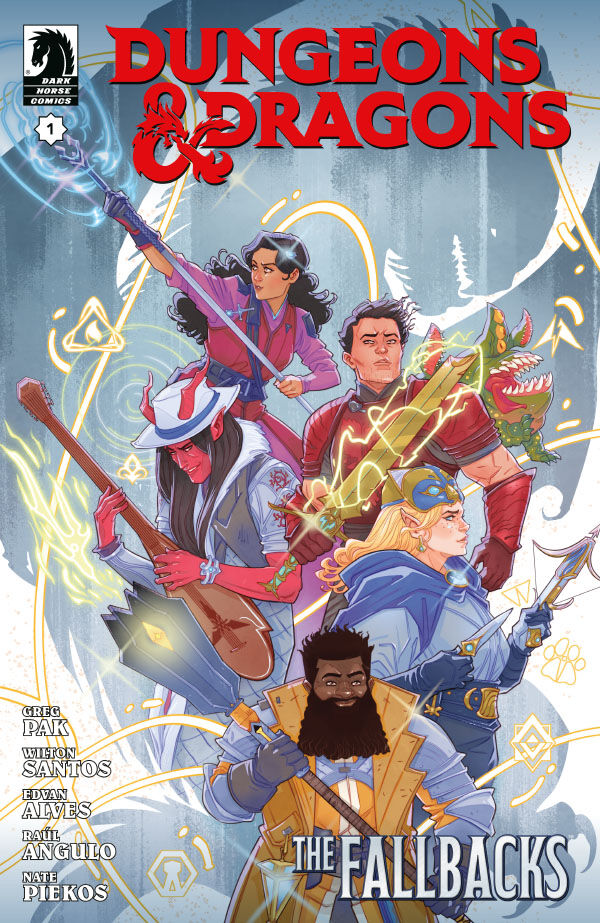
Review: ‘Dungeons & Dragons: The Fallbacks’ #1 Captures The Feel Of A Solid And Chaotic ‘Dungeons & Dragon’ Party
by Anton Kromoff
Summary
The Fallbacks capture what feels like the actual ups and downs of a Dungeons & Dragons adventuring party you would see at a really solid gaming table. No one is really overstepping each other; everything connects plot-wise, there is some weird home-brew in place that is unique but does not break the world, and the whole thing feels fun to be a part of.
Welcome to the table,
For as long as I have had conscious memory, there have been Dungeons & Dragons or, at the very least, D&D adjacent novels close at hand. The Dragonlance chronicles, by Tracy Hickman and Margaret Weis, were read cover to cover on repeat, with brief interruptions to dig into Conan, Ravenloft, Xanth, and other assorted sword & sorcery stories. I ate well, thanks to the Book-It program and my love for reading, and in that time, the ages before I allowed digital distraction to erode my focus, I was always buried in a book, and for the most part, that book was tied in some way to my tabletop roleplaying games either directly by publisher or setting, or tangentially by cultural touchstones and hallmarks.
While some of the stories explored more mature themes, I don’t know that my life experience at the time was fully ready to process. For the most part, everything existed in a young adult/teen space that could be enjoyed by the elder nerds who showed me how to paint Warhammer miniatures after spending a week working on military bases in jobs that I did not understand, or people like myself, whose biggest worry was not pissing off their parents for breathing too loudly or getting punched in the back of the head at school because kids on crutches were easy targets. Without social media clout chasing to defend the defenseless, the halls were way less packed with people willing to step up and say something when that kind of thing went down, as it was wont to do, than seems to be the sentiment these days.
So I hid in these stories of weird, yet somehow heroic folk, who came together to do something that seemed out of their league, all the while offering fun quips, bits of inspirational speeches, and seeds of a world far bigger than what was contained in the pages. These were not just stories that took you through the regular structures of storytelling. They were a toolbox of ideas that could be farmed for adventures at the gaming table, ideas for world-building, and would ultimately form the foundations for world-building far beyond their yellowed secondhand pages.
Dark Horse’s Dungeons & Dragons: The Fallbacks feels very much like those stories of my youth, and I mean that in the best possible way. Let’s get into it.

Based on Jaleigh Johnson‘s novel Dungeons & Dragons: The Fallbacks: Bound for Ruin, this first comic adaptation, titled Dungeons & Dragons: The Fallbacks, is helmed by author Greg Pak with pencils by Wilton Santos, inks by Edvan Alves, colors by Raúl Angulo, and letters by Nate Piekos.

Kicking off in the City of Grottos, Loudwater, one of the humanoid settlements of well-storied Faerûn, The Fallbacks immediately hooked me (in a way that is both compelling from a narrative perspective, and from someone who has spent thousands upon thousands of hours of his life at the gaming table) with a heist.
Well, in truth, it starts with an adorable Kobol child panhandling and the town guard getting on his case for just being a kobold, and because panhandling is illegal, causing him to run from the guards, lose them in a crowd, find himself face to face with our titular adventuring party, and then there is a heist.

It all ties together, of course, because said heist is being perpetrated by the adorable Kobold’s father. The story truly kicks into gear for me as an adult living through this current timeline when you find out the heist was not for gold, but food, and the guards of Loudwater are harrying the Kobold because they are Kobold and they believe they serve evil dragon gods.

The narrative pivot immediately spoke to the counter-culture “we all deserve to eat and have a safe place to lay our head” ideals I personally hold, and turned what I thought was going to be a “fun little D&D story” into something with more to say than I was expecting. The fact that it did this within the first 7ish pages was an impressive feat.
The Fallbacks show their true colors, using their skills to distract the guards so the Kobolds just trying to provide food for their families, and who are clearly being racially profiled against, and allowing the Kobolds to escape. Another adventuring party arrives. They have history with Tess, the Fallbacks’ rogue leader, and showcase their abilities, striking a heroic pose and really selling themselves as the heroes of Loudwater.
The dynamic is great because the new party is called the First Guard of Loudwater, and it’s hard not to realize these are just more advanced versions of the same xenophobic force out here profiling Kobold and making it so people can’t eat. I know this is a D&D comic, but Pak is really painting with a brilliant anti-establishment narrative brush within these pages.

The plot transitions in this book are so tightly aligned that it’s a testament to the economical writing. This is not a giant-sized issue, but quickly after these events, we get a solid moment in a tavern, the setup for the Fallbacks going into a tomb, and the kick-off of the next adventure beat.

The Fallbacks head to a tomb where they clash with some low-level undead and eventually run into the Kobold group, who clash with them. Anson, the party fighter, tries to discuss peace as he says there is more than enough wealth to go around, another push towards this counter-capitalist storytelling I am a fan of. But before a peace can be brokered, some carrion crawlers, very iconic monsters from the Monster Manual, drop down and start attacking everyone.
The Fallbacks and the Kobold team up and get out of the tomb, only to run afoul of a white dragon, bringing the issue to a close.
Until next time, The Fallbacks capture what feels like the actual ups and downs of an adventuring party you would see at a really solid gaming table. No one is really overstepping each other; everything connects plot-wise, there is some weird home-brew in place that is unique but does not break the world, and the whole thing feels fun to be a part of.

