
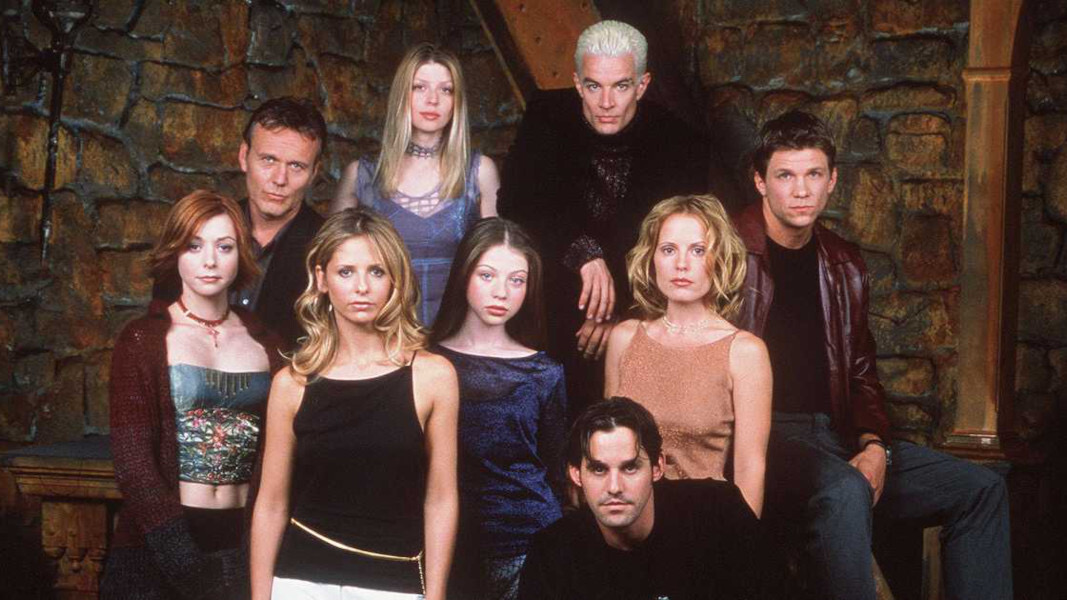
Characterization In The Buffyverse — ‘Buffy The Vampire Slayer’ Season 5, Episode 20
by Benjamin Hall
This is part of a bi-weekly series concerning the characterization of Buffyverse characters. Arguably the best place to begin reading this series is at the beginning, but that is up to each reader. As a reminder this column will cover major and some minor characters from the shows Buffy The Vampire Slayer (1997-2003) and Angel (1999-2004). Other Buffyverse media, such as the graphic novel Spike: Into The Light (2014) are not pertinent to this series. Also there will be no referencing real world events that have direct relation to either show in this bi-weekly series. Although this series does reference things that have no direct relation to the show in order to examine things such as metaphors and literary analogues.

This week: Buffy Summers (Sarah Michelle Gellar) and the Scoobies are going on the run from Glory (Clare Kramer). Unfortunately, the Knights of Byzantium are acting as an obstacle to both parties.
(Warning of spoilers from this point on!)
Buffy declaring running away as the “only option” displays her fear she of Glory. It also makes her a puppet of the plot since her group of friends do not even try a memory spell on Glory, her minions, or the Knights. She also never asks for help from the Watchers’ Council or Angel (David Boreanaz) during their respective visits (Season 5, Episode 12, “Checkpoint” and Season 5, Episode 17, “Forever”). Yes, the Council exposits an answer to a question, but they are not really supporting her in the fight. Additionally, Buffy apparently kill some Knights in this episode, which voids her no killing humans rule. Her appreciation for Spike (James Marsters) probably develops more upon his halting a sword that is about to stab her.
Dawn Summers (Michelle Trachtenberg) is possibly bisexual since she takes time to admit admiration for Glory’s “feet.” Her continued self-recrimination and thinking her mystical nature is evil continues to be a feature of her personality (Season 5, Episode 13 “Blood Ties”).
Spike helps provide tension between Buffy and the Scoobies by his mere presence. He also aids in the fight against the Knights despite his technological handicap.
Rupert Giles (Anthony Stewart Head) and Xander Harris (Nicholas Brendon) are both overprotective of Buffy, particularly regarding her decision to enlist Spike. This paints the pair as idiotic since the situation is dire enough to call in that specific backup. Also, it suggests that Xander is not fully over his feelings for Buffy since he is displays too much interest in her views on Spike. Another factor: they are questioning Buffy’s decisions even as she is trying to firmly lead. This last problem will continue in the future (Season 7, Episode 19, “Empty Places”). Fortunately, they eventually act mature by putting their personal feelings aside and going along with the escape attempt.
Anya (Emma Caulfield Ford) comes off foolish with her various suggestions, like using a heavy object to defeat Glory. It probably even inspires the upcoming plan to actually defeat Glory (Season 5, Episode 22, “The Gift”). Anya also displays intelligence at various times in this episode, most obviously when she is agrees with Buffy’s statement about running away.
Tara Maclay (Amber Benson) is out of her mind in a mostly stereotypical mentally-ill/childlike manner. The result: her ability to grow as a character non-existent.
Willow Rosenberg (Alyson Hannigan) takes on the role of caregiver for this part of the season. Obviously, this is the case for her dealings with Tara and Giles, but she also does so by erecting the magical barrier.
Benjamin Wilkinson (Charlie Weber) appears too calm when helping Giles, and this behavior should be creating suspicion in Buffy. He should also be more wary of the Knights since he is unaware they don’t know about his connection to Glory. Yes, there is a spell covering up the realization of the dual nature, but he still has interactions with her minions. As for Glory, there is little new to say except she can run at a level of extreme speed previously unknown to both the heroes or the viewers. This ability gives some idea of what she is like in her true form.
General Gregor (Wade Andrew Williams) is a complete zealot leading an army of similar individuals. His purpose, along with his army, is to serve as an obstacle to Buffy and Glory while also delivering information about latter’s plan to the former.
Gronx (Lily Knight) is a female minion of Glory, and possibly the only one of that gender. Her purpose here seems to be as a foil for Ben; they argue with while providing exposition and levity.
Murk (Todd Duffy) gets to be an audience to Gronx’s post-prediction pontification. Other than that, he serves no purpose.
Cleric #1 (Jack Donner) provides information to the Knights about Willow’s magical barrier. He and the other cleric (unknown) also serve as a figurative ticking clock for how long the barrier might protect Buffy and the Scoobies.
Orlando (Justin Gorence) is similar to Tara in terms of mental state. Although, instead of predicting the future, he provides exposition to his fellow zealots about Dawn.
Dante Chavalier (Karim Prince) seems more aware of the modern world than the other Knights. His plan, with that awareness, succeeds and results in Orlando’s release from the hospital. Still, he is just as much of a mentally ill person as the rest since he displays poor reasoning when deciding to kill Orlando.
Crazy #1 (Paul Bates), Crazy #2 (Carl J. Johnson), and Crazy #3 — formerly Lunatic outside the Magic Box (Bob Morrisey) from Season 5, Episode 22, “Real Me” — exist to foreshadow the season finale. Their appearance in this episode helps with strengthens the notion that the brain-draining throughout the season is part of Glory’s plan.
The nurse (Mary Sheldon) from the hospital psych ward is unnecessary since she is not contributing much beyond reactions. Her presence in the scene with the pen helps demonstrate how the Knights are willing to kill anyone, though.
There are decent character moments throughout this episode. Yet, one can argue that the plot and the need to advance it overshadow a lot of the characterization.