
Beware Of Wolves And Mountain Spirits: Reviewing Deaf Crocodile’s ‘DEFA Fairy Tales’ Collection
by Rachel Bellwoar
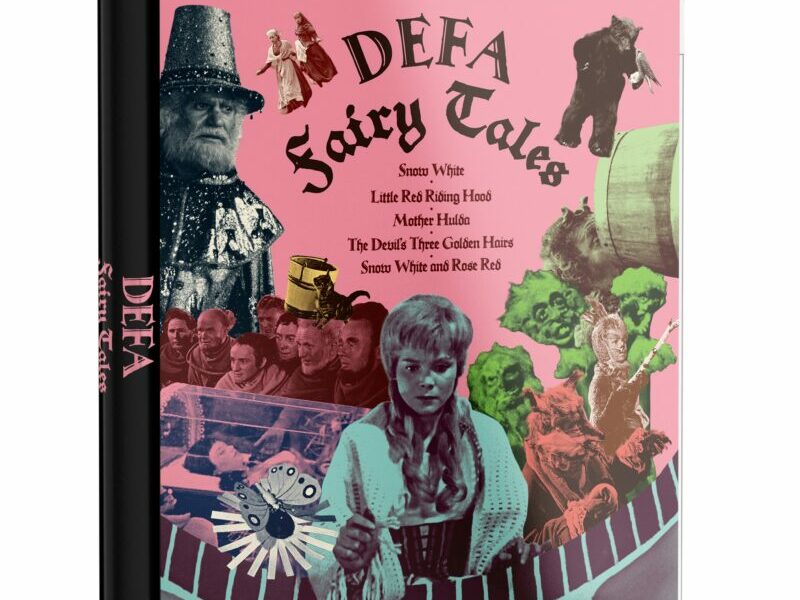
No one is ever too old for fairy tales but in case you might be needing a reminder that there is no age limit on the Brothers Grimm, Deaf Crocodile’s new DEFA Fairy Tales box is the perfect solution. Containing five fairy tale films from the East German film studio, there’s no better way to spend your time than with these magical movies.

Gottfried Kolditz‘s Snow White (1961)
Probably the most straightforward of the fairy tales in this box set, Snow White is a perfectly competent if expected take on the tale of the young girl who inadvertently gets on her stepmother’s bad side. Snow White (Doris Weikow) can’t help it that she’s the fairest in the land but that doesn’t stop the Evil Queen (Marianne Christina Schilling) from trying to kill her when her (particularly clunky) magic mirror insists she’s not more beautiful than Snow White. It’s a version that holds up for kids (outside of the subtitles) but doesn’t really shake things up for adults. Because the Evil Queen’s disguises aren’t as transformative as they can be in other versions it does make Snow White look bad when she continually doesn’t recognize her would-be murderer. Snow White also takes being unconscious and almost killed multiple times way too well.
Samm Deighan provides her first of two commentaries for this box set with Snow White and they really are exceptional, as Deighan goes over the Soviet values the films reflect and references the Aarne-Thompson index for folklore. She points out how DEFA’s take on Snow White is a little more lenient on the Queen, goes over the names chosen for the dwarves, discusses how the studio used agfacolor filmstock, and is generous in her assessment of Snow White and the prince’s speedy courtship. Right when you think she might not have time to get to the cast and crew she goes over their credits as well, making sure no stone is left unturned.
Gottfried Kolditz‘s Mother Hulda (1963)
I know this isn’t next chronologically but Mother Hulda appears on the same disc as Snow White. This is a fairy tale I was completely unfamiliar with before this box set. The initial set-up is a little Cinderella. While Pechmarie (Katharina Lind) is the favored, biological daughter, Goldmarie (Karin Ugowski) is the hardworking stepdaughter who has to do all the chores while Pechmarie lies in bed. While spinning thread Goldmarie accidentally stains the thread with her blood (Sleeping Beauty), only to drop the spindle in the well while trying to clean it. That should be the end of that but her stepmother (Elfriede Florin) orders her to retrieve it, with the result being that Goldmarie falls in the well and winds up in another world, very Alice in Wonderland.
Wonderfully stylized and handcrafted, with paper flowers and paper butterflies, the artificiality of the set design is a real draw and starts from the beginning (in his commentary Michael Brooke compares the stepmother’s cottage to a black box theater). It’s a film that emphasizes the rule of threes that pops up in fairy tales a lot. The well-world turns out to be the domain of Frau Holle, who puts Goldmarie (and later Pechmarie) through three tests. She’s also responsible for making it snow in the real world (which is presented as something people want to have happen all the time which isn’t my personal experience with snow). If Mother Hulda is missing anything it’s more scenes showing consequences for breaking one of Frau Holle’s rules, but otherwise this film is a whimsical (if on the short side) affair.
As mentioned, Brooke provides the commentary and is able to identify and provide some background on the other film adaptations of Frau Holle that have been made (seven of the eight being German and one Czech). He also talks about how the character of Pechmarie was received and Lind’s magnetic performance, which caused viewers (particularly kids) to sympathize with her. This is a great commentary for book recommendations, too.

Götz Friedrich‘s Little Red Riding Hood (1962)
If you only had time to show somebody one film from this box set, this would be the film I’d suggest every time. Again, this is probably a story most viewers are going to have some familiarity with, though it’s no accident that Little Red (Blanche Kommerell) is wearing a cap instead of a hood. According to Shelagh Rowan-Legg and Anne Golden‘s commentary, Little Red Riding Cap is a closer translation of the title. As expected, though, Little Red’s grandmother (Friedel Nowack) isn’t feeling up to snuff and literally wants some snuff and milk to feel better. After convincing her mother (Helga Raumer) she can make the trip through the woods on her own, Little Red sets off to granny’s house with the goodies in tow.
More about the journey than the iconic “what big ears you have?” confrontation at granny’s cottage (which coincidentally looks a lot like the dwarves’ cottage in Snow White) is, what takes this Little Red Riding Hood to the next level is the addition of some new characters that aren’t as synonymous with the story.
Having actors dress in animal costumes isn’t always (or often) a recipe for success, but it works in this movie. Instead of only having the Wolf (Werner Dissel) to contend with, there’s also a wily Fox (Harald Engelmann) who’s partnered with the Wolf. Both are sincerely terrifying with their matted fur and unnerving body language. Having someone to scheme with also allows both characters to become more fleshed out.
The star of the show, though, is Little Red’s best friend Bunny (Jochen Bley), and you’ll have to watch the film to understand why. Another detail Rowan-Legg and Golden draw attention to in their commentary is that viewers can see more of Bunny’s face than the other actors in animal costumes, which could be an advantage. The film didn’t have to hold back as much on the horror with its takedown of the wolf, it’s a masterpiece nonetheless.
Egon Schlegel‘s The Devil’s Three Golden Hairs (1977)
The only film from this box set I don’t foresee rewatching again, The Devil’s Three Golden Hairs marks a big jump from the first three films (which were made in the sixties) to this film, which was made in the late seventies. Some noticeable changes include more on-location filming and a reliance on juvenile humor that’s subjective (or, in this reviewer’s opinion, not funny at all). This film is also the source of the music used for the main menu on all of the discs and if you’re wondering what that “boing” sound effect is about, that’s all you need to know about this movie.
Former clumsy blacksmith Jakob (Hans-Joachim Frank) meets the princess (Katrin Martin) of his dreams but, if he’s to have any chance of marrying her, he needs to complete a quest assigned to him by her father, the king (Rolf Ludwig): venture into hell and go toe-to-toe with the Devil (Dieter Franke) for his three golden hairs. There are some enjoyable special effects but it all builds to a whimper instead of a roar.

Siegfried Hartmann‘s Snow White and Rose Red (1979)
This is another fairy tale I was completely unfamiliar with but ended up really enjoying. First of all, regardless of their names being the same, this is not the Snow White of the first film (and not just in the sense that the actresses are different but that their physical descriptions are completely different). While selling handmade toys and textiles, Snow White (Julie Jurištová) and Rose Red (Katrin Martin) meet two brothers, Michael (Pavel Trávníček) and Andreas (Bodo Wolf), and fall in love, except there’s a reason the village they live in has become a ghost town. When the brothers decide to investigate a tunnel that’s been pegged as the source of the problem they run afoul of the mountain spirit (Hans-Peter Minetti) who lives there and wind up cursed. Part Beauty and the Beast, part something new and exciting, it’s up to Snow White and Rose Red to set things right.
This is the film where Deighan returns as commentator and there’s plenty to unpack, in terms of elements of the story (like the tunnel) that were changed or added for the film and not part of the original fairy tale. There’s also a visual essay by Evan Chester that covers all five films (my favorite part is probably when he compares Mother Hulda to Lars Von Trier‘s Dogville) and a conversation between Deaf Crocodile co-founder Dennis Bartok and Swamp Thing artist Steve Bissette that’s worth sticking to the end for more book recommendations and a confirmation by Bartok that a second DEFA fairy tales box set is coming.
DEFA Fairy Tales is available now from Deaf Crocodile. I reviewed the standard edition but copies of the limited edition (which includes an essay booklet and a slipcase with art by Fables‘ Mark Buckingham) are still available on Deaf Crocodile’s website.

