
Spider-Man Week: An Introduction To Brand New Day
by Tony Thornley

Welcome to Spider-Man week at Comicon.com. Coming straight off San Diego Comic-Con, it’s thrilling to see the web-slinger hitting the big screen again. In this entry in the series, Tom Holland, Zendaya and crew are joined by Shang-Chi and Wonder Man’s Destin Daniel Cretton as Peter Parker is still trying to get his life back together and a new threat rises in New York.
But what exactly is Brand New Day, the comic storyline the film is based on?

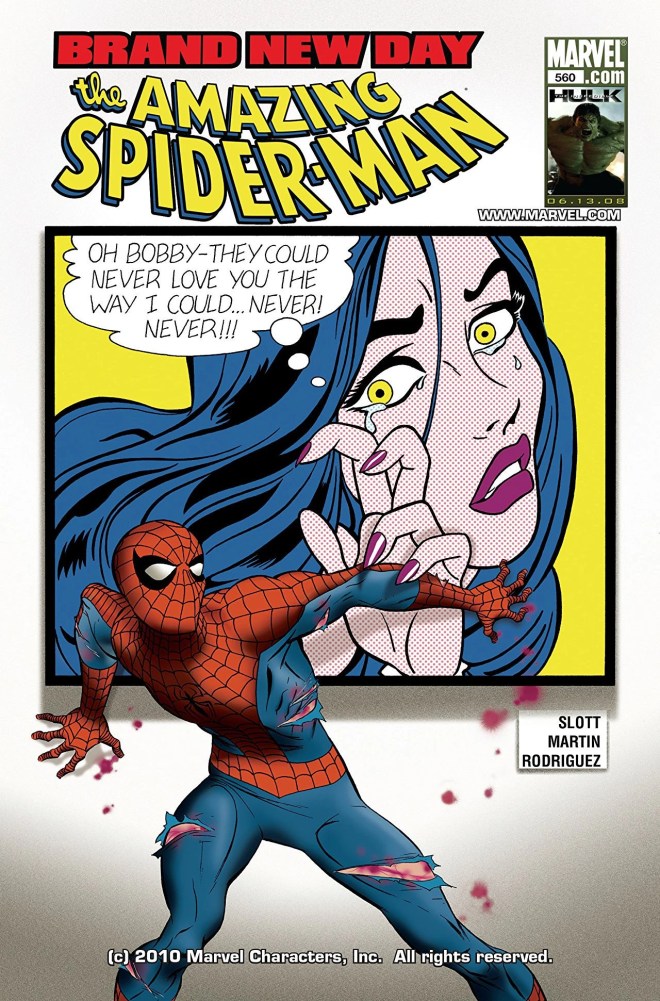
Kicking off in 2008’s Amazing Spider-Man #546, Brand New Day was simultaneously a storyline, a publishing initiative and a branding. The story picks up in the aftermath of the Superhero Civil War. Peter Parker is still picking up the pieces of his life in the aftermath, but things are finally on the upswing. Unknown to him though, forces are rising up against him to stand in his way.
So, without Civil War, Brand New Day wouldn’t have been possible. Spider-Man was at a low point creatively, with multiple much-maligned storylines tarnishing the various Spider-series reputation. Rather than simply rebooting the creative teams, Marvel chose to do something a lot different. The three separate Spider-Man ongoing comics would be consolidated into Amazing Spider-Man, and would be placed on a three-times a month schedule, with rotating creative teams ensuring consistency.
To ensure it would work, Marvel hired DC Comics editor Steve Wacker, who had just successful shepherded the massive weekly series 52, to coordinate this series. Alongside Wacker, they brought in the Spider-Man braintrust — Dan Slott, Marc Guggenheim, Bob Gale, and Zeb Wells, as well as superstar artists like Steve McNiven, Salvador Larroca, Phil Jimenez, Chris Bachalo, Barry Kitson, Mike McKone and Marcos Martin, and were later joined by the likes of Mark Waid, Joe Kelly and John Romita Jr. The initiative also gave editorial a chance to push through a massive change.
For the first time in over twenty years, Peter Parker was single.

To say the least, the initiative was controversial. While the stories themselves were extremely well received, with some great storytelling and absolutely fantastic art, the behind the scenes rankled many fans, most of whom felt Peter and Mary-Jane Watson’s marriage was one of the most consistently good things about the Spider-Man stories of the preceding few years. It’s an editorial decision that still frustrates many fans, even with it lasting for nearly 20 years.
But as a highlight, the initiative brought a level of prestige to Spider-Man that fans hadn’t seen for a while. For the first time since 2002’s Amazing Spider-Man #30, Spider-Man was a positive weekly topic of conversation amongst fans. There were interesting new supporting cast members like Carli Cooper, Vin Gonzalez, and Dexter Bennett. There were frightening new villains like Mister Negative and Menace.
It accomplished exactly what the storytelling initiative needed to, creating storylines and characters that resonate still today, such as Aunt May’s volunteer work at the FEAST Center, and Flash Thompson’s life-changing injury.
The movie isn’t likely to take a lot of cues from this storyline, but let’s hope it takes all the right things, like the energy and excitement of the moment, and brings that to the big screen.
