
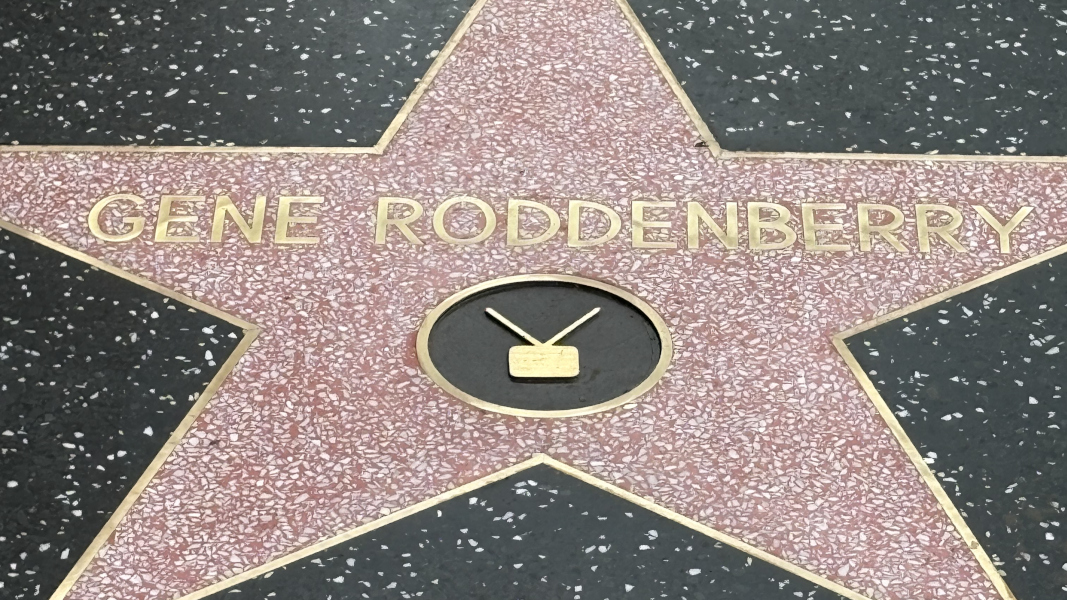
Gene Roddenberry’s Hollywood Walk Of Fame Star Restored; “Thank You” Says Rod Roddenberry
by Erik Amaya
While Star Trek looks to the future, September 8th, 2026 stood as a moment to look back at sixty years of the program and its numerous spinoffs. Celebrations occurred all over the country, but in Los Angeles, a particular event dedicated itself to giving series creator Gene Roddenberry‘s star a new shine.

Indeed, various Trek writers and talent — like Star Trek: Strange New Worlds stars Ethan Peck and Christina Chong and Enterprise fan favorite Dominic Keating — assembled on the 6600 block of Hollywood Boulevard to rededicate Roddenberry’s star on the Walk of Fame. First given to the writer/producer in 1985, son Eugene “Rod” Roddenberry said he considered a restoration effort on the star for “many, many months,” but the 60th anniversary made it an irresistible choice. The results, as seen in the photo above, are as spectacular as the U.S.S. Enterprise‘s refit in Star Trek: The Motion Picture.
Of course, the younger Roddenberry took the opportunity to thank his team at Roddenberry Entertainment for making the restoration a reality and, of course, the storytellers across the last 60 years who joined his father in the ongoing mission.
“This is something he would have loved,” he said. “I was here 41 years ago in 1985 when the star was first given to my father. It was one of the first stars in Hollywood to be given to a writer … Almost every story idea in this industry that has ever been created started with a writer. Every franchise, every character, every quote that I get at a convention, every line, all of it came from a writer, started with an idea of the blank page and depending on the era, maybe a stimulant or two.”
An executive producer on recent Trek programs like Strange New Worlds, Roddenberry also produced the documentary Trek Nation exploring his relationship with the elder Gene and the way others viewed his father. He recalled talking to original series producer Robert Justman for the project, who said the Trek creator was “a better philosopher than he was a writer.” Roddenberry agreed, remembering his father laying in bed and reading. “Every night I came in to say goodnight and that’s what he was doing. It was usually a non-fiction book, something about metaphysics probably or a biography on a world leader. He read books about the heroes of our past and the villains. He wanted to understand humanity.”
Now having worked on Star Trek himself, Roddenberry understood his father’s process better. “It was more about the ideas and the people. And when he got the star here, he talked about people.” One key idea he espoused during that 1985 speech: humanity is still in the nursery. “We’re in a childlike development right now. We’re young, we’re making mistakes, we’re arguing, we’re doing dumb, dumb things,” the younger Roddenberry said of his father’s statement that day. “But all children go through that, as he said. And we will come out on the other side. And he would end it with, ‘yes, and then we’re going to be something special.'”
That message also inspired writers like the late Michael Piller, who worked on Star Trek: The Next Generation in the late 1980s and early ’90s, Ronald D. Moore, another TNG alum who went on to develop the Battlestar Galactica reboot and For All Mankind. And then there’s the countless writers who came through the Star Trek office in the ’60s and the years after TNG and Gene’s death in 1991. No matter if they had a moment with him or not, they were still inspired by the key idea of the original series — we’ll get through it and we’ll be better — into compelling stories.
“That’s the thing about storytelling: [it] is part of who we are,” Roddenberry continued. “Before there was TV, movies, Hollywood, it all started with someone painting on a cave wall. They were sharing what they saw. And today, whether a story is true or entirely imagined, it’s always about something. Writers lay the foundation.
“When a writer is lucky, their ideas and their vision make it all the way in front of an audience. And that audience walks away with a perspective they might never have had … That’s not a small thing,” he said. “I would argue that’s one of the most important things we do. Star Trek is the proof that when it’s done right, storytelling can help shape the world. Since 1966, we’ve had countless super writers on Star Trek. Each one has given it their own fresh perspective while at the same time honoring its core values.”
He admitted the sets, effects, and “on occasion, the skin tight costumes,” made people interested in the show, but “they stayed for what was said. Who counts as a person? What might we be if we were a little less afraid of each other?
“The ideas are what they took home and what they still have sixty years later. Take the ideas out of Star Trek and you’ve got a show that was canceled in the ’60s. So 60 years of Star Trek doesn’t just belong to my father. It belongs to the writers who kept showing up and putting important ideas in it,” Roddenberry said.
He also pointed out that fiction is one of the safest places to tell the truth, something his father delighted in throughout Star Trek‘s original run. “We could use a lot more of that these days. There’s obviously a lot of fear, division and misinformation,” the younger Roddenberry said. “I don’t think we can lecture our way out of it.
However, I think we all know there is one thing we can do and we can tell our way out of it,” he said. “We need to keep showing what’s on the upside of the doom and gloom. Let’s keep creating stories that make people want to hear a different point of view that’s not their own. Stories that explain not just something is the way it is, but why it is that way. Stories that show things that are different are actually interesting instead of threatening.”
Roddenberry was quick to add that “being exposed to new ideas does not obligate you to accept them, but it can elevate your thinking.” That ability in stories can be inspiring. As he put it, “When we end up only going anywhere it’ll be because someone wrote it down first and make it look possible.”
He concluded his comments with this: “So, to my father and to all the writers who have kept Star Trek alive for 60 years, and all the upcoming writers that will keep it alive for the next 60, thank you.”
Shortly thereafter, he unveiled the restored star to a gaggle of fans and Trek veterans. It stands as a testament to the ability of writers to craft, inspire, and endure.
