
Talking Mad Cave Studios’ ‘Momo’ With John Cusack And Ignacio Noé
by Rachel Bellwoar
When you’re short on cash, and there’s a guy trying to kill you hot on your trail, bad options start looking good fast. Certainly, if the circumstances were different, Johnson might have thought twice about getting into the vehicle of a woman who almost hit him with said car, but as writer John Cusack and artist Ignacio Noé explore in their new graphic novel, Momo, beggars can’t be choosers. Before long, Johnson is on a mission involving Richard Nixon, Jackie Gleason, and French artist Antonin Artaud, but for more on that, here’s Cusack and Noé with the scoop:

Rachel Bellwoar: At its core, Momo is about two strangers who decide to team up and find out if two heads are really better than one. Before you started working together on this project had you known eachother long, and what has the collaboration process been like?
Ignacio Noé: No, we didn’t know each other. Well, actually, I did know him, because I had enjoyed his films many times. I have to thank Damien Hirst, the great English artist, for introducing us.
In 2010, the English publisher Other Criteria commissioned me for an unusual project: I had to create a comic set in Bangkok at night, based on the interview that critic Hans Ulrich Obrist wrote about Ashley Bickerton. This interview would appear in a major monograph on the American painter. This publishing house was owned by Damien Hirst, and since the comic was well-received, we started two new projects that later fell through.
Years later, in 2023, remembering that project, Damien Hirst offered me the opportunity to create a comic book based on the screenplay of a film he wanted to make. Shortly after I started the first sketches, he told me that the screenplay was by John Cusack. He introduced me to him, and from then on, I handled everything directly with John. It was a huge and happy surprise for me that an artist like him trusted me with this project.
Working with John was an excellent experience. He constantly invited me to contribute my own vision for the comic, always flexible and attentive to understanding my ideas, but also patient and clear in expressing his own. We were both committed and focused on the project, and that, I think, is what I’m most proud of.
At first, the work was very intense, especially defining the characters and the final sequence, something we tackled with a constant back-and-forth of emails and then Zoom meetings. John had a clear idea about the characters, although defining Animal was the most difficult part. Then I had a lot of freedom to develop the pages. When the work was nearing completion, we began an extensive process of adjustments. John began to precisely point out the weak sequences, and we improved the fluidity and impact of the images.
It was a very demanding project, but I’m sure that thanks to our smooth collaboration, we managed to present this highly original story in the best possible way.
John Cusack: Wonderful collaboration Ignacio has been a dream to work with. We are already working on our second graphic novel and it will be as wild as Momo.
Bellwoar: From the moment Johnson and Animal meet there’s no catching your breath — literally, Johnson is hanging out the window of Animal’s car because she can’t (or won’t) stop long enough for him to get in. What’s it like trying to create and maintain that momentum in a still medium?
Cusack: No difference than writing a script or a short story or novel — momentum can be felt on the page.
Noé: Maintaining that dynamic was the main challenge for me. I worked hard to move the camera enough so that the action wasn’t lost, while at the same time showing what was necessary to delve deeper into the story, because in addition to the movement, many things happen; there were many details to consider.
The opening sequence, where Johnson climbs through the car window and meets Animal, is fundamental. It was the first thing I drew, and I can say that with it, John and I learned to work together. It also foreshadows what’s to come in the book: a chance encounter in a dynamic reality that emphasizes, by contrast, a certain fulfillment of a predetermined destiny.
Bellwoar: Comics also don’t have sound yet I love how you came up with ways to incorporate music into this story. Do you listen to music while you work and why do you feel it was important that Momo have a soundtrack?
Cusack: Yes — in fact, we were suppose[d] to have a QR code that directly linked to the music/Sonic’s — from Hawaii Five-O theme to Solomon Burke to Nixon’s war on drugs speech.
Noé: Music is very important; it’s precisely marked in the script and is a continuous presence throughout the book. It had to be incorporated visually into the comic somehow.
John is a great connoisseur of music, and thanks to his script, I discovered Solomon Burke. I regret not being able to showcase a leitmotif that was left out. While creating the comic, I frequently thought of High Fidelity, a film I’ve always loved, and through which I discovered John’s work and began to pay attention to his great career.
I always listen to music when I work; for me, it’s inseparable from my life. Music connects with the deepest part of your soul, and that’s why it’s a possibility of salvation. I understand that’s the function of its presence in the comic, and especially in the final soundtrack of Momo.
Bellwoar: While Johnson essentially sticks to the same priest garb over the course of this graphic novel, Animal changes up her look (and wigs) multiple times. Did you enjoy playing with that contrast?
Noé: Absolutely! This is one of the many details of the comic that I enjoyed so much. From the beginning, it was something John marked as one of Animal’s characteristics, which is why we worked hard to develop a detailed wardrobe for all stages of the book.
Cusack: Yes, Animal decides who and what she wants to be every day when she wakes up — a totally unformatted person.
Bellwoar: Animal and Johnson end up crossing paths with a number of figures from pop culture. Of those people, Antonin Artaud is probably not the biggest name but why did you choose to feature him on the cover versus, say, Jackie Gleason?
Cusack: You’ll have to read the files — and the graphic novel — Momo and Jackie are inextricably linked by the Lords of Karma.
Noé: It’s true, many famous figures appear, and Jackie Gleason is one of them, although I must say I didn’t know him; he’s another of my discoveries while drawing this book. I have to admit I possess a profound ignorance.
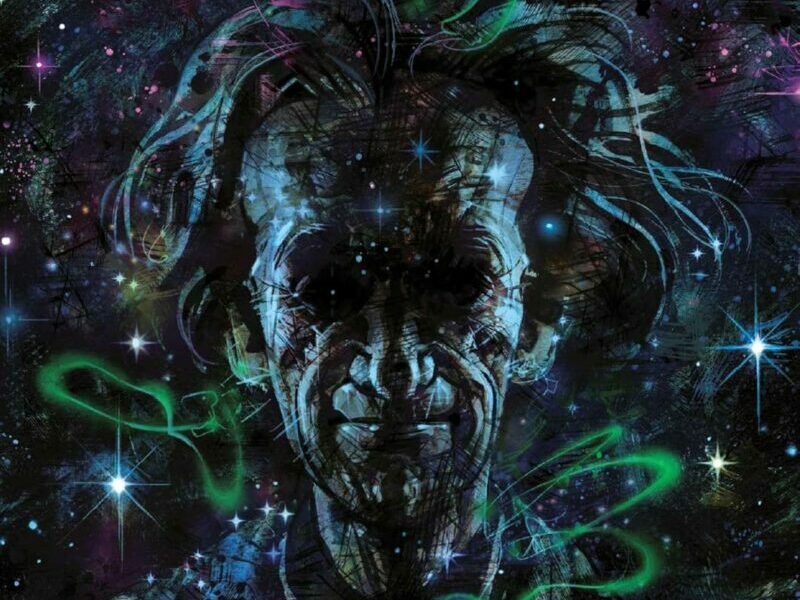
Jackie Gleason’s role is very important, but the story’s central figure is Antonin Artaud; he’s the key, and I think he deserves the cover for that reason.
Bellwoar: If you had to describe this book in one sentence to people, what would you say?
Cusack: A wild fusion of theological noir, cosmic satire, and darkly comic Americana — a mind-bending odyssey unlike anything else on the shelves.
Noé: Momo is a metaphysical pulp thriller. Almost without any doubt.
Bellwoar: Thanks for agreeing to this interview, John and Ignacio!
Momo is on sale now from Mad Cave Studios and lettered by Taylor Esposito.