
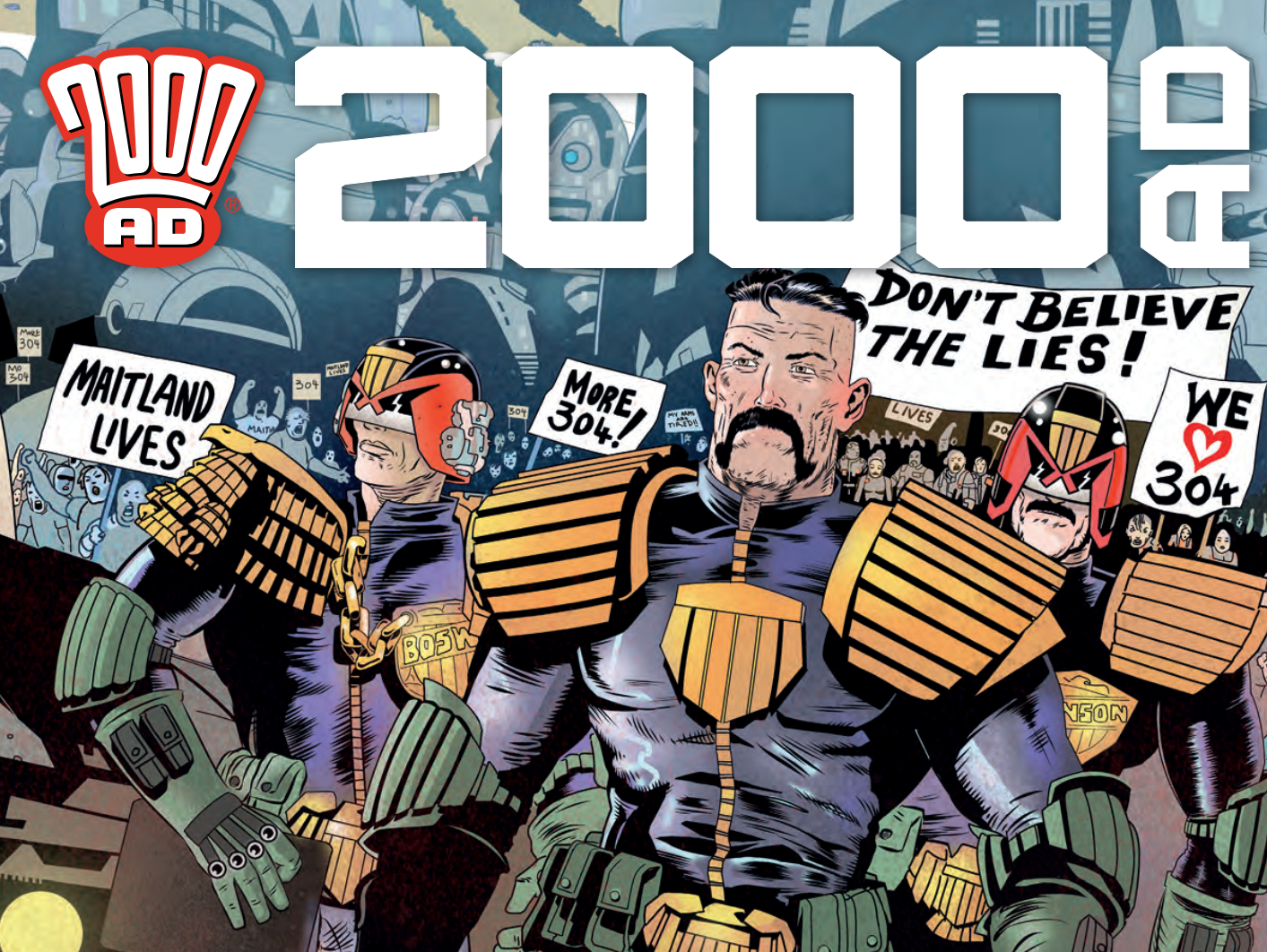
The Weekly 2000 AD Prog 2503: Hernandez On Patrol, But Dredd’s On His Case In ‘The New Future’
by Richard Bruton
Taking a look inside the UK’s greatest sci-fi comic, the Galaxy’s Greatest, fast approaching 50 years of brilliance — it’s the Weekly 2000 AD.

Another week of the wonders of 2000 AD for you now, and, as I keep on telling you, you won’t find a better weekly sci-fi anthology out there. Truly, for nearly 50 years now, it’s been the very best of Brit comics.
Again this week, it’s all the same five strips. And that’s no bad thing, as all five offer something good for you, indicative of all that’s great about 2000 AD: no strip like the other, packed with variety and great storytelling, with five very different visual approaches to the art you’ll see in here.
It all opens, of course, with Judge Dredd, and the latest episode of ‘The New Future‘, where we’re following Dredd as he investigates the death of Judge Maitland, killed because her ideas and her experiment were just a little too transformative and successful. It is just one of the best Dredds we’ve seen for a long, long time — in fact, since Rob Williams, Arthur Wyatt and Henry Flint gave us A Better World.
After The New Future, we’ve got more from Ghosted, where Guy Adams and Megan Huang tell a decidedly different sort of alien invasion tale. There’s also more Durham Red by Alec Worley and Ben Willsher, as the Strontium Dog’s vamp killer mutie finds herself on a strange world with no idea what she’s meant to be doing here. Then there’s more techno mysteries spinning out of Sinister Dexter from Dan Abnett and Tazio Bettin, as Azimuth continues. And then, to end the Prog, more from Herne & Shuck by David Barnett and Lee Milmore, where the meddling magician is planning how to rescue the children from the clutches of a demon.
Yes, five strips, all different, all good, and all proving, yet again, that 2000 AD is something you really ought to be reading.
All of it starts under a Stewart K Moore wrap-around cover for ‘The New Future’ that looks rather fabulous …


2000 AD Prog 2503 was out in the UK on 7th October. Which means I’m only a few days late here — again. Not bad going, really, with all that’s going on here. It’s also out in the Americas on 21st October, meaning you should be heading into your local comics shop and asking them to order it in for you. Honestly, you won’t regret it one bit.
Okay then, all that done, time to have a look inside the latest Prog …

Judge Dredd: The New Future — Part 3 — By Rob Williams, Arthur Wyatt, Henry Flint, letters by Annie Parkhouse
Well, ‘The New Future’ is already up there as the best Dredd of the year. In fact, as I said, I’d say it’s the best Dredd since Williams, Wyatt and Flint brought us ‘A Better World’, where they gave Accounts Judge Maitland the chance to prove her figures right, showing the Justice Department that there was a way to cure crime in Mega-City One. That she didn’t wasn’t down to Maitland — her experiment was working, only brought down by the combined might of the media and bad actors in the Justice Department.
We open here with Robert Glenn, media baron, the right-wing voice of MC-1, eagerly manipulating the citizens into hatred and violence to suit his own ends, a key figure in bringing Maitland down. He’s now commanding an all-powerful grip on all media in the City, controlling what’s seen and heard, his power-grabbing, sociopathic, ego-driven desires made all too real as he spews his bile over the airwaves. It’s perfect Dredd writing from Williams and Wyatt, echoing what we see all around us today.
Of course, the other side of his plans for domination involves getting Judge Hernandez into the Chief Judge’s job. He’s marching, triumphantly, into Sector 304, Maitland’s Sector, every bit the Chief Judge in waiting, put there by his association with Glenn and his part in bringing down Maitland, all part of his designs on the Mega-City throne.

It would almost be too easy — if only it weren’t for Dredd. Because Dredd is on his case. It’s only suspicion, of course, but Dredd’s suspicions are powerful things.
And then there’s the journalist, Roth. In possession of the Maitland files, his attempt to publish last episode was blocked, inevitably, by the SJS Judges. Now he’s on the run, hunted by SJS, the only one in possession of all the facts, facts that could kill him, facts that could potentially blow up the Justice Department.

Oh, ‘The New Future’ is something very, very special. It’s taking everything from ‘A Better World’ and running with it, creating this perfect political Dredd. We’re several episodes in now, and it’s just packing on the tension, all building so well. And of course, everything is made so much better by the way Henry Flint is just excelling himself here, every page full of invention, the best work of his already stellar career.

Ghosted Book Two — Part 4 — By Guy Adams and Megan Huang, letters by Simon Bowland
Back to the now in Ghosted, in this established pattern of an episode from 13 months ago, followed by an episode from the now in this tale of an Earth invaded and how one shielded city-state, Kinshasa, is dealing with matters in a particularly secretive and brutal fashion, one involving its lower citizens being conscripted and transformed, painfully, into their army against the alien invaders.
Ghosted isn’t a strip you’re going to enjoy if you’re after something simple and easy. No, Ghosted is challenging, frustrating, complex, playing with ideas, and not giving up its secrets easily. But if you’re in any way interested in uncovering those secrets, if you don’t mind having to think about what’s going on on the page, you’ll find Ghosted something that frustrates in all the best ways, keeping you on edge, surprising you, intriguing you. It’s great writing from Guy Adams, backed up with Megan Huamg’s art, deliberately, I’d imagine, keeping things simple in terms of layouts and style, all the better to play against the complexity of the ideas here.
Anyway, back to the wilds outside the shielded city-state of Kinshasa, where there’s just a few of the neurally-transformed warriors sent out by Kinshasa to fight the aliens at the gate, exploring new freedoms, aware of how they’ve been manipulated, lied to, and tortured for the state. This is where the line is drawn, indeed.
And former rich kid Benu, whom we followed all through Book One, is now part of this little resistance group, undergoing her own transformation…

She’s already figured out that the alien war that those in the Trust have been sending the expendable of Kinshasa society to fight is a whole lot closer than anyone’s been told. Now she’s being dissected once more. All for the greater good? And where does this tie into the scenes from a couple of episodes back where she figured out she had been implanted with a bomb by the aliens? Oh, it’s all part of the mystery of Ghosted.
Like I say, Ghosted is one of those that takes a bit of work on your part. But that’s never, in my experience, a bad thing, and Adams and Huang have crafted something rather special, a difficult, fascinating thing that I find myself getting drawn into with every episode. I have no idea where we’re going in Ghosted, and that’s all part of the appeal.

Durham Red: Hungry City — Part 4 — By Alec Worley and Ben Willsher, letters by Simon Bowland
More action and mystery with Durham Red now, again, completely different to anything else here in the Prog. More of an all-out action thing, laced with a little mystery — mostly concerned with Red attempting to work out why the hell she’s here on Mondo Carnivallo, Hungry City, a Resort Station, where the crime syndicates have a bit of a free-for-all.
She woke up to bloodshed and a giant rabbit’s head in her lap. Ever since then, she’s been playing catch-up. And, as she said last episode …

Here, we’re catching up with more of the giant rabbits, seemingly crime bosses, a syndicate family, ruled over by Master Donnie, an addled thing with strange hair — no, absolutely no reference there to anyone we may know.
Donnie’s grieving for his dear departed dad — the bloody and decapitated giant rabbit we saw in Red’s lap back in episode 1. Although said grieving appears to consist of butchering Hendrix lyrics and manically spouting insane claims of superpowers (he can take a dump three years into the future, apparently), and plentiful conspiracy theories (did you know moles can burrow into people’s heads and drive them around like cars?) Again, no reference here to any particular world leader. Oh, absolutely not.
But after that little funny dig, Worley and Willsher head off into establishing the politics of the syndicates, with the Seizuki Family offering a temporary merger, something politely refused by Donnie’s consigliere. Although he does want any information they can come up with regarding Durham Red’s ‘retiring’ of Donnie’s dad. But whilst they’re all having a chat, they’ve failed to notice that Donnie’s on the loose, meaning there’s a mad rabbit out there, looking to prove to dear old (dead) dad that he’s not a complete screw-up.

As for Red, she’s attempting to put together her memories of being here. Off to hit the strip joints, looking for someone.
This Durham Red story, like all that Worley and Willsher have done prior to this, is a hell of a lot of fun, Willsher’s eye-popping art just looking so good here, as we wander along with Red, piecing together the why and the how she’s here, not to mention wandering just when it’s all going to go tits up for her, as Donnie and others track her down.
A little bit of mystery, a nice bit of over-the-top comedy, and a hell of a lot of Red action. This Durham Red series really does hit the spot.

Azimuth: How To Train Your Dagon — Part 4 — By Dan Abnett and Tazio Bettin, colours by Matt Soffe, letters by Rob Steen
So, we’re with Dexter, Cass and Suzi Nine on the hypotheseas, the building blocks of Azimuth itself, where the Captain of their little boat has revealed himself to be rather a backstabbing bastard, albeit a backstabbing bastard on a mission from ‘a mutual acquaintance’. So, he’s been told to test the Outsiders, Dexter and Cass, to find out if they are who they claim to be: ‘Outsiders… freaks from the impossible outside. Freaks who could change everything,’ and who’ve ‘come from the outside to end the feral A.I.’
Thing is, the test involves dropping them down into the Hypotheseas …

Yep, that was the end of the last episode. Here, we get a little of the trouble Dexter and Cass are in — fishes, bit fishy things, big fishy things with big fishy teeth.
But we also get, with the Captain and Suzi Nine Millimetre, something of a backstory, the tale of how Azimuth (perhaps) came to be …

Citigenesis? AI taking over, plagues, faux news, the false facts … why that could almost be today, couldn’t it? Oh yes, there’s always been that rich vein of sci-fi shining a light on our lives in 2000 AD, and Abnett’s not one to shy away from it here.
The Captain goes on, telling of Anicca, the feral A.I. taking over Downlode, the world, and then casting her consciousness to other worlds … which could well explain why Judge Cassandra Anderson of a Mega-City One (not, we’re assuming here, THE Mega-City One) came to be included.
So here we are, two strangers cast into a strange world, Ramone Dexter from Sinister Dexter and Downlode, Cass Anderson, from a MC-1, down in the Hypotheseas, coming face to face with the Dagon, and about to meet a trio of familiar (well, one at least) faces — with Abnett really casting his net far and wide in the 2000 AD multiverse. Who are they? Well, you’ll have to wait till next week for that little revelation.
But, like I say, and keep saying, Abnett’s doing good things here, really playing with us, playing with the strip, playing with the links to Sinister Dexter and to other bits of 2000 AD, and playing with them so well. It’s transformed the world of Sinister Dexter, turned it properly on its head and given it new life.
And all of that wouldn’t have been half as good were it not for the wonderful art of Tazio Bettin, giving the world of Azimuth a beautiful, techno-infused look that is so perfect. But more than that, it’s consistent. Bettin is the architect of Azimuth; and it’s his consistent and beautiful vision that makes it work, something that Sinister Dexter, over the years, suffered from, with multiple artists, multiple styles somewhat diluting the story Abnett was telling. None of that here in Azimuth, just this wonderfully out there world to explore.

Herne & Shuck: Storming The Stone — Part 4 — By David Barnett and Lee Milmore, colours by Quinton Winter, letters by Annie Parkhouse
Our raggle-taggle magician and his crew are plotting a way to get young Caris out of the clutches of the St Michael group, meaning they’re going to need to infiltrate the St. Michael base underneath Stonehenge.
Trouble is, not only are the St. Michael group aware of this, the group have had something of a hostile takeover, as seen last episode, where the demon Moloch, inhabiting the body of Tory twat MP, Alex Ramsey-Hall, now controls all the resources of the group. And knowing Herne’s plans, and knowing where they are, Moloch/Ramsey-Hall sends a little welcoming party…

Here, though, we’re going back a little bit, to before the forces of St. Michael are about to wreak havoc on Herne and Co’s base of ops. We get the tale of the exorcism that Herne missed, and the story of how Moloch came to possess Ramsey-Hall.
Turns out, it’s all to do with Herne and that exorcism he missed. Why did he miss it? Well … he was running late …

Or, alternatively, Herne was, at the time, ‘shagging a succubus.’
Well, picture the scene … you’re a young magician, hormones all over the place, and who amongst us can say we haven’t made some bad decisions along the way? It’s just that our bad decisions don’t tend to result in an all-powerful demon being set loose upon the world. And once that little bit of previous exposition is all over and done, time for the attack.
There’s a hell of a lot to enjoy here in Herne & Shuck, where Barnett writes it with a mix of deep ancient British folklore and just the right amount of sarcastic, knowing humour. The characters have been given life, made interesting, made fallible, and in doing so, makes it all the more readable and enjoyable. Likewise, Milmore’s found his style here, his first major series, finding a sweet spot where he can give us the horrors and the humour.


