
Reviewing Deaf Crocodile’s ‘The Scarlet Sails’, Or Why All Fairy Tale Film Fans Need This Movie
by Rachel Bellwoar
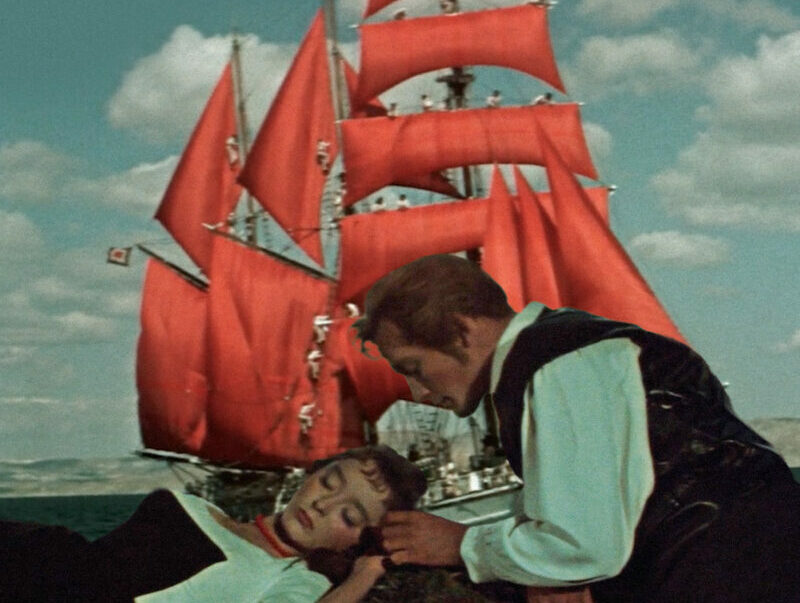
As an introduction to the films of Aleksandr Ptushko, The Scarlet Sails might not be the kind of movie the Russian director is best known for. That would be high fantasy epics like Ilya Muromets or Sampo, but fairy tale lovers looking for an entry point into his work will want to scoop this film up (assuming the box art by Sam Hadley or cover art by Beth Morris hasn’t already done the trick — one look at those colors plus sailboat and I knew I was a goner).

It’s a small price to pay, though, to experience this beautiful romance for the first time. Scarlet Sails might not immediately seem epic the way thousands of extras and a dragon would (see Ilya Muromets), but a love story where you get to see the two leads grow up and be played by different actors is as sweeping and epic as it gets. Assol (played as an adult by Anastasiya Vertinskaya) and Arthur (played as an adult by Vasiliy Lanovoy) couldn’t come from more different walks of life. Assol’s father (Ivan Pereverzev) scrapes by on money he earns making toy boats while Arthur is next in line to become a count. Logically speaking, there’s no reason they should ever cross paths except there’s nothing Arthur wants less than to follow in the footsteps of his entitled father (Pavel Massalsky). The life of a sailor is the life for him and he’s willing to forsake the privileges of his birth to prove it.
In their conversation recorded for this release, film critic Tim Lucas and Swamp Thing artist/film historian Stephen R. Bissette point out that Scarlet Sails could be seen as a film about the freelancer life and the lonely path of the creator. It’s certainly an aspect of this film that stands out. In the same way you hear about artists who couldn’t get anyone to buy their work when they were alive, only to have their pieces fetch millions after their death (see Vincent van Gogh), this film is very conscious of the ongoing struggle of the artist to keep going against discouragement and ridicule. It’s a small moment, but one of my favorite scenes occurs when Assol’s father gets paid a pittance for one of his boats, only to immediately stop and share some of his earnings with a street musician. As someone who’s seen how often it’s the people who don’t have money to spend going the extra mile to support other artists, this scene speaks volumes to this film’s hipness and sense of humanity.
This isn’t the only detail Scarlet Sails gets right, either. Maybe its portrayal of sailing feels a little suspect or too romanticized, in correlation with how Arthur sees sailing. But, at one point, young Arthur (Aleksandr Lupenko) overhears a servant (Nataliya Orlova) say she can’t afford her dowry to get married. He immediately tries to supplant the funds with his piggy bank. Now, this is a future count’s piggy bank, so it might actually be substantial but the film never overtly says whether or not she got married. She is shown still working for the family when Arthur grows up. Does that mean she didn’t get married? It’s impossible to say definitively and it does place some limits on the impact of Arthur’s gesture, but it doesn’t make the gesture less kind or make it worthless just because it might not have worked out like he intended.
Assol is a fascinating female lead as well. In film historian Celeste de la Cabra‘s visual essay, I really appreciate that one of the things she tackles is how the damsel-in-distress, while arguably an accurate read of Assol’s situation, isn’t a fair summation of who she is. Essentially, as a child she meets a “sorcerer” (Nikolay Volkov) who tells her one day she’ll fall in love with a prince on a boat with red sails. Assol believes him, even though it means opening herself to mockery by children and adults alike. Scarlet Sails recognizes there’s a bravery in that decision. There’s nothing silly or naive about dreaming. In fact, it’s essential; just like this movie — which may be full of coincidences, but is completely devoid of magic. It is a deliberate choice De La Cabra unpacks as well.
In addition to the bonus features already mentioned, there’s also a commentary by film historian Rich Johnson that provides a ton of background on Ptushko and compares his career with that of Russian director Alexander Rou. Maybe we can work on some Rou releases next, Deaf Crocodile (that and Ptushko’s Sadko/The Magic Voyage of Sinbad, which Lucas and Bissette bring up in their conversation)? For the essay booklet (which uses Hadley’s box art if you can’t afford the limited edition), Russian film historian Peter Roliberg gives American viewers a much needed crash course on writer Aleksander Grin, whose novella Scarlet Sails is adapted with this film. Not that everything is biographical, but there’s a lot about Scarlet Sails that makes more sense after learning about Grin’s life. Film critic Walter Chaw celebrates Ptushko’s imagery in his essay. There’s also a tribute to artist Tony Stella, who passed away far too young and provided paintings for Deaf Crocodile’s previous Ptushko releases.
The Scarlet Sails is available on Blu-ray starting December 15th from Deaf Crocodile. If you love Jacque Demy movies or the artifice of films like Black Narcissus which create worlds rather than shoot on-location, you owe it to yourself to check out this movie.

