
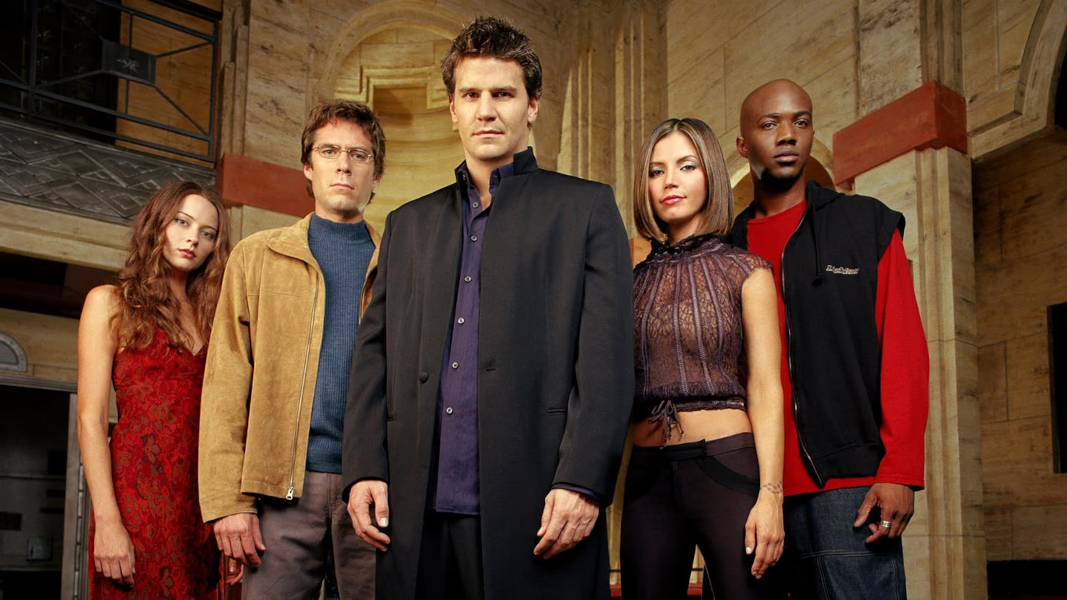
Characterization In The Buffyverse — ‘Angel’ Season 3, Episode 1
by Benjamin Hall
This is part of a bi-weekly series concerning the characterization of Buffyverse characters. Arguably the best place to begin reading this series is at the beginning, but that is up to each reader. As a reminder: this column will cover major and some minor characters from the shows Buffy The Vampire Slayer (1997-2003) and Angel (1999-2004). Other Buffyverse media, such as the graphic novel Spike: Into The Light (2014), are not pertinent to this series. Also there will be no references to real world events that have direct relation to either program. That said, references to things that have no direct relation to the show in order to examine certain elements, such as metaphors and literary analogues, will appear.

This week: Two vampire romantics face off against Angel Investigations. Also, Angel (David Boreanaz) relates old history to his allies.
(Warning of spoilers from this point on!)
(Trigger warning for mentions of infanticide and suicide)
Angel in the present day is more jovial than the brooding version of Angelus in the flashbacks. This is at odds with the fact his present self should be feeling constant guilt from his curse — plus the grief from Buffy Summers’s (Sarah Michelle Gellar) death. Speaking of which, Angel never really expresses it verbally or physically despite declaring his love for her. Thus, James (Ron Melendez) may be right in saying that Angel’s feelings for Buffy are not true love. Additionally, one can put forth that Angel abandoning everyone to go to a monastery for months is selfish since he neglects his personal responsibilities, including helping Fred Burkle (Amy Acker). When it comes to Angelus emotionally manipulating James and Holtz (Keith Szarabajka) in order to escape could indicate Angel is not a real fighter. Granted, this cowardice is on display even in his early appearances (Buffy The Vampire Slayer Season 1, Episode 2 ,“The Harvest”).
Cordelia Chase (Charisma Carpenter) displays knowledge of horror movie tropes while applying them to real life. At least that is what one can argue when she tells Angel she does not want to go home alone. However, this disagreement is also a plot point since it helps distract Angel from knowing James is already in the hotel. Between this plot-specific debate and Cordelia demanding the rest of the story on James and Holtz, she is a puppet of the plot. Additionally, her fighting ability sees regression during the confrontation with James in order to give Angel someone to protect. There is also the odd moment when she remarks on the effects of the necklace in combination with her cleavage. This feels out of character for her.
Wesley Wyndham-Pryce (Alexis Denisof) and Charles Gunn (J. August Richards) are on a wild goose chase for most of the episode, and this limits their growth. At the same time, they both get develop an admiration for Fred, which plants the narrative seed for the future love triangle (Season 3, Episode 13, “Waiting in the Wings”).
Fred’s sense that her current reality might be a dream is understandable because of her recent past trauma. And seeing her hotel room as a safe space is also sensible. These two things, plus her reluctance to leave the room, suggests a lack of comfort with moving forward health-wise. Unfortunately, the lack of treatment — along with her future recovery –means she is in a stereotypical state of being mentally unwell; she is living out the fiction that one just heals with time and no legitimate help, medical or otherwise.
Darla (Julie Benz) has a conversation with Angelus in a flashback that results in no change to her characterization in the past or future. Still, she has a change in status in the present: she is pregnant and trying to kill the baby via smoking.
James and Elisabeth (Kate Norby) are two vampires in love with each other. In a way, they are a variant of Spike (James Marsters) and Drusilla (Juliet Landau). This duo’s only differences from their younger counterparts seems to be faithfulness to each other and a relatively healthy version of co-dependence. Their fighting styles also differ from Spike and Drusilla’s own, specifically being less thoughtful and more emotional. Also, the dependency these elder vampires display for each other results in James going on a literally suicidal vendetta.
Dr. Gregson (Bob Morrisey) and his nurse, Sandy (Dalila Brown-Geiger), simply serve as medical staff who provide illicit procedures to demons. They have a lot of potential as characters to affect future plot lines, but will never see use again
Lorne (Andy Hallett) exists here to provide a musical number. He also gives Angel Investigations additional information about Dr. Gregson.
Glith-roo (Bob Fimiani) is a codger demon who loves Lorne’s singing. This demon is a gag character since he acts and looks like a stereotypical old man.
Vamp #1 (Christian Svensson) and Rough Man (Robert Madrid) are nothing in this narrative. In fact, they could easily be written out of the episode, replaced by inanimate objects.
Bobby (Sam Littlefield) and his girlfriend (Unknown) are stock characters Elisabeth kidnaps. While unimportant as characters, they obviously will break up after Angel Investigations rescues them because of Bobby’s decision.
Pilgrim (Koji Kataoka) exists for Angel to have someone to exposit to about the reason for the now-empty monastery. Thus, this nameless Pilgrim is rather pointless to this episode’s narrative.
Holtz exhibits overconfidence, yet at the same time he also appears wary when confronting Angelus. The combination of both results in him going for information about Darla’s whereabouts versus just ending Angelus.
Merl (Matthew James) continues to act as an informer to Angel Investigations. But in this episode, he barely gets to give exposition since Lorne takes over providing the remainder of it.
The Shur-hod demons (Cast Unknown) are barely stock characters. They only exist to reference and homage martial arts movies as well as for the sake of a joke.
The characterization in this episode quickly comes together, as things go, within a paint-by-numbers narrative. Yet, one can say the use of metaphors and parallels takes precedence over the characters experiencing major developments.
