
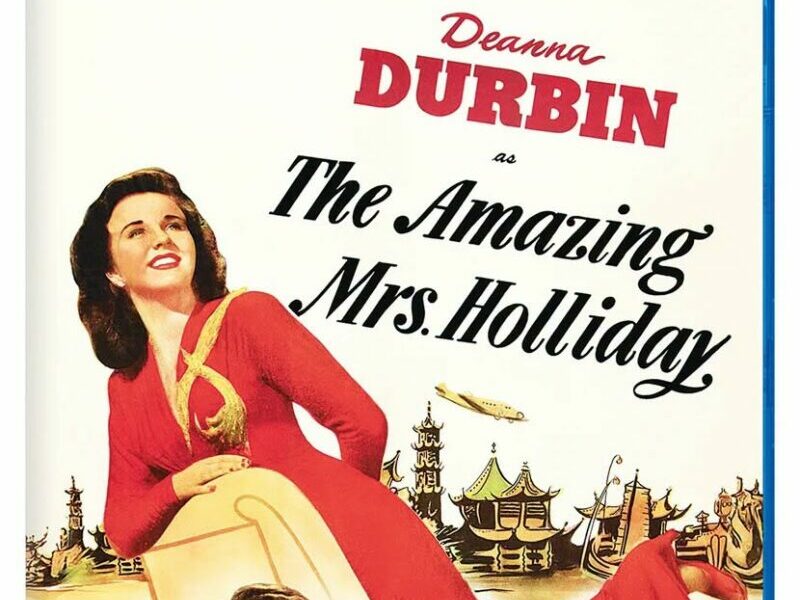
Deanna Durbin’s Wartime Picture: ‘The Amazing Mrs. Holliday’ (1943) Reviewed
by Rachel Bellwoar
Set during wartime, Bruce Manning and Jean Renoir‘s The Amazing Mrs. Holliday isn’t a complete departure from the Deanna Durbin formula.
She’s still playing a protagonist who sees the best in people. She’s still being provided with excuses to sing (a lullaby here, a fundraising event there). She’s not a child actor anymore, though, and this film allows her to graduate to playing an adult. In fact, the way she’s filmed suggests she might’ve been pregnant at some point during filming. There are a lot of big coats and holding of objects in front of the stomach. I couldn’t confirm when her children were born (and it’s not any of my business really) but this is where a bonus feature would’ve been neat to provide some context. Universal’s Blu-ray is barebones but does offer subtitles.

Some things never change — a big part of the plot is whether she’ll end up with the guy (Edmond O’Brien), but it’s complicated by the lies she has to tell in order to ensure the war orphans under her care aren’t separated or forced to leave the country. You see, they technically don’t have passports but Ruth (Durbin) promised her uncle (John F. Hamilton) on his death bed that she would take care of them. Then the boat they were on got torpedoed. Then the Commodore (Harry Davenport), who (allegedly) promised to house the children and pay any necessary immigration fees, went down with his ship.
While Ruth wouldn’t make a story like that up, that doesn’t mean there’s not more to it, as gets revealed in flashback. Now Ruth has to appeal to the Commodore’s family for help — what starts out as a pointless venture, except agent of chaos Barry Sullivan is with her and, unlike Ruth, he has no problem lying.
If Ruth were a stickler for honesty she would put a stop to his tall tales right away but it’s not for herself that she keeps up the charade. It’s for the children and, honestly, it’s a refreshing moral gray note to her character, who might be expected to be a goody toe shoes. She may be moral, but that doesn’t mean she’s not going to put the children first.
Because this film actually came out during WWII, there’s a lot of unsoftened anger directed at the Japanese (who are referred to as “Japs” and with plenty of venom). The portions set in America are familiar territory for Durbin, but the choice to include flashbacks means seeing Durbin in a warzone, which is more startling.
There’s also a consolidated effort to acknowledge America’s alliance with China (much like the Good Neighbor policy resulted in a number of films featuring Latin American acts). A great book to read for more on this is Christian Blauvelt‘s Hollywood Victory, but in Mrs. Holliday Ruth sings one song in Mandarin. There are also some misguided choices, like some stereotypical music cues and the wild decision to only refer to “the Chinese baby” as “the Chinese baby” for most of the movie, instead of giving him a name. Then in the closing credits, where all of the other children are named, he’s not. It’s just “the Chinese baby” — no name for the child playing him.
The Amazing Mrs. Holliday is an unusual film from Durbin’s oeuvre but it is available on Blu-ray from Universal and can be purchased from Movie Zyng.

