
Talking To The Wrong Guy: An Interview with `Draculina: Blood Simple’ Writer Christopher Priest
by Tom Smithyman
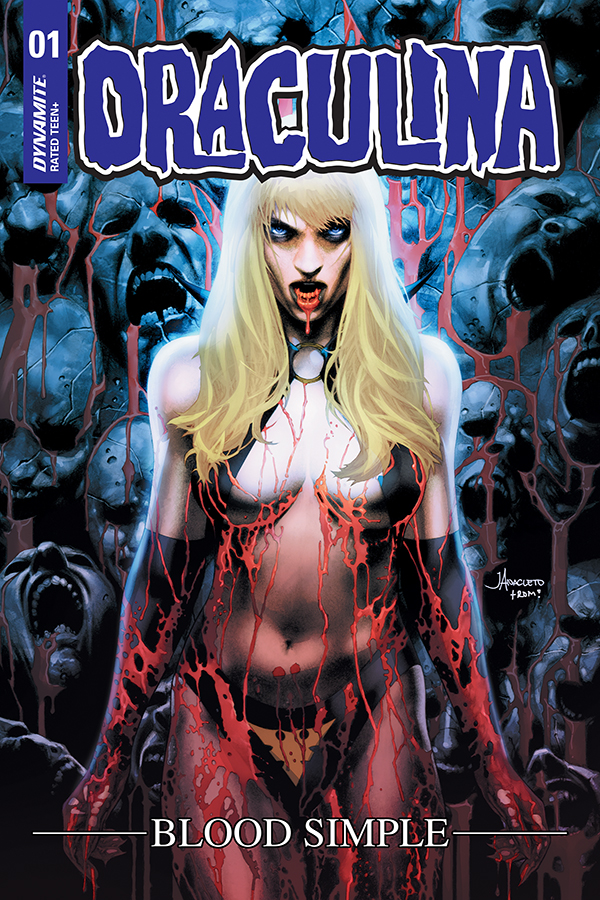
Vampirella’s sister Draculina is back in a new Dynamites series this February. In Draculina: Blood Simple, writer Christopher Priest crafts a tale featuring nearly every character from the Vampiverse. In this exclusive interview with Comicon, Priest discusses predators, the characters’ longevity and his Casper The Friendly Ghost theory.
Tom Smithyman: The title of the new series is called Draculina: Blood Simple. What does that phrase mean?
Christopher Priest: It means we ran out of ideas for arc titles! 🙂
This is a story about predators: people who live by the blood of others and who are related by blood to one another. So, I figured, sure, why not “Blood Simple?” 🙂
Smithyman: This story is a family affair, with the introduction of Draculina’s brother Leviathan. What does he bring to the story?
Priest: A lot of smelly sea water. I’m not sure that we can actually call him “Leviathan” for legal purposes, so we named him “Levi.” Imagine what Ben Grimm might be if Marvel allowed him to run amok murdering people: a perfectly likeable huge guy who happens to be very scary looking. A monster with a sense of humor.
Smithyman: You’ve written Draculina before and have over 50 Vampiverse issues under your belt. What is it about these characters that makes them so interesting?
Priest: That’s actually a good question because Vampirella and Draculina were here long before I was and, I imagine, they’ll be around long after I’ve moved on. At the moment, the fun, for me, is the investment Dynamite has made in the characters and in my work. They’ve allowed me to craft my own interpretation of these legends and have enthusiastically supported our work.
I’ve grown accustomed to navigating more complex shared universes, which usually involve my scripts coming back red-lined, “You can’t do this because Banana Man is having rhinoplasty this week over in his book,” or, worse, having creative designs interrupted by massive line-level crossovers that have nothing to do with us.
What interests me most about Vampirella is my Casper The Friendly Ghost theory: that, like Casper, Vampi simply wants what we all want – acceptance, community, love. But she happens to be a blood-sucking vampire from outer space, and that tends to freak people out.
Draculina, on the other hand, is a near polar opposite of that idea. Vampi just wants acceptance and community. Draculina is too wounded, has suffered too much for too long and is unavailable to be loved or accepted. So she’s more of a nihilist who simply wants to watch the world burn.
Between the two is Vampirette, our preteen Katie, who sees, in her alternate reality self Draculina, the possibility of who she could become and wonders if she can escape that fate.
Smithyman: It’s not just you, but most of the creative team is returning, including artist Michael Sta. Maria. How do you collaborate when you are working on the story?
Priest: I had some extensive conversations with Michael before beginning this arc, asking him what kinds of things he enjoyed drawing and what things he didn’t. Levi emerged from those conversations.
Michael is one of those rare artists whose work improves by leaps and bounds with every issue. Don’t take my word for it, go back and map his progress over the years. He’s one of those guys whose work evokes a gasp when the pages land on my desk.
A writer can only hope for the best, hope the artist understands the theme and mood the writer is going for. And, every now and then the writer gets lucky and gets people as invested as Michael and our colorist Ivan Nunes, both of whom swing for the fences every month.
Smithyman: Families can be messy, but this family takes the cake, right? It’s literally the family from hell. Do you find story inspiration from your own family drama, or do you draw from other sources?
Priest: I think every writer is striving to find truth; that’s what makes writing cathartic. In my experience, I have encountered two kinds of families: families with messy problems and families who pretend they don’t.
Now, if you’re hanging out with people who annoy you, you can just stop. You can change bars, change churches, change schools. But if these same people are your family, well, you’re kind of stuck.
While Blood Simple is obviously not autobiographical (I mean, I don’t think I have any vampires in my family), the tension and pressure points the story illustrates are universal. They’re just being played out by sociopathic demons and fallen angels.
Smithyman: You’ve had the opportunity to write many of the most iconic comic book characters, from Batman to Spider-Man to Black Panther. And in a few months, your Superman: Lost debuts. Is there any thread that runs across all of your stories, or do you just enjoy writing some of these fascinating characters?
Priest: I think, perhaps, the common thread of these characters is I am the wrong guy to write them. I am literally the Wrong GuyTM. Marvel has a certain flavor and DC has a certain flavor. Publishers have a rhythm, and a fan base comes looking for and expecting certain things.
And then you have The Wrong Guy. Keith Giffen was a Wrong Guy. Grant Morrison was a Wrong Guy. Garth Ennis, Frank Miller could not possibly be more Wrong. These are not mainstream writers. The late Denny O’Neil, my mentor, was O.G. Wrong Guy, existing outside of the mainstream to the point where he wasn’t accepted and wasn’t considered cool, and his brilliant Green Lantern/Green Arrow didn’t sell.
A lot of our most cherished and beloved classics didn’t sell. They sell now, Watchman and Sandman, O’Neil’s GL/GA. But a lot of ideas encountered fan pushback because those ideas, like the Giffen/DeMatteis Justice League International, seemed to challenge or even mock convention. It’s hard to imagine Frank Miller not being the industry giant he is today, but I was there, at Marvel, when the receptionist didn’t know who Frank was.
The way I think tends to go against the mainstream grain, so my writing is kind of an acquired taste. Most everything I write, from Panther to Quantum & Woody, to last year’s U.S. Agent, mocks everything the mainstream stands for. I was, however, the Right Guy for Deadpool, which was probably why Marvel fired me.
Vampirella and her ilk is an anomalous safe space for me because I control my corner of it. I work for people who “get” me, who find the dark humor in Vampi speed dating or Draculina doing her Paris Hilton bit. Now, how will any of that translate to Superman, THE most main of the streams, is something you’ll have to tune in to find out. I mean, DC let me write Justice League for 10 issues, and I had them all turn on Batman and got the JL sued.
I am THE last guy anybody should ever ask to write Superman. But I’m so very grateful somebody did.
Smithyman: This title is about Draculina literally coming to terms with her inner demons. What is your most persistent inner demon and how do you deal with it?
Priest: You really expect me to answer that? 🙂 Let’s just say I’m a guy haunted by regret. I have reached an age now where I can soberly assess the trail of bad choices I’ve made along the way.
The main difference between myself and Draculina is I, like most of us, am trying to do something about my shortcomings. Draculina, like many people we all know, is a dysfunctional type who, rather than deal with the painful process of reconciliation, plunges deeper into that dysfunction.
Maybe she should run for political office.
Smithyman: She wouldn’t be the first bloodsucker in office! Thanks so much for your thoughtful answers – and best of luck with the new series.
