
An Interview With ‘Steady Rollin” Graphic Novelist Fred Noland
by Rachel Bellwoar
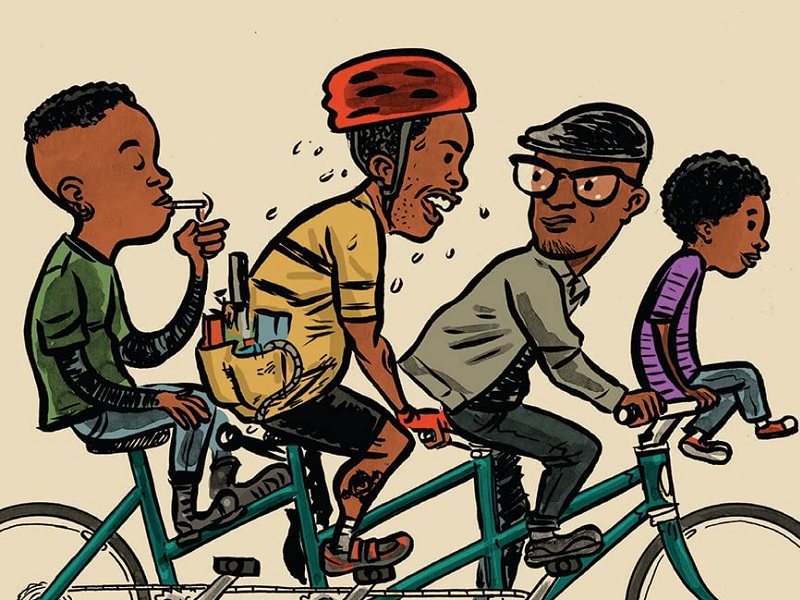
“Son of a Preacher Man” is a great song. It’s also what Fred Noland was growing up in Texas. Now, in a new graphic memoir coming out this April, Noland shares all. From his mom’s theory about black & white TVs, to his experiences in mosh pits, to visiting New York with his son, Steady Rollin‘ covers a wide variety of subjects, a few of which I asked Noland about over email:

Rachel Bellwoar: Usually a table of contents doesn’t inspire much notice. Where did you get the idea to break-up the table of contents, and use it to divide the book into four sections?
Fred Noland: When I was working out a running order it occurred to me to group the stories roughly as they happened from childhood to the COVID era. I didn’t create the stories with any thought of reprinting or collecting them so there’s no unified format. Sometimes there isn’t even a title. It’s just anarchy. So running the table of contents like that hopefully won’t leave the reader guessing what they’re reading.

RB: For the most part the sections seem to loosely match-up with the title (Preacher’s Kid, Black Punk, Pedaling, and Papa), with the first section focusing on your early childhood, while the pandemic comes up more towards the end, but there is a pandemic-related outlier or two in the first section and I was wondering why you decided to include them there?
FN: Sadly, it’s just economics. I had to group all the color pages in one section at the beginning, middle or end to keep printing costs down. So the first few pages jump around a little chronologically.
RB: True to your first story (about how much a gift from your mom of a 64 box of Crayola crayons meant to you), Steady Rollin‘ constantly experiments with different approaches to color. How much fun was that to play with?
FN: Color is fun but challenging. I never studied color theory so I kind of struggle creating palettes. And that’s where the different approaches come in — incompetence. Procreate makes it a little easier. I can just steal color schemes from someone who knows what they’re doing.

RB: Without having to go into detail about how having your crayons taken and destroyed by a classmate affected you, the gravity of that event is completely felt in the lines: “I had no idea what to do and, in the end, did nothing. / Nothing but watch my trust and belief in people whither a little.” Just by placing that first line at the top of the panel and the second line on the bottom, so there’s a pause between the sentences, makes them really resonate. Have you always lettered your own comics?
FN: I’m a one-man-band so yes, all the letters, inks, misspellings. I’m so happy you noticed that. I try to think about how I would meter my words if I was speaking and tried to translate that to the page.
RB: I also appreciated the moments you allowed for reflection or for sharing how certain memories feel differently now. Was the process of putting this book together cathartic, or was it difficult sometimes to be so personal?
FN: It was all the things. When J.T. asked me to assemble a collection I thought ‘this will be fun and easy” but the sketchbook stories were planted in over a dozen sketchbooks at home and in my studio. And there was A LOT more work to sort through than I realized. I’d completely forgotten about some of them. And I didn’t realize how much I write about my family. Stories like ‘I Need More” recontextualize the past in a really satisfying way. Others remind me of sometimes not-so-pleasant or just plain weird things that were happening at the fringes and maybe not even mentioned in the story. The comics with my son caught me off guard. He’s so much the same and so completely different than he was in the events that seemingly happened yesterday. Ultimately it is pretty cathartic because it captures a journey and I like where I am now. And I hate that I wrote that last sentence.

RB: Without naming names, there is a celebrity you met before they were famous who appears in this book. As someone who missed the clues you dropped and was surprised by the reveal, was it a treat to set-up?
FN: Ha! It was. I mean the real-life reveal was pretty surprising. Most of the people I worked with at that job were locally infamous at best, getting their face in the paper for a petty crime or a photo on a store counter “Do not accept a check from this person!” I wrote that comic before he was FAMOUS-famous, which in hindsight is better.
RB: Biking is a hugely important activity in your life. Were there any biking stories that didn’t make the final cut, and when did you first learn to ride a bike?
FN: Biking is THE THING. I don’t play video games, have “my shows,” follow sports or any of those normal, social, human things. So riding is an important outlet. It’s often the only time I see people in the course of a day.
There were some negative things like getting menaced in traffic that I got my venom out writing about and didn’t need to share. Some stuff was just “rode here, had a coffee, that was nice” and I want to steer clear of anything too navel-gaze-y/lonely boy. I did a mini some time ago about the week-long AIDS/Lifecycle ride I participated in that I love, but reprinting it in the book would have thrown off the energy.
I first learned to ride when I was about 8 and continued until I was about 13. I resumed when I was about 30 and never stopped. I taught my son when he was three. Now he wants to race me. “Son, I would DESTROY you.” He gets back at me by telling me Cavendish is better than Sagan.

RB: Thanks for agreeing to this interview, Fred!
Steady Rollin’: Preacher’s Kid, Black Punk, and Pedaling Papa goes on sale April 12th from Birdcage Bottom Books. It’s also going to be part of a Kickstarter campaign starting this week.
