
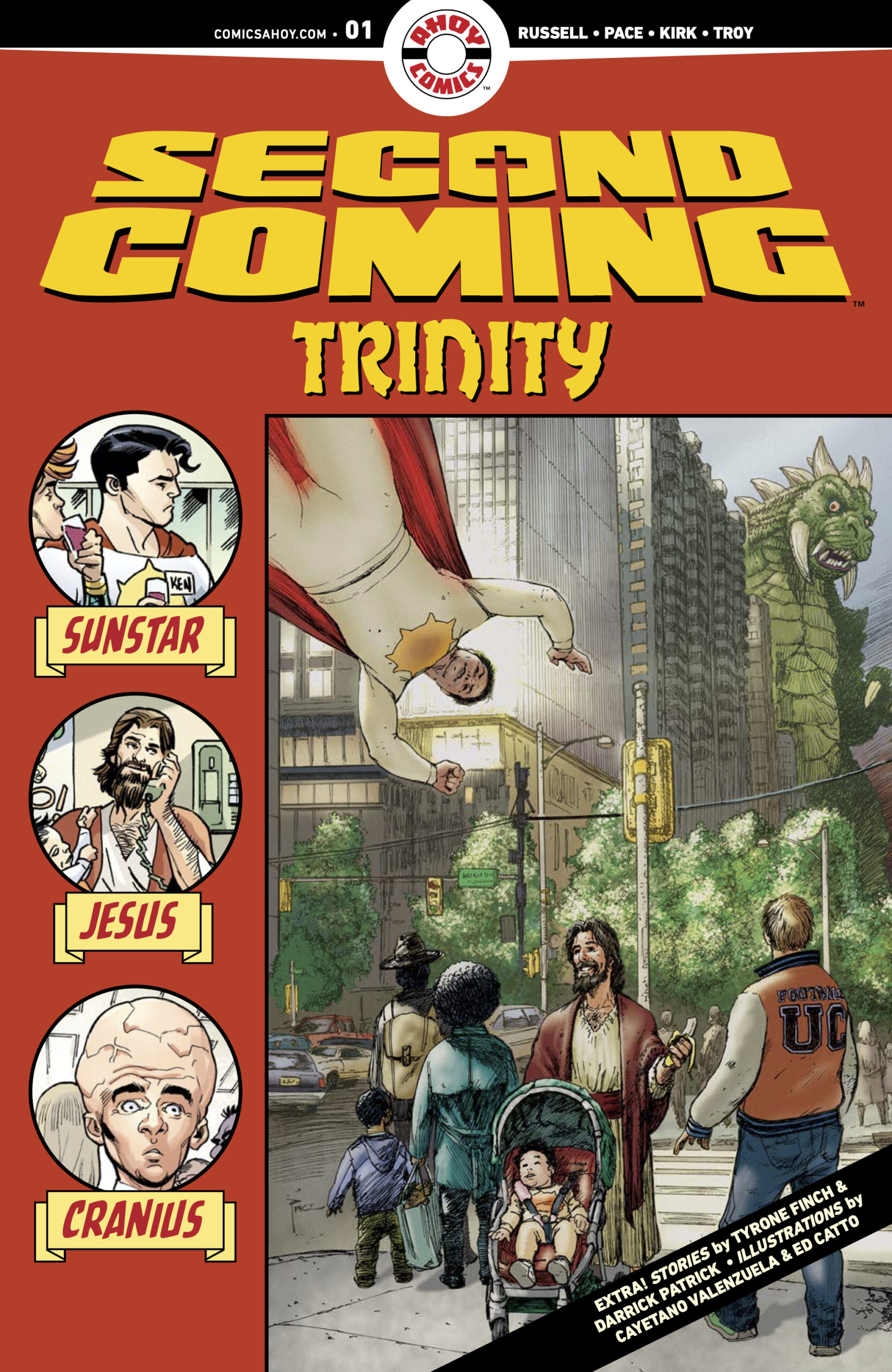
Talking With Mark Russell About ‘Second Coming: Trinity’ #1
by Olly MacNamee
Like the Holy Ghost, all good things come in threes. And so it ahs come to pass that Mark Russell, Richard Pace and Leonard Kirk return with a third series of Second Coming from AHOY Comics. The comic book that sees Jesus Christ returning to Earth, befriending its supreme superhero, Sunstar, and teach us all how to live better, more empathetic and charitable lives. All with Russell’s typical brand of satirical humour. Having spoken with him in the past about the first two series, I thought it only Christian of me to catch up with him again on the eve of Second Coming: Trinity #1 and ask him about the news series. Read on, my friends…

Olly MacNamee: While the heart of this new series is still one that relates to the true teachings of faith, from the evidence of Second Coming: Trinity #1, would I be correct in thinking Sunstar is even more a focal character than ever before, and how he has been changed for the better as a result of his friendship with Jesus?
Mark Russell: I think that’s fair to say. The series has largely been about Sunstar slowly realizing that so many of Christ’s critiques of power are spot-on, but also that it’s so hard to change when people expect you to be the same person you’ve been your whole life. Ina lot of ways, the world is a bucket of crabs, designed to sabotage personal growth. And I think that’s why it’s been so hard for Christ to set the record straight on his teachings. In the last two thousand years, all the institutions and their incentives are set in the opposite direction. But I think what both Sunstar and Christ have discovered is that even though change may be slow, it’s still worth doing.
MacNamee: In your story, we get to see a part of superheroing rarely touched upon: the court case. And this is where we get to see, even more, how Sunstar has redeemed himself. Is this light-hearted, but also empathetic, critiquing of modern superhero narratives something that will fuel this series?
Russell: Yes, we get a glimpse into how being a superhero bent on cleaning up crime also makes you something of a professional witness. You’re probably going to spend as much time navigating the legal system and testifying in trials as you are flying around and nabbing people. We also see Jesus trying to sign a lease for his new church without any credit history or job. Whether you are a superhero, or the Son of God, there’s just no escaping modern bureaucracy.

MacNamee: It’s certainly a very mature, and original, look at the dynamics of good versus bad, hero versus arch-villain. Something I’ve seen in your work on DC’s Wonder Twins series. With Sunstar saved, what of his rogues’ gallery and in particular, Cranius?
Russell: One of my favorite things about writing superhero comics is creating a rogues gallery. Introducing villains that play on popular villain archetypes, but tweaking them in a way that makes them feel more like an animal that could actually occur in nature. And I think Cranius is a good example of that. A sort of generic genius-villain, a la Lex Luthor, trying to settle a high school beef with the hero. But in Trinity, we get to see their relationship from Cranius’ perspective, which is something I always think is fun to do with villains.
MacNamee: And, as with the second-rate (or, even third-rate) villains of Wonder Twins, you encourage us to sympathise with the bad guy. Why is that?
Russell: The villains, in a lot of ways, make more sense to me. They are willing to admit it’s about vanity in a way the heroes can’t. A lot of times, they wouldn’t even BE villains but for some grudge they’ve got to settle or some specific goal they have in mind for changing the world. That makes more sense to me than some sort of generic interest in fighting crime, or a safely undefined commitment to justice. I’m sure a lot of them were set down the career path of a villain because of choices they made when they were eighteen or nineteen years old and would probably like to retire, but there’s no other life open to them now. It’s hard not to sympathize with that, at least a little.

MacNamee: Once more you are working with Leonard Kirk and Richard Pace. How is the division of labour divvied up this time round?
Russell: Richard is doing layouts and covers. Leonard is doing the interior art.
MacNamee: Finally, what are some of the other themes you’re hoping to explore in this newest series of Second Coming from AHOY Comics?
Russell: I think the largest single theme of Second Coming: Trinity is how having children changes everything. Sunstar and Sheila had a baby (Jordan) at the end of the last series and having a child now forces Sunstar to think a little harder about the world he’s setting Jordan to grow up in. About how all his petty squabbles with Cranius and other villains sabotage his son’s ability to have a better life. It’s also a lens through which we get to understand God’s love for Jesus and how he blames himself for the awful things done to Jesus by people created in his own image.
MacNamee: Mark, as ever, it’s always a pleasure and thanks for finding the time. You are certainly a very busy man these days. Congrats, and all the best for this book and the others on the horizon.
Russell: Thanks, Olly! Always happy to talk to you.

Second Coming: Trinity #1 is out Wednesday 5th April from AHOY Comics. And, you can check out Mark’s new Kickstarter, for his book of self-penned cartoons, Bunkbed Mishaps, here and my advance review for the first issue here.


