
I Went To A ‘Suzume’ Advance Screening And Makoto Shinkai Q&A
by Anna Lindwasser
When life hands you the opportunity to see Makoto Shinkai give a talk in person, you pounce on that opportunity like you’re a cat that’s really good at pouncing on things.

I got an invitation to see an advanced screening of Suzume, Shinkai’s most recent film, at the Museum of Moving Image in Queens. This was the second invitation to a Crunchyroll event I’d received – the first was a Demon Slayer screening in Los Angeles. I live in New York City, and the timing didn’t add up for traveling across the country, so I had to turn that one down. So I was thrilled to be invited to something that was just an hour away.
The invite came with a guest ticket, so after hitting up my friends’ group Discord to see who could come, my pal Divvy and I headed to Queens. We got there nearly two hours before the screening started, and it was a good thing we did – the tickets were first-come, first-serve, and we needed seats where Divvy could conveniently store her mobility device.
The film itself was phenomenal. I think it may be my favorite Shinkai film yet. I always enjoy his work, but sometimes it comes off as a little bit too polished. I liked Your Name, but it was hard to really feel for the characters because there wasn’t anything messy or weird about it. Suzume is delightfully weird.

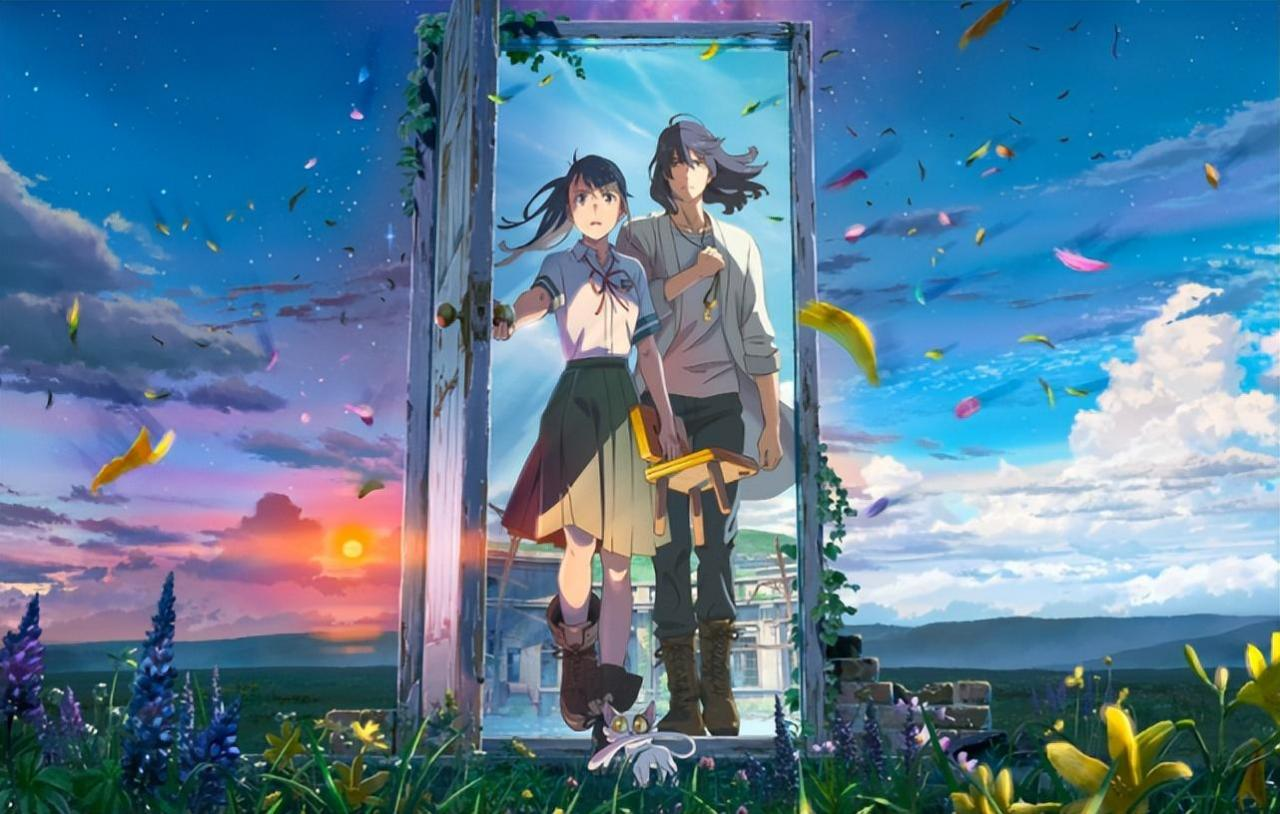
It follows a teenage girl whose mother died in an earthquake who gets embroiled with a college student whose job is to close doors that spring up around Japan. If they aren’t closed, massive creatures called Worms burst through and cause earthquakes. Normally, these are kept in check via a keystone, but Suzume accidentally removed the keystone from its post – and it doesn’t want to go back. Most of the rest of the series is a madcap journey to replace the keystone – but there are plenty of emotional revelations along the way.
Afterward, there was the Q&A. Shinkai walked on stage holding a three-legged chair prop, and answered questions from an interviewer and then from the audience. Tragically, I can’t remember the interviewer’s name, but they did an excellent job. He spoke in Japanese, so his comments were translated by an interpreter.
I want to share some of the more interesting things he said.
The first is about the idea behind the film. He was inspired by the 2011 earthquakes in the Tohoku region. He wanted to bring awareness to these events and commemorate the tragedy, but he was also worried that people in Japan would think the film was offensive, especially since he opted to include light-hearted moments – like Souta spending most of the movie transformed into a chair – in order to create balance. Luckily, the film has been well-received so far.

Another notable thing about Suzume is that unlike most of his movies, it’s not particularly romantic. He actually didn’t want to include romance at all, since it was starting to feel repetitive and he had other themes he wanted to explore. His producer said that while he might be sick of romance, his audience wasn’t, so he should still include it. Ultimately, he compromised. The relationship between Souta and Suzume is important, but it’s never really pushed forward romantically – it would be kind of hard to do that when the guy spends most of the movie as a chair. The focus is on Suzume’s coming of age.
Shinkai also shared a little about his writing process. He said that when he creates a storyboard, he actually records himself doing all the lines. This is helpful for the animators when figuring out how to orchestrate the scene, and it’s also helpful for the voice actors…but it’s problematic for him at home. His daughter sometimes comes running in thinking he’s in danger, and his neighbors get bothered and sometimes consider calling the cops.
He demonstrated his voice acting in one of the more dramatic scenes. The audience appreciated it a lot more than his neighbors do!
When asked if he ever got writer’s block, he said that he does and that it doesn’t get easier even though he’s been doing this for twenty years. Sometimes, when he needs inspiration, he goes to the local graveyard and lights incense.
He also talked about unintentional symbolism. He put a lot of butterflies into the film, but he wasn’t sure why he was doing it – only that it felt right. Later, he was repeatedly asked about what the butterflies symbolized, so he had to start thinking about it. He ultimately decided that because butterflies symbolize souls in Japan, the butterflies could be symbolic of Suzume’s mother – or of Suzume herself.
A fan pointed out that the film contained multiple Ghibli references. Shinkai confirmed that this was intentional, but it wasn’t just because he admires Ghibli. It was because pretty much every Japanese person will have seen Ghibli films at some point in their lives, and he wanted to use existent media to ground Suzume in the real world.
Thank you, Shinkai-san and everyone who came out last night! https://t.co/x06WaIBLSH
— Museum of the Moving Image (@MovingImageNYC) March 29, 2023
Overall, it was a wonderful experience, and I’m so grateful that I got to go.
~~~
For more of my work, check me out at Ranker, at Medium, on Twitter @annalindwasser and @sinistealatte, and on my website annalindwasser.com. If you like my writing and want to help pay for my Crunchyroll subscription, you can donate to my Ko-Fi.