
‘Starman’ Creator, Reinhard Kleist, Talks Ziggy Stardust And The Spiders From Mars
by Rachel Bellwoar
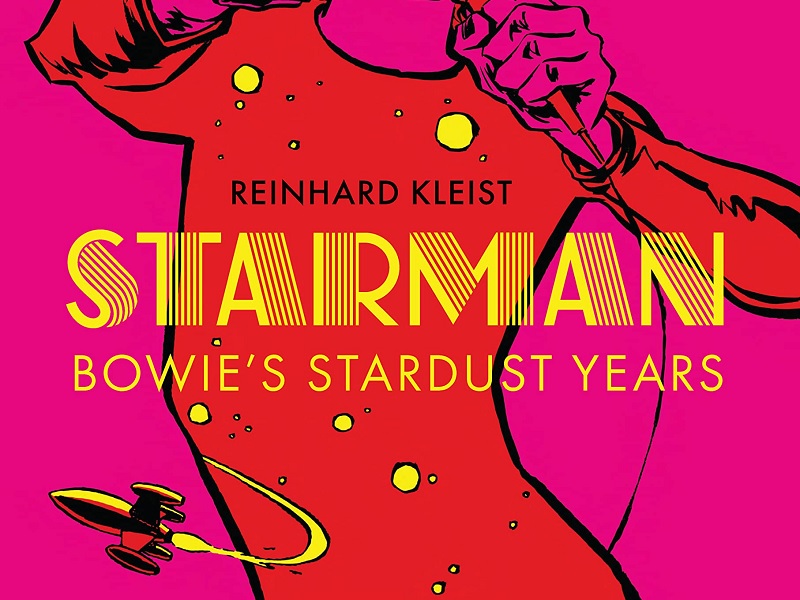
It’ll be fifty years ago this July that David Bowie (as Ziggy Stardust) announced on stage that Ziggy Stardust and the Spiders from Mars would be performing their last concert. Bowie’s career would, of course, go on, yet his Ziggy Stardust years still stand out today. In Reinhard Kleist‘s latest graphic novel, Starman: Bowie’s Stardust Years, Kleist explores how Bowie became Ziggy, and why it took adopting a persona for his music to take off. With colors by Thomas Gilke and Kleist, learn more out how Kleist built up to tackling Bowie and the sequel that will be covering Bowie’s Berlin Years below:

Rachel Bellwoar: Having previously done graphic novels on Nick Cave and Johnny Cash, how did you choose David Bowie as your next musical subject?
Reinhard Kleist: I actually had the idea before, in the ’90s when the album “Outside” came out and I wanted to do a comic narration of the storyline of the album (and the announced second part that never appeared). The project did not survive the zero interest of the management. So I waited until the time was right and I had more experience with biographies, because I knew that Bowie is difficult to deal with. You have to concentrate on parts of his biography that are important to you as an artist. In my case it was dealing with what I call the mission of an artist.
What is of significant importance to me is, that the music and the lyrics can be illustrated, because I want to include the narration of the songs into my dramatical setup of the biography. I could never do a graphic novel of, let’s say, Madonna.
Bellwoar: The Nick Cave graphic novel is a particularly massive tomb but, rather than cover Bowie’s life in one book, Starman ends with the promise of at least one sequel. What made you want to split-up Bowie’s life into multiple volumes?
RK: There will be two parts, the second one will be about his time in Berlin and will be called “Low.” After that one I have the feeling that everything I want to tell is said and done. I lift the curtain on who is the narrator and who is the astronaut that appears during the flashbacks. The split was originally an idea of my publisher who wanted to come out with the book for the jubilee of Ziggy Stardust. I am now very happy with that idea, because it gives me the chance to have a more advanced narration scheme and I can build up some mysteries that I can solve in Part Two. I also have the feeling that the two parts are dealing with different aspects of my theme that lies behind the narration of Bowie’s life: In part one it is about building up a second persona that can fulfill the dreams of the young artist, becoming popular, living a Rockstar life and also diving into the abyss of this life. In the end he is freeing himself from this persona.
In part two I can deal with the forming of Bowie’s personality: How he almost extinguished himself when he was in the USA and how he resurrected and found himself in Berlin. He called Berlin his sanatorium. Not many folks from other countries coming to Berlin would call my city this!
Bellwoar: Starman opens and closes with imagery from Bowie’s song, “Five Years.” Why do you think that song acts as the perfect bookend for Bowie’s Ziggy persona?
RK: It is more the narration in general that interested me and the connection it opens to the times we live in: We live in a world where the apocalypse and the end is appearing to come closer and closer. “Five Years” is exactly dealing with this fear. And then Bowie offers a salvation in the storyline of the Ziggy Stardust album. Just moments later he pushes everything into the gutter: The messiah of the entity from space, that could save the earth, is ending in drugs and alcohol. A Rock n Roll suicide.
In my illustrations of the song I included a lot of imagery from today: Q-Anon, Trump, people with face masks, climate change demonstrations etc. I wanted to show how relevant Bowie’s narration of the end of the world still is.

Bellwoar: Among the key figures in Bowie’s life, his relationship with his half-brother, Terry Burns, stands out as being hugely important, both personally, and in terms of Bowie’s career. How much of an influence do you think Terry had on Bowie’s music?
RK: He had a huge influence on him when he was younger, he brought him into contact with jazz and took him to concerts in London and showed him a bohemian lifestyle. He also gave him the books of [William S.] Burroughs and [Jack] Kerouac. I give their relationship much space in my book, because I think he had a huge influence on him and Terry serves as a kind of source for advice.
When Terry more and more glided into schizophrenia Bowie was shocked and dismayed being unable to help him. To say Terry’s disease was an influence on Bowie’s tendency to create different types of personas and not only play them on stage, but live them, would be too far, though.
Bellwoar: David goes on quite a hair journey in this book. Given that Bowie was so heavily photographed, was it ever overwhelming to sort through and recreate these iconic looks?
RK: No, absolutely not. It was challenging to find out when he was wearing which haircut or outfit. I also wanted to pay tribute to the wonderful artists and designers that created these iconic looks and dresses: Kansai Yamamoto and Freddy Burreti. And of course the hairdresser Suzi [Ronson], who also did Bowies mother’s hair (in a very much different style). Not forgetting Angela Bowie, who seems to be a quite difficult person, but also had not to underestimated influence on Bowie’s looks.
Bellwoar: After signing with RCA, Bowie brings up the fact that Elvis was on the same label and Elvis has been in the news a lot lately thanks to the Oscar buzz around Baz Luhrmann’s biopic, Elvis. Do you think it’s fair to draw parallels between Elvis’ manager, Colonel Tom Parker, and Bowie’s manager, Tony Defries?
RK: Well, maybe, yes. I guess both of them had this craziness and ruthless drive that you obviously need to create such a superstar. Tony was the motor behind Bowie’s success in the beginning. But he had a very gambling way how to deal with money: Everything that came in was immediately spend. This was successful for a time but only little money arrived at the artists. In fact Bowie was bankrupt for a long time. He then changed business to Michael Lippman, which was not a satisfactory relationship as well. When he arrived in Berlin, he was so low on money that his assistant Coco Schwab ordered a strict regime of austerity.

Bellwoar: Despite playing a major role in Ziggy’s success, the Spiders from Mars were completely blindsided when Bowie decided to let the band go and stop performing as Ziggy. Do you know if they were ever able to reconcile offstage?
RK: I am not really sure how much they all knew about this. A lot of that is mystery and some sources quoted it differently. I just know that he had a good relationship with Mick Ronson, although Tony wanted to build Mick as a new Bowie, which failed.
Bellwoar: With the sequel covering Bowie’s Berlin years, do you think living in Berlin will give you an edge, when it comes to uncovering research?
RK: Actually I do not think it will give me new insights or more details. Every step of Bowie seems to be documented. But it gives me a stronger feeling for the city. I think a lot of the book will be a portray of the mid seventies in Berlin (which I failed to live in, I came to Berlin end of the ’90s and was more a techno head in the beginning). I did quite the same in the Nick Cave book, where I also portrayed my city in the chapter where Nick lived in Berlin in the ’80s. I had so much fun putting some of my friends, that were there during that time, in the pictures.
But I met Bowie’s sound engineer from Hansa studio lately and he told me some nice background stories and also helped me with the sound engineering instruments that they used during the recording of “Low” and “Heroes.” Eduard [Meyer] will be in the book too. I hope he likes how I picture him.
Bellwoar: In the “thanks to” section, you mention having been given a ticket to see Bowie in New York. What was it like to see him perform LIVE?
RK: That was end of the ’90s and actually very funny in a way: Me and my boyfriend from New York wanted to see the concert so bad and somehow he got tickets for the show, which was at the Radio City Music Hall. We were so excited to see Bowie in such a great location! But it turned out to be the prize giving ceremony of the GQ magazine and the audience consisted only of magazine yuppies. We had to sit through 3 hours of the most boring award ceremony.
The cool thing was, he played a whole set and everybody else was just staying on their seats except for the few that came for Bowie. So we were running in the front and saw him from just a few meters away! I remember him being extremely gentleman like and cute. But when he performed “I Am Afraid of Americans” the stage exploded with energy and the few weirdos in the front were screaming and yelling. The magazine people in their seats did not.
Bellwoar: Thanks for agreeing to this interview, Reinhard!
Starman: Bowie’s Stardust Years is on sale now in the UK and goes on sale May 2nd in the US from SelfMadeHero.
