
Heard It Through The Mycelial Network: Reviewing ‘Poison Ivy’ #11
by Scott Redmond
Overview
It’s easy for many titles to stick with what has worked and sort of follow the same paths as long as they can, but ‘Poison Ivy’ #11 shows how much this creative team loves the character and world as they continue to expand it and go deeper. A truly gorgeous, powerful, emotional series that is truly a defining one for the title character. There is a reason this series has leapt to ongoing status, and if you haven’t started reading it now is the time to get on board.
Overall
10/10One of the things that help endear characters to the audience is relatability. Seeing them deal with issues similar to our own. Often with characters in any sort of superhero/antihero/villain role that comes from seeing them struggle to figure out who and what they are in the long run, even if they are long-established characters.
With Poison Ivy #11, we’re getting quite a bit of that with our favorite plant-loving villain with a heart of green.

There is little doubt that overall Pamela Isley/Poison Ivy is a villain. This series began with a tale where she was on a mission to use lamia spores within herself as a means to wipe out all of humanity. It was only after encountering actual good people and defeating and ending her foe/creator/abuser Jason Woodrue/Floronic Man/ that she was able to pull away from that with a new mission. One that sees her specifically targeting those that are in power and doing things to harm the Earth rather than wiping out or targeting everyone.
That’s not where G. Willow Wilson is leaving any of it though, continuing to do that character development magic that she’s so good at doing. Seeing Ivy struggle here really helps flesh the character out even more because, like many of us, she’s stuck in two places. Part of her still wants to harm anyone that she sees as a threat to the green, even if that includes using others and putting them in harm’s way, but then there is the part of her that is aligned more towards helping and not harming those that do not deserve it.
Gwen, the CEO of Glop, is not a bad person overall, but she is someone that entered the world of capitalism with a mission to actually help people to live better and in harmony with nature but got wrapped hard into the world of capitalism and her dream was crushed into something far more marketable. It’s a great pivot and allows Wilson to showcase the effect Janet from HR and Harley and others have on Ivy as she forgives the woman, and makes it harder when we have to witness the painful horrible fate that Gwen undergoes in the closing moment of the issue.
Constantly evolving and exploring characters, especially those that have been around for a long time, is always a great goal. In just these eleven issues Ivy has been fleshed out more than she had been in quite some time, and with the series now being an ongoing one, there is so much more room for Willow and her collaborators to really hone in the core of Ivy and explore how she moves through this world and what that means to others.

Speaking of collaborators, the work that Marcio Takara and Arif Prianto continue to do on this series is just beyond words. We’re at a point where the story is not as eco/body-horror focused as it was during the first villainous storyline, but there are still spaces to allow them to dip into that well (with how the spores twist people) and it fits so well with the quieter or more real-world oriented moments. It takes something special to be able to not only hit that otherworldly funky appearance (done beautifully I might add) of the trippier panels and nail all the more human/emotional elements, but to do so in a way where they flow through and around each other seamlessly.
Takara not only has such a detailed and deep feeling style but the choices for paneling, especially the fantastic use of white space, really are something else. Part of creating a unique feel for a story artistically is finding the right way to display that story. Standard panel styles work great for many stories but personally, I’m all about the shifting styles that Takara and others employ where panels are wildly varying sizes and shapes sometimes eschewing borders at all as they also quickly shift between full page spreads and stacked panels.
Speaking of mixing, the way Priaf mixes up the color palettes plays deeper into how the two different ‘worlds’ on the page flow together. For most of the people and ‘normal’ world elements, the colors are lighter/toned down quite a bit which allows the more fantastical elements (and elements to do with Ivy such as her hair) to go with the far wilder vibrant colors. It allows the two different parts of the world to stand apart while also standing on the same ground together.

Colors and the overall visuals are not the only places that can be experimented with, as Hasan Otsmane-Elhaou shows with the lettering. I’ve already gushed about how masterful Otsmane-Elhaou is at adding energy and personality into any bit of lettering on the page, allowing us to fully hear the voices of the characters as they are meant to be heard. We see so much more of that here as the bits of dialogue flow around and have little changes made to them that allow it to show how affected the characters are from the spores, their bubbles taking on interesting shapes and the font shifting to make it clear that their voices should be heard altered (much like one would think of for someone under the influence of substances). It’s all so smooth and great, but there is one that just had me pausing and thinking of how fantastic a choice it was.
That would be on one of the pages where Ivy is learning that she has control of all the women at this party because of the lamia spores that are within them. Each panel has those great green boxes with Ivy’s inner monologue as she’s piecing the situation together. All except the second panel where putting those boxes into the frame would likely cover up at least one or more of the women’s faces there. So instead, Otsmane Elhaou turns the silhouette of one of the women, who is facing Ivy, into the caption box so that all of Ivy’s words are contained within the woman’s head. It’s just such a fun and unique thing and speaks to how awesome lettering and comic books can be and how to maximize the space that is given within a panel to bring all the words to life.

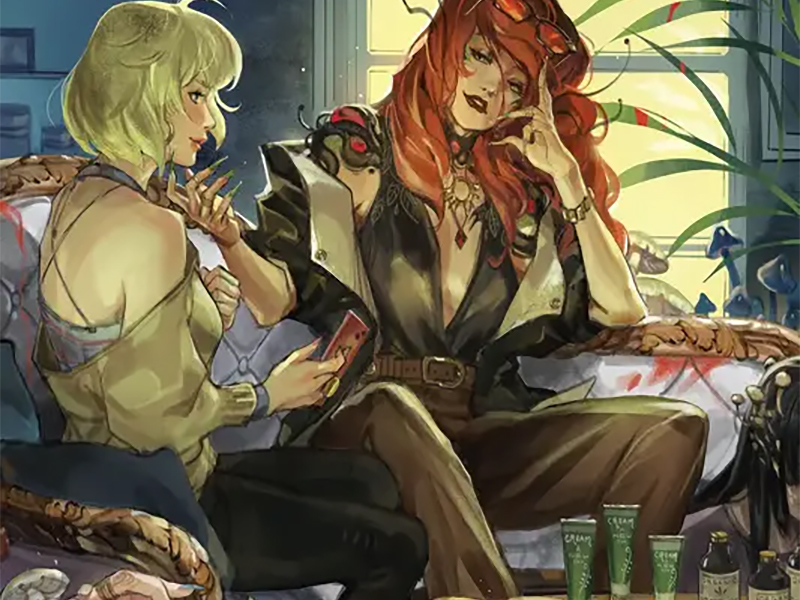
People are of various minds, even to this day, about what purpose a comic book cover should serve. Some think it should be something fully unique featuring the character(s) in some way that sells the book or what is happening overall, while others think it should be a depiction (whether 100% or in spirit) of something specifically from the book much like many classic books. I’m one of those that doesn’t lean either way but I can say that I think Jessica Fong nails it perfectly with the main covers of this book. They capture the spirit of what is happening in the overall story without having to 100% mirror something from it, providing a unique gorgeous mood-setting entrance to every issue.
This particular issue cover captures the idea that death and such follow Ivy in many ways and speaks to her overall mission, but again showcases the character-defining journey she’s currently on through the body language of her and Janet as they sit together. It’s just so wonderfully realized.
Poison Ivy #11 is now available from DC Comics.


