
Talking ‘Black Demon Tales’ With Hector Rodriguez III And David Bowles
by Rachel Bellwoar
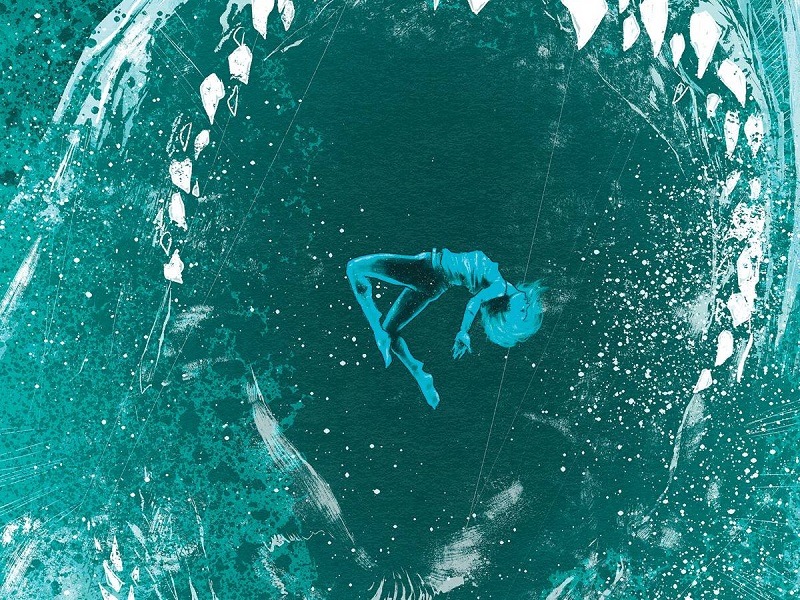
If you thought the shark in Jaws was scary, that’s nothing compared to the shark in writer, Hector Rodriguez III, and artist, Vincenzo Sansone‘s, new series, Black Demon Tales. With colors by Saul Shavanas and letters by Rodriguez III, find out more about the Mexican mythology and kaiju that inspired the story in this interview with Rodriguez III and editor, David Bowles:

Rachel Bellwoar: Besides Attack at Acapulco: A Black Demon Tale (which was a special release at New York Comic Con in 2021), Black Demon Tales is the first title out of Scout Comics’ new Latinx imprint, Chispa Comics (and both issues revolve around the Black Demon Shark of Mexican legend). How do you feel Black Demon Tales is representative of what readers can expect from Chispa Comics going forward?
Hector Rodriguez III: Readers can expect authentic storytelling. Exciting stories based on history and lore.
Bellwoar: Can you provide some background on the mythology of the Black Demon Shark and why you wanted to do your own take on the story?
David Bowles: The Nahuas (including the Mexica / Aztecs) believed that the earth was created out of a primordial leviathan called Cipactli. Her tail was planted in her back and now holds up the heavens. The Nahuas called our world “Cemanahuac” or “Sea-Ringed World,” because the rest of the universe is a cosmic ocean.
Their god Tlaloc was married to the goddess of the oceans (Chalchiuhtlicue) … their children were powerful demigods that controlled rain, thunder, lightning … they could bring the moisture humans needed for agriculture, or withhold it if people displeased the gods. They could bring devastating storms, too. Most of the time they’re called Tlaloques (“Tlalocs”), but their other title is Ahuahqueh (“Lords of the Water”) … the idea is that the Black Demon is one of these Ahuahqueh.
In Purepecha tradition, Lord Inpiencha, God of Coastal Waters, is the son of Xarátanga, Goddess of Moon and Sea. As long as people of the Pacific Coast are obedient, he keeps beaches safe, bays full of fish. But there is a vengeful counterpart to Inpiencha, hidden by his mother until there is a need to punish or exact vengeance.
Bellwoar: Size-wise, the shark from Jaws is a guppy compared to the Black Demon. What was it like trying to get the scale of this monster across?
Rodriguez III: I’m a huge kaiju fan! I have a lot of respect towards of the works of Ishiro Honda and Eiji Tsuburaya. When I was writing issue one of Black Demon I was thinking directly towards the kaiju aspects of the Black Demon. It is important to share to our community that we have our own kaijus that are grounded in deep history and native mythology.
Bellwoar: Having just used the word “monster” to describe the Black Demon, in the original press release Scout released on the series the Black Demon is, “an ancient megalodon that lurks the seas, guarding nature at the behest of Tlaloc, the supreme Aztec god of rain, earthly fertility, and water,” which doesn’t necessarily sound malevolent. Might readers be too quick to judge the creature?
Rodriguez III: In a way Tlaloc represents nature’s fury. Humanity has not been good stewards and the Black Demon is nature’s way of keeping us in check in the high seas.
Bellwoar: Bella (the protagonist in this first issue) certainly isn’t the Black Demon’s biggest fan (or a fan of the ocean in general). Do you share Bella’s poor view of marine life?
Rodriguez III: Growing up my father was a big Jacques Cousteau fan, the famous world renown oceanographer. I recall reading Cousteau’s books in a very young age. It gave me a great sense of wonder. There is something primal of fearing the unknown depths of the ocean. What strange undiscovered creatures lurk in the dark recesses of the ocean? Bella’s perspective is the complete opposite of what I personally feel.
Bellwoar: Whereas Jaws came out in the ’70s, Black Demon Tales takes place in the ’80s (it’s been a while since I’ve thought about floppy discs). What was it like trying to capture the era and how do feel setting this series in the 80’s serves the plot?
Rodriguez III: I’m a fan of ’80s aesthetics and in this case I used cassette punk as a major influence. Bella lives in a retro cyberpunk world. We see scenes that may be monochromatic due to the overuse of grey/beige colours, sometimes with the glow of an LED light, usually in red, green, or blue. If there are multiple colours, they are often analogous.
Bellwoar: Sharks aren’t the only massive predators in this series’ food chain. Should readers be concerned about what else might be lurking in the ocean’s depths?
Rodriguez III: There is an outworldly feel that can be terrifyingly exciting at times. Readers might experience a sense of dread while reading Black Demon Tales especially those with fear of large bodies of water. One thing is for sure with the ocean, somthing is always watching you.
Bellwoar: Thanks for agreeing to this interview, Hector and David!
Black Demon Tales #1 goes on sale April 19th from Scout and Chispa Comics.


