
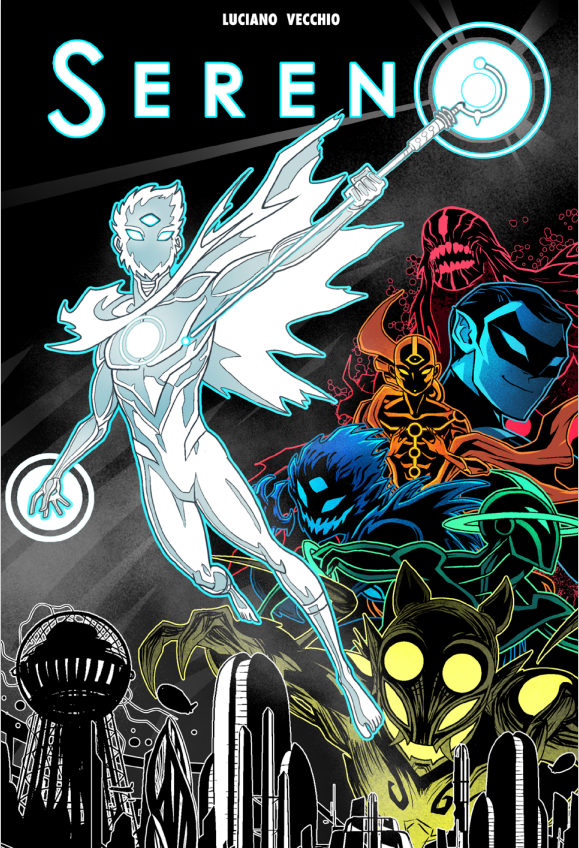
Writing Was Always Part Of The Equation: Discussing `Sereno’ With Creator Luciano Vecchio
by Tom Smithyman
Argentine artist Luciano Vecchio is best known for his work on Marvel’s Iceman and Champions but has broadened his creative endeavors to include writing the web series Sereno. Sereno is now on the crowdfunding platform Zoop, where the first three issues are being published as a hardcover edition. In the first of two exclusive interviews with Comicon.com, Vecchio discusses why he wants to do more than draw, how he works with LGBT+ characters as well as his creative process.
Tom Smithyman: Fairly or not, you’re thought of primarily as an artist. What made you want to try your hand at writing an original character?
Luciano Vecchio: Though I dedicated my professional career to be an artist first, writing was always part of the equation. There is a long tradition of doing it all in Argentinian comics-making, telling stories as a whole rather than focusing on either writing or drawing. That’s why even as a collaborator when I draw for another writer, I’m very involved with the storytelling process if the creative chemistry allows it, and when the chance shows up to write my own story, I will take it.
Smithyman: What was it about the character of Sereno that made you want to tell this particular story?
Vecchio: I started Sereno as a weekly webcomic years ago. I was already working in mainstream superheroes, so I wanted to make sure what I offered was different and needed. Back then this kind of character did not abound. A queer superhero lead, with a method of approaching and solving his battles with supervillains in a way that is more about understanding and integrating rather than punching things hard.
I was examining how the epic stories we tell affect our worldview and the way we interact with our pushbacks, and I wanted to explore an alternative to what we were used to, updating the key notes of the superhero genre with a 21st century sensitivity. A hero path told through the Magician archetype rather than the Warrior.
Smithyman: You’ve worked on a lot of stories about younger heroes, like Wiccan, Hulking, Champions and Ironheart. How has that impacted your storytelling?
Vecchio: After doing Sereno, my interest shifted to wanting to focus on superhero stories with a meaningful impact in our reality. There’s this meta level when working with LGBT+ and POC superheroes, where the characters are living their heroic adventures while we as authors are giving life to a cause that affects us in the real world.
We’re picking our own fight through art and telling stories, and that’s what superheroes taught us in the first place! I was even lucky enough to get to write some of my own stories in Marvel’s Voices and Iceman – best full experience ever.
Smithyman: How do you approach writing and drawing a story like this? Do you script everything out ahead of time and then draw, or the other way around?
Vecchio: It differs on each project. I worked on Sereno as a weekly webcomic first, so what I did was set a few format rules: Doing 13-page episodes of compressed silver age-y storytelling, making each page a satisfactory read on its own, and using one or two colors per episode in a narrative way.
I would start with a general idea of where the episode was going and who the main villain and resolution of the conflict was, but there was a lot of improvising too, almost like automatic writing or channeling. I would take a day off my week working with Spider-Man and the Guardians of the Galaxy at the moment, to focus on my weekly Sereno page.
And drawing and writing happened at the same time in a chaotic way. Jumping from sketching to inking a panel, to writing down a line of dialogue, to adjusting the page composition while coloring, anything was allowed and it was a very experimental and free creative process.
Smithyman: Although you can obviously read and speak English, translated your original text. Did you review the translations or just trust that he captured the spirit of your story?
Vecchio: Actually I translated it myself, and then Alexandro edited and fine-tuned any mistake or roughness in my writing. We met when he interviewed me for his podcast Super Gay! about queer rep in comics. He’s a comics and academic artist and writer too, and with a Latinx background he had read the Spanish edition and was the right person to make sure what I wrote and meant translated properly.
He also suggested keeping the characters names in Spanish, which was something I was struggling with. Translating some of the names, specially Sereno himself (which in Spanish means both “serene” and “nightwatchman”) didn’t work the same way in English, so with his advice, I embraced the fact that this is a work with Latinoamerican roots and they show through language.
Smithyman: Most of the pages are black and white, with splashes of color for emphasis. And it seems that you only work with two colors per story. What are you trying to convey with this use of color?
Vecchio: I had the experience of working with a limited palette of black, white and red on another project before, and I found the limitation actually very inspiring and full of narrative potential, so I wanted to expand on that by picking a color or two per episode and see how that affected the story in literal, expressive and poetic ways. And it’s creatively super fun!
Smithyman: In your story, science and magic intertwine. Arthur C. Clarke famously said that: “Any sufficiently advanced technology is indistinguishable from magic.” How do you think that quote relates to Sereno?
Vecchio: I see them as point of views, or paradigms from where to interpret the world around us. One of Sereno’s main themes is vision, views, optics and how to change, adapt and flow through them. In this story these apparent opposites coexist in tension, and Sereno is the bridge, the being where they coexist in harmony. The superhero!
Smithyman: Thanks for taking the time to talk with me. I know my colleague Rachel Bellwoar has some additional questions, so please look for that interview soon.
