
Talking To The Cast Of ‘A Kind Of Spark’
by Rachel Bellwoar
If the thought of subscribing to yet another streaming network makes you want to scream, here’s the first thing you should know about BYUtv: it’s free. The second thing you should know: A Kind of Spark is one of the best new shows to come out so far this year and all ten episodes are streaming on BYUtv.

Based on Elle McNicoll’s novel of the same, A Kind of Spark follows Lola (Lola Blue) as she adjusts to a new school and learns about her town’s local ties to the witch trials.
The perfect blend of high school drama and historical mystery, on the show Lola and her sister, Keedie (Georgia de Gidlow), are autistic and, in real life, fifty percent of the cast and crew of A Kind of Spark are neurodivergent.
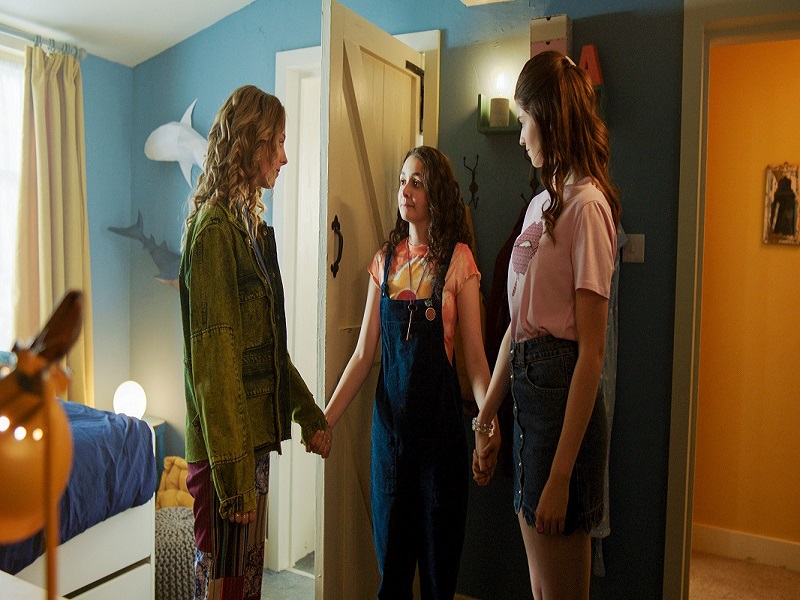
There’s truely no other show like A Kind of Spark on TV and I couldn’t be more excited to share this interview with the actresses who play the Darrow sisters: Lola Blue, Georgia De Gidlow, and Caitlin Hamilton.
Rachel Bellwoar: What was the casting process like for A Kind of Spark and were you always drawn to the character you would end up playing?
Lola Blue: The first time I met Matt [Holt] (our second block director) in person I was actually reading for Keedie! There was some uncertainty because of my age and Addie’s age and casting were swapping about Addies and Keedies trying to find a fit. Being a big sister I definitely see certain elements of myself within Keedie but in terms of character I was always drawn to Addie with her optimism, her passion and her spark.
Georgia de Gidlow: When I first auditioned, I auditioned for Addie, and due to her age I was not expecting a recall, but was excited to get the opportunity to play an autistic girl as I had never auditioned as an autistic girl before. I remember being particularly excited by Addie’s shark hyper fixation, as when I was younger I had one myself. When I got recalled as Keedie I immediately read the book and was extremely moved as I had never related to a character so much before in terms of both her personality and her experience being autistic.
Caitlin Hamilton: For me, it started as every audition does. I was asked to tape for the role of ‘Nina’ by the lovely casting director Sue Needleman. I related far more to Addie and Keedie (being autistic myself) than Nina, but the relationship between the sisters rang true of my own relationship with my sister. Only this time, I was playing the neurotypical sister. After this initial self tape, I was recalled for a second audition via zoom. About a week later, whilst on holiday in Italy, I got a call from my agent to say I was the first choice for the role. I was extremely excited but trying desperately to remain calm as the role wasn’t confirmed yet. I painstakingly waited for two days and then finally got a call saying an offer had been made. I was over the moon! Not only was this the first series regular role for me, but it was about women with Autism and that was so empowering.
RB: How familiar were you with Elle McNicoll’s book before working on this project?
LB: I remember first reading the book for the audition and feeling so seen, which was an incredible feeling. It’s been such a privilege to have been able to bring Addie off the page and I hope Elle’s words continue to help others as they have so helped me.
GdG: I had not heard of the book, and I am so grateful that I have worked on this project since the story of A Kind of Spark has helped me process my own autism in so many ways, including the imposter syndrome that I had been struggling with
CH: Before auditioning, I hadn’t read their books. Admittedly, I’m not a massive reader. This is probably due to the fact I’m a slower reader. However, once I had booked the role of Nina, I bought A Kind Of Spark straight away. I read it all in one sitting. The words felt so familiar to me and I understood every emotion etched into the page. For the first time ever, I didn’t struggle to read and I felt seen.

RB: The Darrow sisters have a really close bond. What was it like to cultivate that relationship as actors, and can you relate to having siblings in real life?
LB: Georgia and Caitlin are my sisters. Honestly I’ve never connected with anyone like I have with them. We’ve become a family and I’m so grateful to have met them through the show. It’s been so incredible working with two such strong autistic women. They inspire me to be unashamedly myself by being unafraid to be themselves and I’m proud to know them.
GdG: I value Lola, Caitlin and Eve like my own sisters after working with them and living with them throughout filming. Particularly I have found it very healing to be the person for Lola that I needed when I was younger. In real life I have a younger brother, who I have a very different but just as loving and supportive relationship with.
CH: I was very fortunate to be cast alongside Lola and Georgia. From the first workshop we meet, I felt a connection. I think this was born out of us all being neurodivergent and bonding over our traits. Such as oversharing and great levels of empathy. I also think being an older sister, in real life, helped as I had an ingrained understanding of what it means to be a sister.
RB: Whether it’s sharks or the wrongly accused witches of Juniper, Addie is extremely passionate about the things she cares about. Do you share any similar passions?
LB: Yes! I think special interests and hyperfixations are often portrayed in a way that makes them out to be weird or irregular which is NEVER the case!! They help make us who we are as autistic people and they bring us joy – that’s nothing to be ashamed of ever! Personally, I’m really passionate about gender studies, Shakespeare and Greek and Roman ancient history!
GdG: I have always been extremely fixated on social justice, politics has been a big passion of mine, which is why I am currently studying International Relations and Politics at university.
CH: I went through lots of hyper fixations when I was younger. For example, I was extremely passionate about collecting:
- Keyrings (not that I was old enough to have keys)
- Snow globes
- Hot wheels cars
- Match attacks (the football cards)
Just to name a few. My main hyper fixations, that have lasted my whole life, are singing and the psychology of human behaviour. Makes sense why I’m an actor. When I was younger, I would act out scenes from movies over and over. This was me making sense of the world and it was fascinating. Although I no longer copy scenes in this way, I am still very passionate about acting and human behaviour.

RB: What do you think is one of the biggest misconceptions people have about autism or what it means to be neurodivergent?
LB: The media is saturated with very stereotypical images and depictions of autism and whilst any and all expressions of autism are valid and important, perpetuating a repeated very narrow insight into the autistic experience can be detrimental and lead to really harmful misconceptions. This is why this show is so important; it represents other ‘flavours’ of autism especially from a female perspective which is something we rarely see in mainstream media. I think the show demonstrates just how powerful autistic women (and women in general) are. If this show inspires or lights a spark within even one neurodivergent young person then it’s done its job.
GdG: The misconception that I most struggle with is that autistic people cannot be confident, outspoken, sociable and have strong personalities. We often can be those things more than neurotypical people, but it tends to be more exhausting for us.
CH: That if we are able to appear functional from a neurotypical view, then we are either doing “better” than other neurodivergent people or that we don’t ever struggle. To make ourselves more digestible for other we are always masking – which is very draining. Sometimes, when burnt out, we aren’t able to mask at all and that shouldn’t come with such negative judgment.
RB: We already know Juniper has ties to the witch trials. What other historical time period or event would you love to see the series explore, if A Kind of Spark gets picked up for a second season (which hopefully it does because the first two episodes are excellent)?
LB: Because of Addie’s passion and empathy, I could see her exploring perhaps the history of damage to the climate?
GdG: I would love for the show to explore a period of history that can show in more depth the further challenges that autistic people go through if they are a part of other minority groups.
CH: For me, I would love to see the characters tackle each their own unique life event. I think it would be nice to see the characters face different challenges to give even more understanding. Even something as small as Addie going to the dentist. As I know for me and many other neurodivergent people, this is an uncomfortable experience as it would be educational to see.
RB: Thanks for agreeing to this interview, Lola, Georgia, and Caitlin!
A Kind of Spark is available to stream on BYUtv and the free BYUtv app. It will also air on the BBC in the UK.

