
Advance Review: ‘The Essential Judge Anderson: Shamballa’ – An Appreciation Of The Complete Saga
by Richard Bruton
Summary
The first volume in The Essential Judge Anderson is exactly that, with Alan Grant and Arthur Ranson’s Shamballa an acknowledged classic. But here we’re presented with Shamballa and the three essential tales that built up to it – and it’s those that create the emotional setting that elevates Shamballa to brilliance.
Overall
10/10The Essential Judge Anderson brings you the very best of MC-1’s greatest Psi-Judge’s adventures, starting with a volume culminating in one of her greatest adventures, Shamballa.

Written by Alan Grant, Shamballa and the other tales in here gave a previously unseen depth to Anderson. Sure, we already knew her as the dedicated Psi-Judge, her steel and bravery making it easy for the Justice Department and Dredd to tolerate the quirks of her nature, but here, across four tales, the stories open up her character and dives deep into the mind and heart of Anderson.
This is an Anderson increasingly weary, worn down with the nightmares of her existence, the things she sees really getting to her. It’s Anderson increasingly unsettled by this world and her place in it and her role as a cog in the wheels of Justice.

So, as she faces a calculated and controlled psychic assault on the city from psychic twins in Triad, it’s just the wrong time to find her faith in the systems breaking down, seeing herself in the brutalised minds of the twins she’s trying to save.
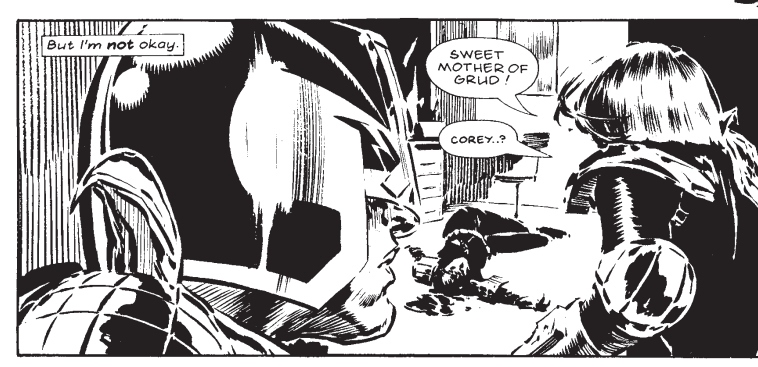
Worse comes in Leviathan’s Farewell when her friend, Psi-Judge Corey, succumbs to the demons that Anderson can feel swirling around in her own head. It’s all too much and Anderson becomes a Judge teetering on the brink.
And from then, it’s on to Shamballa, to so many the absolute pinnacle of Anderson’s stories and the epitome of the exploration of the character that Alan Grant had embarked upon. That’s where Grant and Arthur Ranson push Anderson to the brink and out the other side, facing a world plagued by ominous precursors to something apocalyptic, paired up with PsyKop Amikov from East-Meg 2, and off on a globetrotting trip that takes them to a fabled impossible city and takes Anderson deep into herself, questioning her place in this terrible, dark world, asking whether the things she does in the service of justice are really for the greater good of this world.
The thing is, with this first Essential Judge Anderson, it’s all too easy to focus on just the Shamballa story in here. Certainly, it’s the artistic zenith of Grant’s Anderson tales, where his writing opened up to explore both the emotional fallout that Anderson’s feeling and the complexities of human spirituality, all of it wrapped up in a tale illustrated by Arthur Ranson, his beautifully cultured and classicist lines giving way at times to a more experimental side, simply magnificent on the page. But what readers to this Essential Judge Anderson volume will soon discover, as I did, is that everything leading up to the Shamballa story is just as powerful, just as character-defining, just as damn good. So instead of telling you how amazing Shamballa itself is – just take that as read at this point – I’m going to focus on what comes before it here.

The first story, Triad, is where all the heavy lifting is done, all the beautiful Ranson work is here, almost more affecting presented in stark black and white. But it’s the way Grant takes Anderson apart through the course of Triad that transformed the character.
It all starts with the Anderson we know, greeting Dredd with a quip and a joke, but by the end of it all, Anderson’s questioning herself and her city, questioning whether it’s all worth it.
Grant tells Triad as a classic procedural thing, having Anderson follow those leads to the very end, and it’s simply a masterclass in how to get it done, tying it all together and facing down one of Dredd’s old enemies in the climax.

The single parter that follows, The Witch? Report, sees Ranson in colour – and of course it’s glorious – but it’s watching Anderson’s protectiveness over the twins from Triad, now in the same Justice Dept Psi School she grew up in, a hideous place for children who, “don’t take part in life. They watch it. When they grow up, they’ll judge it,” that makes this a powerful, downbeat piece of brilliance.
And then we have Judge Corey: Leviathan’s Farewell, the one that brought tears to my ears. Again, a done in one tale, this time for the 2000 AD Sci-Fi Special 1989 and with Mick Austin on art, an artist whose limited comic work is, sadly, undervalued.
If The Witch? Report is downbeat, Leviathan’s Farewell is heartbreakingly so, a literal suicide note in comic form.
It’s Corey’s final day and she’s writing down her goodbye. Her end is there on the first page and it’s brutally, sudden, final…

The rest of the tale tracks back to the events leading up to her suicide, culminating in her sighting of the last Humpback Whale, collateral damage as the Judges bring in another perp. Corey hears the whale that saves her life sing and she’s linked to it, hearing and feeling its last goodbye. It breaks her completely, just as it does the reader.
Grant’s writing here is sublime, hands-off, minimal, just letting us hear a little of the depths that Corey finds herself down in. And Austin’s artwork is everything it needs to be to get over the terrible, terrible sadness that permeates the story.
The final page is everything, those final few panels where Anderson finds her friend dead, finds her note, and sets Anderson off on the path that ends in Shamballa. Leviathan’s Farewell is that short yet essential pause in the book, a quiet, heartbreaking moment that works in isolation but its the role it plays in the whole that makes it pivotal here.

When I’ve read Shamballa before, it’s impressed obviously, a truly great Grant written piece with Ranson’s incredible artwork. From the very first page of it we have that intense emotional punch of Anderson’s revere, remembering her friend.
But here, preceded by Leviathan’s Farewell, preceded by Triad, we have a completeness in our understanding of what brought Anderson so low. It makes all the quiet, beautifully sad moments in Shamballa resonate with a new intensity and that first page, given what we’ve just read suddenly becomes imbued with so much more…

And as Shamballa continues, with Anderson’s globetrotting adventure and all of those big moments, it’s the small moments that suddenly really hit hardest.
Whether it’s that first page or the one later on with Anderson and Mikhael on the train and the moments between them, it’s all given so much more import because of what came before this.
That line – “People with gifts like ours shouldn’t use them for ugly things” – taken alone, it’s sad, taken in the context that the rest of this volume of Shamballa gives the reader, it’s heartbreaking.

With this whole Shamballa, what came before puts the finale into a new light, a complete light. What was great before now becomes a brilliant, perfect whole. That’s why The Essential Judge Anderson is just so good – not for Shamballa the tale but for the complete story, with Leviathan’s Farewell the most singularly affecting moment and a key element to make this a work that truly is essential.
So, it really is the case that, just as The Essential Judge Dredd began at the very highest point with Wagner and MacNeil’s America, this first volume of the Essential Judge Anderson dives into things with the quintessential Anderson story – it’s just that the quintessential Anderson story turns out to be four stories.
Essential Judge Anderson Volume 1: Shamballa – by Alan Grant, Arthur Ranson, and Mick Austin.
Contains the stories Shamballa, Triad, The Witch Report, Judge Corey: Leviathan’s Farewell
Released by 2000 AD/Rebellion on 20th June 2023
